The Trials and Tests of the Avot
Torah Papers | August 04, 2023
Print This Article
View Original PDF

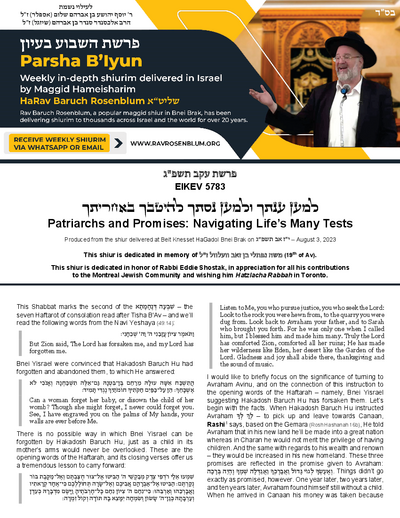
The Trials and Tests of the Avot

Torah Papers | December 31, 2025

When he leaves Charan on a journey to Canaan. Hakadosh Baruch Hu appeared to Avraham and instructed him, seemingly out of the blue:

Would you like to know who this Avraham character is? Sorry, there are no details available. Would you like to know why he was selected for this mission? Unfortunately, there is nothing more to share. We know he was born, and now we’re told what happened to him 75 years later. When Noach was introduced to us, it came with descriptors regarding his character, his actions, and why he was put on center stage. Even when he was born, we were told why he received his name: This one will bring us rest from our work and the anguish of our hands. Have a look at the first Pasuk in Parshat Noach – it contains the bare minimum of what we’d except to be told about Avraham Avinu, our forefather. Yet, all we get is: וַיֹּאמֶר ה’ אֶל־אַבְרָם לֶךְ־לְךָ. The rest is a secret.

When do the stories of Avraham Avinu in the Torah end? When he is 140 years old. He was 137 at the time of Akeidat Yitzchak, and the following three years were dedicated to marrying off his son. There is lots told about Avraham between the age of 75 and 140, but following that, from the age of 140 until his death at 175, once again – not a word. Quick math shows that we are only privy to what took place during 65 of Avraham Avinu’s 175 years in this world. Nearly two-thirds of his lifetime is hidden from us. I am sorry to ask, but when a well-known Jew dies nowadays, how much is written about them? At their shiva you already have 750 pages, including where they were born, what did they did as a toddler, where their pacifier was purchased, and on and on. You then read about who they learned with, who influenced them, and who they influenced at each stage of their life. And then they got married and once again every detail is reviewed, this time including family members they interacted with, shuls they davened at, and shuls they didn’t daven at. Nothing is left out. Avraham Avinu? We’re told he was sent on a mission. That’s it. The Akeida concluded, and with it the published story of Avraham Avinu.

Yitzchak Avinu has even less written about him. He was born, he had his bris, he was taken to the Akeida, he then disappeared for three years – according to the Zohar he was in Gan Eden – and then he was married at age 40. At age 60 he had twin sons, and that is all until he’s called upon to bless them. The pattern does not change much for his children. At the age of fifteen, Yaakov Avinu acquires the bechora from his brother, and the next time we hear about Yaakov is when he is 63 years old, some 48 years later. There are no stories in the interim – we believe he learned at the Yeshiva of Shem V'Eiver, but we have no details. After receiving the bracha from his father, he returns to his Yeshiva for fourteen more under-the-radar years. At the age of 77, he sets out on his journey that we are told about in Sefer Bereshit. That is until the age of 130, at which point he once again goes off the grid for the next 17 years, when the time of his death neared. Of his entire 147 years of life in this world, we are privy to approximately one third. Rabbotai, none of this makes any sense, and Ori V'Yishi calls it out.

When I was growing up there were but two biographies available – “Chut HaMeshulash” on the Chatam Sofer, and “Pe’er HaDor” on the Chazon Ish – but today our shelves are lined with tremendous works profiling Rabbanim of all generations, with so much to get lost in. New volumes hit the stores each year and amazingly there are always untold stories and lessons to cover. There is nothing greater than learning about these role models and shaping our Avodat Hashem around their lives and lessons. But the Avot? The Torah gives us just a small taste.

The answer given by Ori V’Yishi is amazingly simple and equally poignant. The Torah doesn’t tell us any stories about the Avot. Period. It only tells us about their נִסְיוֹנוֹת – their trials and tests. The reason is simple, too. The Torah is only interested in explaining to us how they achieved the titles: אֱ-לֹהֵי אַבְרָהָם אֱ-לֹהֵי יִצְחָק וֵא-לֹהֵי יַעֲקֹב. The Torah wants us to understand why they gained the title Av – Father. They are the only three who carry such titles and the only three referenced in such fashion within our Tefillah, and it is because they are the only three to be consecrated through such tests. As the Maharal says, one was tested in material (Avraham), one physically (Yitzchak), and one with every general struggle possible (Yaacov). Rav Chaim Volozhin points out a discrepancy between two Mishnayot (Avot 5:2-3). The first says: עֲשָׂרָה דוֹרוֹת מִנֹּחַ וְעַד אַבְרָהָם, yet the next one says: עֲשָׂרָה נִסְיוֹנוֹת נִתְנַסָּה אַבְרָהָם אָבִינוּ עָלָיו הַשָּׁלוֹם וְעָמַד בְּכֻלָּם. One does one refer to Avraham and the other Avraham Avinu? He explains, the latter Mishna speaks of the tests that Avraham passed, and it was a direct result of these tests that he became Avraham Avinu.

Rav Chaim Volozhin then adds an amazing by-product of this idea. That we saw many people leave their homes in Morocco, Yemen, Hungary, Poland, Romania, and many other cities in order to move to Eretz Yisrael, was a direct result of Avraham Avinu doing so thousands of years earlier. He is not referring to those who moved after the Shoah, but rather those like the students of the Ba’al Shem Tov and the Gr”a who left their comfortable homes for Eretz Yisrael knowing full well that little awaited them in terms of food and parnassa. Their strength to leave everything behind and arrive in Eretz Yisrael in a fragile state – בְעֵירֹם וּבְחֹסֶר כֹּל (in nakedness and lacking everything) – was derived from the test Avraham Avinu passed in לֶךְ־לְךָ.

Avraham Avinu gave every Jew the strength to leave everything behind, including possessions, family, and students alike, and journey to Eretz Yisrael.

Likewise, the strength to give up one’s life Al Kedushat Hashem, comes from Avraham Avinu’s final test. Rav Shach famously commented on the Gemara recounting the tragic story of Channah (also referred to as Miriam) and her seven sons (Gittin 57b). The first of the woman’s sons was brought before the emperor and told to bow down to an idol. But the son responded: “I cannot do so, as it is written in the Torah - אָנֹכִי ה׳ אֱלֹהֶיךָ.” They immediately took him out and killed him. The same then played out, one son after the next, with each quoting another pasuk and refusing to comply. When only the youngest of the seven was left, the emperor felt a sense of pity for him and started looking for a way to save the boy's life. He said to the boy’s mother, “I will throw down my ring; have him bend over and pick it up, so that people will say that he accepted my authority and bowed down, yet you and he will know that isn’t the truth.” The mother said to her lone-surviving son, “Do not do it. Do not bend down. It a few moments you’ll be with your brothers in Gan Eden.” As they were taking the boy out to be killed, his mother asked to give him a kiss, and she whispered in his ear, “My son, go and say to your father Avraham, ‘You bound one son to the altar, but I bound seven sons to seven altars.’” She then went up to the roof, fell, and died. Rav Shach asks, what does it mean she sacrificed seven and he only one? Was it some type of competition? He answers, the meaning of the message being delivered to Avraham was, “You sacrificing one gave me the power to sacrifice seven.” One and seven were the same result. Avraham sacrificing one would result in him having no children left, just as Channah sacrificing seven.

In תשמ״ד (January 1984), the Baba Sali was niftar. On the way back from his levaya, there was a tragic car accident that killed four special people – Spinka Chasidim. The Spinka Rebbe’s own son, Yitzchak Isaac, was one of those who lost their lives, and his grandson was critically injured. At the levaya, there was not a dry eye when the Rebbe spoke. He told a story of a group of spies who were well-trained at keeping quiet and holding onto secrets, irrespective of the pain and torture they endured. One was once caught, but no tactic succeeded in getting him to talk, regardless of how brutal it was. One of the interrogators had a novel idea and brought the spy’s children to the cell, where they started crying out, “Abba! Help us! Abba!” The man broke down and told them everything. Years later, after he was returned as part of a prisoner swap, his boss asked why he had given up the information after being so well trained and one of the best at staying silent. He replied, “You trained us for every physical pressure and pain – and we passed. But there is something you never trained us for – hearing the cries of our children. I couldn’t handle it.” The Rebbe concluded, “Ribbono Shel Olam, you took a son, and the children are here crying out ‘Abba!’ But if You think I will break, You are wrong. Because that son is named Yitzchak Isaac, and just as Avraham passed the test of an Akeida, so will I.”

We are subject to four types of tests in this world, related to our bodies, our wealth, our spouses, and our children. Some will experience one and not the other, and some will experience more than one, or even all of them. Avraham Avinu went through all of them. On his body: Brit Milah, the war with the kings, the fiery furnace. On his wealth: he arrived in Canaan during a famine and had no food. On his wife: she was taken by both Avimelech and Pharoah. On his children: casting away Yishmael and offering Yitzchak as a sacrifice. He passed them all and became complete as a result, achieving the title of Av not when the genealogy from Noach reached him, but only after passing the tests.

Avraham Avinu was not put in these predicaments as punishment, but rather because Hakadosh Baruch Hu wanted to see how far he would go in his commitment. He was promised goodness and firmly believed in that promise, to the extent that he remained completely silent even when it seemed like the blessings might not materialize. The Navi tells us: הַבִּיטוּ אֶל־אַבְרָהָם אֲבִיכֶם וְאֶל־שָׂרָה תְּחוֹלֶלְכֶם – Look at the extent of the tests one can endure despite not seeing any sign of light at the end of the tunnel. Do not for a second think that Hakadosh Baruch Hu has forgotten or forsaken us. Like a mother holding their child, that will never occur.

The Midrash says (Midrash Tehillim 18:25), David HaMelech asked, “Ribbono Shel Olam, why am I not one of the Avot? Why do Bnei Yisrael not recite אֱ-לֹהֵי דָּוִד and מָגֵן דָּוִד in the opening bracha of the Shemonah Esrei?” The Ben Yehoyada asks, why do we not see Moshe Rabbeinu also ask this question? Why does only David HaMelech ask it? He answers, David HaMelech knew the Merkava would consist of four, and he was promised to be the fourth leg alongside the Avot. Once he was in that group, he asked why it couldn’t also extend to status as Forefather. Hakadosh Baruch Hu replied, “I don’t give out those titles so easily. Each of them was rigorously tested before achieving it.” David then suggested that he too be tested: בְּחָנֵנִי ה' וְנַסֵּנִי (Tehillim 26:2). Hakadosh Baruch Hu warned him he would not be able to stand up to the test and even previewed what it would be. But David insisted. When Hakadosh Baruch Hu tested him with Bathsheva and he did not stand up to it, David immediately prayed that they instead recite בָּרוּךְ אַתָּה ה' מָגֵן דָּוִד in the Brachot of the Haftarah. And that is what he received.

There was only one other person who Chazal say was worthy of the title אֱ-לֹהֵי, and that was Iyov. But he slipped up and lost it as a result. The Vilna Gaon says, four adjectives were used to introduce Iyov, and they each reflect one leg of the Merkava: תָּם - Yaakov, יָשָׁר - Avraham, וִירֵא אֱלֹהִים - Yitzchak, וְסָר מֵרָע - David. Furthermore, everything he received as in tens: ten children (seven boys and three girls), ten thousand livestock (7000 sheep and 3000 camels), ten thousand cattle. Ten is the number of shleimut – completeness. Iyov was poised to become אֱ-לֹהֵי אִיּוֹב until everything went downhill.

One day the divine beings presented themselves before the Lord, and the Adversary came along with them. וַיְהִי הַיּוֹם וַיָּבֹאוּ בְּנֵי הָאֱ-לֹהִים לְהִתְיַצֵּב עַל־ה’ וַיָּבֹא גַם־הַשָּׂטָן בְּתוֹכָם. Rosh Hashanah arrived, and Hakadosh Baruch Hu asked the Satan, “הֲשַׂמְתָּ לִבְּךָ עַל־עַבְדִּי אִיּוֹב – Have you noticed my servant Iyov? There is no one like him on earth, a blameless and upright man who fears G-d and shuns evil!” The Satan replied that Iyov had everything and no reason not to fear G-d. The Satan suggested that some of his animals be taken away, then some of his children, and then a bit more and then all of them, and through this process, they’d see just saw how G-d fearing he was. The challenge was accepted, and the tests began. Iyov passed with flying colors, never once asking why or challenging G-d, and in the process giving us the ultimate Pasuk of faith: ה’ נָתַן וַה’ לָקָח יְהִי שֵׁם ה’ מְבֹרָךְ. But another series of difficult tests was right around the corner, this time directly affecting him and his health. Suffering tremendously from severe boils, his wife suggested that he give up, and that he curse G-d and die. Iyov rejected his wife’s suggestion, but Chazal say (Bava Batra 16a) that although he did not sin with his lips, he did so in his heart, and this eventually led to sinning verbally as well. The Gemara then says that Iyov asked to invite Hakadosh Baruch Hu to din (judgment). Rav says: עַפְרָא לְפוּמֵּיהּ דְּאִיּוֹב! Dust should be put in his mouth for speaking this way about his Master. Chazal say in Yalkut Shimoni (Nach 908:15), had Iyov remained silent and not responded as such, we’d be reciting אֱ-לֹהֵי אִיּוֹב today. But he failed his test. It was not a punishment he received, but a test to see if he could be elevated.

לְמַעַן עַנֹּתְךָ וּלְמַעַן נַסֹּתֶךָ – We are tested not as punishment, but rather לְהֵיטִבְךָ בְּאַחֲרִיתֶךָ, so that we realize our potential and receive goodness, and so that Hakadosh Baruch Hu can promote us and elevate us. We are to learn from Avraham Avinu, who recognized his Creator for 172 (עקב) years, but throughout that entire time we do not recount how he argued with the Dor Haflagah, or how many battles he took on and won, or what he learned and where. We only recount the ten tests he underwent – i.e., his growth – and how he remained steadfast in his belief in the promises given to him, despite how grim things may have looked at any given time. Yaakov Avinu reached Egypt and lived there as though he was in Olam Haba, but we have no stories of this either. We only recount stories where there was personal growth, and personal growth comes through tests and pushing ourselves to do more and achieve more. Tests are what grow a man.

The first time the word שָׁכַח appears in the Torah is in the story of Yosef: וְלֹא־זָכַר שַׂר־הַמַּשְׁקִים אֶת־יוֹסֵף וַיִּשְׁכָּחֵהוּ. The Sar HaMashkim may have forgotten him, but Hakadosh Baruch Hu never forgets. He had His plans, with His timeline, and His steps along the way – and Yosef ultimately benefited. Who waited for Avraham and Sarah in their old age before giving them a child? Who waited for Yosef as he endured all his troubles and sat in prison before becoming viceroy? Who waited for Moshe Rabbeinu when he was placed into the Nile and then exiled to Midyan before becoming our leader? Who waited for Ruth, the Moavite, before initiating a lineage to Malchut Yisrael? Who waited for David HaMelech when he ran from home before making him Melech Yisrael? Who waited for Yehoyachin to get out of prison? Who waited for Chanania, Mishael, and Azaria to climb out of the furnace? Who waited for Haman to devise his wicked plan and execute nearly all its steps before hanging him and his sons on a tree? Who is waiting for the galut to come to its end? Who is waiting for Sukkat David HaNofalet to be rebuilt?

Man may think וַתֹּאמֶר צִיּוֹן עֲזָבַנִי ה' וַה' שְׁכֵחָנִי, but none of us are ever forgotten or forsaken. Our test is to remain steadfast in our belief that Hakadosh Baruch Hu will bring us all that He promised. When in doubt, in any aspect of our lives, we only need to look to Avraham Avinu. We are promised, and may we immediately see the fulfillment of the Navi’s words: כִּי־נִחַם ה’ צִיּוֹן נִחַם כׇּל־חׇרְבֹתֶיהָ וַיָּשֶׂם מִדְבָּרָהּ כְּעֵדֶן וְעַרְבָתָהּ כְּגַן־ה’ שָׂשׂוֹן וְשִׂמְחָה יִמָּצֵא בָהּ תּוֹדָה וְקוֹל זִמְרָה׃
When he leaves Charan on a journey to Canaan. Hakadosh Baruch Hu appeared to Avraham and instructed him, seemingly out of the blue:

Would you like to know who this Avraham character is? Sorry, there are no details available. Would you like to know why he was selected for this mission? Unfortunately, there is nothing more to share. We know he was born, and now we’re told what happened to him 75 years later. When Noach was introduced to us, it came with descriptors regarding his character, his actions, and why he was put on center stage. Even when he was born, we were told why he received his name: This one will bring us rest from our work and the anguish of our hands. Have a look at the first Pasuk in Parshat Noach – it contains the bare minimum of what we’d except to be told about Avraham Avinu, our forefather. Yet, all we get is: וַיֹּאמֶר ה’ אֶל־אַבְרָם לֶךְ־לְךָ. The rest is a secret.

When do the stories of Avraham Avinu in the Torah end? When he is 140 years old. He was 137 at the time of Akeidat Yitzchak, and the following three years were dedicated to marrying off his son. There is lots told about Avraham between the age of 75 and 140, but following that, from the age of 140 until his death at 175, once again – not a word. Quick math shows that we are only privy to what took place during 65 of Avraham Avinu’s 175 years in this world. Nearly two-thirds of his lifetime is hidden from us. I am sorry to ask, but when a well-known Jew dies nowadays, how much is written about them? At their shiva you already have 750 pages, including where they were born, what did they did as a toddler, where their pacifier was purchased, and on and on. You then read about who they learned with, who influenced them, and who they influenced at each stage of their life. And then they got married and once again every detail is reviewed, this time including family members they interacted with, shuls they davened at, and shuls they didn’t daven at. Nothing is left out. Avraham Avinu? We’re told he was sent on a mission. That’s it. The Akeida concluded, and with it the published story of Avraham Avinu.

Yitzchak Avinu has even less written about him. He was born, he had his bris, he was taken to the Akeida, he then disappeared for three years – according to the Zohar he was in Gan Eden – and then he was married at age 40. At age 60 he had twin sons, and that is all until he’s called upon to bless them. The pattern does not change much for his children. At the age of fifteen, Yaakov Avinu acquires the bechora from his brother, and the next time we hear about Yaakov is when he is 63 years old, some 48 years later. There are no stories in the interim – we believe he learned at the Yeshiva of Shem V'Eiver, but we have no details. After receiving the bracha from his father, he returns to his Yeshiva for fourteen more under-the-radar years. At the age of 77, he sets out on his journey that we are told about in Sefer Bereshit. That is until the age of 130, at which point he once again goes off the grid for the next 17 years, when the time of his death neared. Of his entire 147 years of life in this world, we are privy to approximately one third. Rabbotai, none of this makes any sense, and Ori V'Yishi calls it out.

When I was growing up there were but two biographies available – “Chut HaMeshulash” on the Chatam Sofer, and “Pe’er HaDor” on the Chazon Ish – but today our shelves are lined with tremendous works profiling Rabbanim of all generations, with so much to get lost in. New volumes hit the stores each year and amazingly there are always untold stories and lessons to cover. There is nothing greater than learning about these role models and shaping our Avodat Hashem around their lives and lessons. But the Avot? The Torah gives us just a small taste.

The answer given by Ori V’Yishi is amazingly simple and equally poignant. The Torah doesn’t tell us any stories about the Avot. Period. It only tells us about their נִסְיוֹנוֹת – their trials and tests. The reason is simple, too. The Torah is only interested in explaining to us how they achieved the titles: אֱ-לֹהֵי אַבְרָהָם אֱ-לֹהֵי יִצְחָק וֵא-לֹהֵי יַעֲקֹב. The Torah wants us to understand why they gained the title Av – Father. They are the only three who carry such titles and the only three referenced in such fashion within our Tefillah, and it is because they are the only three to be consecrated through such tests. As the Maharal says, one was tested in material (Avraham), one physically (Yitzchak), and one with every general struggle possible (Yaacov). Rav Chaim Volozhin points out a discrepancy between two Mishnayot (Avot 5:2-3). The first says: עֲשָׂרָה דוֹרוֹת מִנֹּחַ וְעַד אַבְרָהָם, yet the next one says: עֲשָׂרָה נִסְיוֹנוֹת נִתְנַסָּה אַבְרָהָם אָבִינוּ עָלָיו הַשָּׁלוֹם וְעָמַד בְּכֻלָּם. One does one refer to Avraham and the other Avraham Avinu? He explains, the latter Mishna speaks of the tests that Avraham passed, and it was a direct result of these tests that he became Avraham Avinu.

Rav Chaim Volozhin then adds an amazing by-product of this idea. That we saw many people leave their homes in Morocco, Yemen, Hungary, Poland, Romania, and many other cities in order to move to Eretz Yisrael, was a direct result of Avraham Avinu doing so thousands of years earlier. He is not referring to those who moved after the Shoah, but rather those like the students of the Ba’al Shem Tov and the Gr”a who left their comfortable homes for Eretz Yisrael knowing full well that little awaited them in terms of food and parnassa. Their strength to leave everything behind and arrive in Eretz Yisrael in a fragile state – בְעֵירֹם וּבְחֹסֶר כֹּל (in nakedness and lacking everything) – was derived from the test Avraham Avinu passed in לֶךְ־לְךָ.

Avraham Avinu gave every Jew the strength to leave everything behind, including possessions, family, and students alike, and journey to Eretz Yisrael.

Likewise, the strength to give up one’s life Al Kedushat Hashem, comes from Avraham Avinu’s final test. Rav Shach famously commented on the Gemara recounting the tragic story of Channah (also referred to as Miriam) and her seven sons (Gittin 57b). The first of the woman’s sons was brought before the emperor and told to bow down to an idol. But the son responded: “I cannot do so, as it is written in the Torah - אָנֹכִי ה׳ אֱלֹהֶיךָ.” They immediately took him out and killed him. The same then played out, one son after the next, with each quoting another pasuk and refusing to comply. When only the youngest of the seven was left, the emperor felt a sense of pity for him and started looking for a way to save the boy's life. He said to the boy’s mother, “I will throw down my ring; have him bend over and pick it up, so that people will say that he accepted my authority and bowed down, yet you and he will know that isn’t the truth.” The mother said to her lone-surviving son, “Do not do it. Do not bend down. It a few moments you’ll be with your brothers in Gan Eden.” As they were taking the boy out to be killed, his mother asked to give him a kiss, and she whispered in his ear, “My son, go and say to your father Avraham, ‘You bound one son to the altar, but I bound seven sons to seven altars.’” She then went up to the roof, fell, and died. Rav Shach asks, what does it mean she sacrificed seven and he only one? Was it some type of competition? He answers, the meaning of the message being delivered to Avraham was, “You sacrificing one gave me the power to sacrifice seven.” One and seven were the same result. Avraham sacrificing one would result in him having no children left, just as Channah sacrificing seven.

In תשמ״ד (January 1984), the Baba Sali was niftar. On the way back from his levaya, there was a tragic car accident that killed four special people – Spinka Chasidim. The Spinka Rebbe’s own son, Yitzchak Isaac, was one of those who lost their lives, and his grandson was critically injured. At the levaya, there was not a dry eye when the Rebbe spoke. He told a story of a group of spies who were well-trained at keeping quiet and holding onto secrets, irrespective of the pain and torture they endured. One was once caught, but no tactic succeeded in getting him to talk, regardless of how brutal it was. One of the interrogators had a novel idea and brought the spy’s children to the cell, where they started crying out, “Abba! Help us! Abba!” The man broke down and told them everything. Years later, after he was returned as part of a prisoner swap, his boss asked why he had given up the information after being so well trained and one of the best at staying silent. He replied, “You trained us for every physical pressure and pain – and we passed. But there is something you never trained us for – hearing the cries of our children. I couldn’t handle it.” The Rebbe concluded, “Ribbono Shel Olam, you took a son, and the children are here crying out ‘Abba!’ But if You think I will break, You are wrong. Because that son is named Yitzchak Isaac, and just as Avraham passed the test of an Akeida, so will I.”

We are subject to four types of tests in this world, related to our bodies, our wealth, our spouses, and our children. Some will experience one and not the other, and some will experience more than one, or even all of them. Avraham Avinu went through all of them. On his body: Brit Milah, the war with the kings, the fiery furnace. On his wealth: he arrived in Canaan during a famine and had no food. On his wife: she was taken by both Avimelech and Pharoah. On his children: casting away Yishmael and offering Yitzchak as a sacrifice. He passed them all and became complete as a result, achieving the title of Av not when the genealogy from Noach reached him, but only after passing the tests.

Avraham Avinu was not put in these predicaments as punishment, but rather because Hakadosh Baruch Hu wanted to see how far he would go in his commitment. He was promised goodness and firmly believed in that promise, to the extent that he remained completely silent even when it seemed like the blessings might not materialize. The Navi tells us: הַבִּיטוּ אֶל־אַבְרָהָם אֲבִיכֶם וְאֶל־שָׂרָה תְּחוֹלֶלְכֶם – Look at the extent of the tests one can endure despite not seeing any sign of light at the end of the tunnel. Do not for a second think that Hakadosh Baruch Hu has forgotten or forsaken us. Like a mother holding their child, that will never occur.

The Midrash says (Midrash Tehillim 18:25), David HaMelech asked, “Ribbono Shel Olam, why am I not one of the Avot? Why do Bnei Yisrael not recite אֱ-לֹהֵי דָּוִד and מָגֵן דָּוִד in the opening bracha of the Shemonah Esrei?” The Ben Yehoyada asks, why do we not see Moshe Rabbeinu also ask this question? Why does only David HaMelech ask it? He answers, David HaMelech knew the Merkava would consist of four, and he was promised to be the fourth leg alongside the Avot. Once he was in that group, he asked why it couldn’t also extend to status as Forefather. Hakadosh Baruch Hu replied, “I don’t give out those titles so easily. Each of them was rigorously tested before achieving it.” David then suggested that he too be tested: בְּחָנֵנִי ה' וְנַסֵּנִי (Tehillim 26:2). Hakadosh Baruch Hu warned him he would not be able to stand up to the test and even previewed what it would be. But David insisted. When Hakadosh Baruch Hu tested him with Bathsheva and he did not stand up to it, David immediately prayed that they instead recite בָּרוּךְ אַתָּה ה' מָגֵן דָּוִד in the Brachot of the Haftarah. And that is what he received.

There was only one other person who Chazal say was worthy of the title אֱ-לֹהֵי, and that was Iyov. But he slipped up and lost it as a result. The Vilna Gaon says, four adjectives were used to introduce Iyov, and they each reflect one leg of the Merkava: תָּם - Yaakov, יָשָׁר - Avraham, וִירֵא אֱלֹהִים - Yitzchak, וְסָר מֵרָע - David. Furthermore, everything he received as in tens: ten children (seven boys and three girls), ten thousand livestock (7000 sheep and 3000 camels), ten thousand cattle. Ten is the number of shleimut – completeness. Iyov was poised to become אֱ-לֹהֵי אִיּוֹב until everything went downhill.

One day the divine beings presented themselves before the Lord, and the Adversary came along with them. וַיְהִי הַיּוֹם וַיָּבֹאוּ בְּנֵי הָאֱ-לֹהִים לְהִתְיַצֵּב עַל־ה’ וַיָּבֹא גַם־הַשָּׂטָן בְּתוֹכָם. Rosh Hashanah arrived, and Hakadosh Baruch Hu asked the Satan, “הֲשַׂמְתָּ לִבְּךָ עַל־עַבְדִּי אִיּוֹב – Have you noticed my servant Iyov? There is no one like him on earth, a blameless and upright man who fears G-d and shuns evil!” The Satan replied that Iyov had everything and no reason not to fear G-d. The Satan suggested that some of his animals be taken away, then some of his children, and then a bit more and then all of them, and through this process, they’d see just saw how G-d fearing he was. The challenge was accepted, and the tests began. Iyov passed with flying colors, never once asking why or challenging G-d, and in the process giving us the ultimate Pasuk of faith: ה’ נָתַן וַה’ לָקָח יְהִי שֵׁם ה’ מְבֹרָךְ. But another series of difficult tests was right around the corner, this time directly affecting him and his health. Suffering tremendously from severe boils, his wife suggested that he give up, and that he curse G-d and die. Iyov rejected his wife’s suggestion, but Chazal say (Bava Batra 16a) that although he did not sin with his lips, he did so in his heart, and this eventually led to sinning verbally as well. The Gemara then says that Iyov asked to invite Hakadosh Baruch Hu to din (judgment). Rav says: עַפְרָא לְפוּמֵּיהּ דְּאִיּוֹב! Dust should be put in his mouth for speaking this way about his Master. Chazal say in Yalkut Shimoni (Nach 908:15), had Iyov remained silent and not responded as such, we’d be reciting אֱ-לֹהֵי אִיּוֹב today. But he failed his test. It was not a punishment he received, but a test to see if he could be elevated.

לְמַעַן עַנֹּתְךָ וּלְמַעַן נַסֹּתֶךָ – We are tested not as punishment, but rather לְהֵיטִבְךָ בְּאַחֲרִיתֶךָ, so that we realize our potential and receive goodness, and so that Hakadosh Baruch Hu can promote us and elevate us. We are to learn from Avraham Avinu, who recognized his Creator for 172 (עקב) years, but throughout that entire time we do not recount how he argued with the Dor Haflagah, or how many battles he took on and won, or what he learned and where. We only recount the ten tests he underwent – i.e., his growth – and how he remained steadfast in his belief in the promises given to him, despite how grim things may have looked at any given time. Yaakov Avinu reached Egypt and lived there as though he was in Olam Haba, but we have no stories of this either. We only recount stories where there was personal growth, and personal growth comes through tests and pushing ourselves to do more and achieve more. Tests are what grow a man.

The first time the word שָׁכַח appears in the Torah is in the story of Yosef: וְלֹא־זָכַר שַׂר־הַמַּשְׁקִים אֶת־יוֹסֵף וַיִּשְׁכָּחֵהוּ. The Sar HaMashkim may have forgotten him, but Hakadosh Baruch Hu never forgets. He had His plans, with His timeline, and His steps along the way – and Yosef ultimately benefited. Who waited for Avraham and Sarah in their old age before giving them a child? Who waited for Yosef as he endured all his troubles and sat in prison before becoming viceroy? Who waited for Moshe Rabbeinu when he was placed into the Nile and then exiled to Midyan before becoming our leader? Who waited for Ruth, the Moavite, before initiating a lineage to Malchut Yisrael? Who waited for David HaMelech when he ran from home before making him Melech Yisrael? Who waited for Yehoyachin to get out of prison? Who waited for Chanania, Mishael, and Azaria to climb out of the furnace? Who waited for Haman to devise his wicked plan and execute nearly all its steps before hanging him and his sons on a tree? Who is waiting for the galut to come to its end? Who is waiting for Sukkat David HaNofalet to be rebuilt?

Man may think וַתֹּאמֶר צִיּוֹן עֲזָבַנִי ה' וַה' שְׁכֵחָנִי, but none of us are ever forgotten or forsaken. Our test is to remain steadfast in our belief that Hakadosh Baruch Hu will bring us all that He promised. When in doubt, in any aspect of our lives, we only need to look to Avraham Avinu. We are promised, and may we immediately see the fulfillment of the Navi’s words: כִּי־נִחַם ה’ צִיּוֹן נִחַם כׇּל־חׇרְבֹתֶיהָ וַיָּשֶׂם מִדְבָּרָהּ כְּעֵדֶן וְעַרְבָתָהּ כְּגַן־ה’ שָׂשׂוֹן וְשִׂמְחָה יִמָּצֵא בָהּ תּוֹדָה וְקוֹל זִמְרָה׃

PDF Preview



