ABSTRACT Likkutei Sichos (Continued)
Ben Chamesh L'Mikra | May 13, 2024
Print This Article
View Original PDF

ABSTRACT Likkutei Sichos (Continued)

Ben Chamesh L'Mikra | June 27, 2025

Both opinions relate to our service

  1. Influencing the animal soul by withdrawal of food
  2. G-dly soul feels deficiency in being distant from Him

Opinions on issue of Chadash outside of Israel:

  1. Applies outside of the Land in order instill a concept that one’s first action must be for G-d
  2. Does not apply outside the Land to arouse feelings of one’s lowliness due to not having this mitzvah

Section of Peah, Leket & Shikcha does not interrupt the section of Holidays; since done without the owner choosing who is the recipient, these mitzvos become a part of the concept of bringing Korbanos without a benefit

Mitzvah to rejoice applies to all Festivals, but on Sukkos Jews excel in this Mitzvah; Simchas Bais HaShoevah begins this great service

The siddur’s primary focus is a person’s avodah. Unique connection between the Alter Rebbe’s siddur and Sefiras HaOmer (last item in siddur): A person’s intent (object) and self-improvement

Time of Sukkos is not connected to a particular event, but is established by the Jews through seven special Mitzvah days of sitting in the Sukkah that surrounds all aspects on one’s life

Aravos (lacking Torah & Mitzvos) highlights the value of the simple Jew – connection with their essence; thus, we love every Jew for their essence (not their qualities)

“Speaking” softly applies how each Jew speaks to another; always judge another in a positive manner and mention another’s merits

Different understanding of the mitzvah of Kiddush HaShem

  1. Highest form of Kiddush HaShem is to be killed for His sake
  2. Greatest Kiddush HaShem occurs when a miracle saves someone from death
  3. Kiddush HaShem is to surrender oneself to sanctify His Name; a possible miracle is G-d’s business and not part of the Mitzvah

Difference in order of Holidays as listed in the Torah and as listed in Rambam
Holidays are an obligation of Time – אלה מועדי - Days of holiness distinct from other non-holy days; thus, listed in order of occurrence (לפי סדר בתורה)
Holidays are an obligation of the Person – אות בינינו לעולם - a person has a constant obligation to fulfill the holiday in its appropriate time; thus, listed in order to reflect the decree that the holiday impacts the person’s service (לפי סדר ברמב"ם)
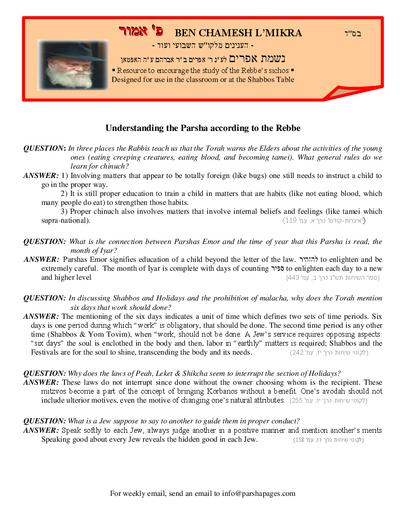
Both opinions relate to our service

  1. Influencing the animal soul by withdrawal of food
  2. G-dly soul feels deficiency in being distant from Him

Opinions on issue of Chadash outside of Israel:

  1. Applies outside of the Land in order instill a concept that one’s first action must be for G-d
  2. Does not apply outside the Land to arouse feelings of one’s lowliness due to not having this mitzvah

Section of Peah, Leket & Shikcha does not interrupt the section of Holidays; since done without the owner choosing who is the recipient, these mitzvos become a part of the concept of bringing Korbanos without a benefit

Mitzvah to rejoice applies to all Festivals, but on Sukkos Jews excel in this Mitzvah; Simchas Bais HaShoevah begins this great service

The siddur’s primary focus is a person’s avodah. Unique connection between the Alter Rebbe’s siddur and Sefiras HaOmer (last item in siddur): A person’s intent (object) and self-improvement

Time of Sukkos is not connected to a particular event, but is established by the Jews through seven special Mitzvah days of sitting in the Sukkah that surrounds all aspects on one’s life

Aravos (lacking Torah & Mitzvos) highlights the value of the simple Jew – connection with their essence; thus, we love every Jew for their essence (not their qualities)

“Speaking” softly applies how each Jew speaks to another; always judge another in a positive manner and mention another’s merits

Different understanding of the mitzvah of Kiddush HaShem

  1. Highest form of Kiddush HaShem is to be killed for His sake
  2. Greatest Kiddush HaShem occurs when a miracle saves someone from death
  3. Kiddush HaShem is to surrender oneself to sanctify His Name; a possible miracle is G-d’s business and not part of the Mitzvah

Difference in order of Holidays as listed in the Torah and as listed in Rambam
Holidays are an obligation of Time – אלה מועדי - Days of holiness distinct from other non-holy days; thus, listed in order of occurrence (לפי סדר בתורה)
Holidays are an obligation of the Person – אות בינינו לעולם - a person has a constant obligation to fulfill the holiday in its appropriate time; thus, listed in order to reflect the decree that the holiday impacts the person’s service (לפי סדר ברמב"ם)

PDF Preview