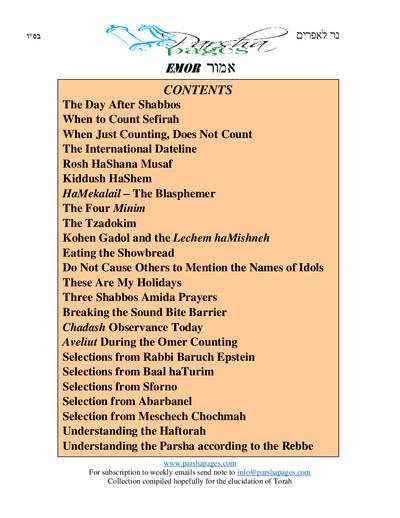
Three Shabbat Prayers
Based on article by Rabbi Yehonatan Chipman
This week's parashah, in Leviticus 23, contains the fullest and most comprehensive account in the Torah of all the festive and holy days of the Jewish year, beginning with Shabbat, and including both the three pilgrimage festivals (also found in Exodus 23, 34, and Deut 16) and the Days of Awe. This seems a suitable opportunity to discuss the prayers for Shabbat.
The basic framework of the Shabbat prayers is much the same, structurally, as that of the weekday prayers, albeit expanded: Pesukei de-Zimra is the same as weekdays, with the addition of half a dozen psalms not recited on those days, and ending with the prose poem Nishmat; Shema is recited with its blessings, with the addition of extra verses, the liturgical poem El Adon, and a passage referring to Shabbat in the blessing Yotzer Or; the Amidah has a different middle section, which we shall discuss presently. The centerpiece of the Shabbat morning service is, in many ways, the reading of the weekly Torah portion but, here too, the introduction and conclusion of the Torah service is essentially the same as that used at the more abbreviated readings of Mondays, Thursdays, and Shabbat afternoon.
The Shabbat Amidah, like that for festival days, including Rosh Hashanah and Yom Kippur, follows the same basic format as the weekday Amidah, with a difference. The weekday Amidah consists of three introductory blessings of shevah, praise of God; a series of thirteen petitionary prayers constituting the middle section (bakashat tzerakhim)-i.e., prayer in the classical sense of asking God for one's needs; and three concluding blessings, described as hoda'ah, thanks-giving. Un1ike the weekday prayers, the middle section of both Shabbat and festival prayers consists of on1y one blessing, focused on the holiness of the day, its meaning, and a request for spiritual blessing-but without a word of request for such things as livelihood and economic blessing, healing for the sick, or even for the collective needs of the Jewish people-redemption, the end of the Exile, and so forth.
Unlike both weekdays and festive days, the middle blessing of the Shabbat Amidah differs for each of the three daily statutory prayers-i.e., Evening, Morning and Afternoon.
Thus, the middle blessing for Ma'ariv begins with the words Atah kidashta ("You have sanctified the seventh day to Your name"), and includes the account as to how God blesses and sets aside the Shabbat at the end of Creation (Gen 2:1-3). The blessing for Shaharit beginning Yismah Moshe... ("Moses rejoiced in the gift he was given that was his portion..."), describes the Revelation at Sinai and the "gift" to Moses of the two tablets of the Law, among whose commandments included th e observance of Shabbat; this is followed by a passage about the same from Exod 31:16-17. In the Afternoon prayer, Minchah, one reads Atah Ehad veshimkha ehad... "(You are one, and Your name is one, and who is like your people Israel, one people in the earth... "), going on to describe the Shabbat as a day of religious intimacy between God and the Jewish people.
Much has been written about these three varied blessing. One of the oldest sources, quoted by the rishonim, characterizes these three divergent texts as alluding to "three Sabbaths" -i.e., three different aspects of the Shabbat: the Shabbat of Creation, the Shabbat of the giving of the Torah, and the Shabbat of the World to Come.
That is, Friday night is seen as celebrating Shabbat as a "remembrance of the Acts of Creation" (a motif that reappears in the Kiddush recited at the beginning of the evening meal);
Shabbat morning corresponds to and in some sense duplicates or recreates the moment of Revelation at Sinai, which according to the aggadah in b.Shabbat 86a occurred on a Shabbat morning. This idea also seems to be reflected in the reading of the Torah on Shabbat morning (for which reason some people stand, again reminiscent of the people standing at Sinai), as well as by the devotion of the Shabbat day generally to study of the Torah, with public lectures and classes.
Shabbat afternoon alludes to the future Redemption, insofar as Shabbat is seen as a kind of "foretaste of the World to Come." The words of this Amidah blessing hint at this: "Abraham rejoiced, Yitzhak sang out, Jacob and his sons rested therein; a rest of love freely given, a rest of truth and trust, a rest of peace and tranquility, quiet and security... " (Tosafot at b. Haggigah 3b alludes to this point as well: Shabbat, God and Israel all "testify" to one another).
Another opinion is that the day of Shabbat reflects the marriage of HaShem (the chasan) and Bnai Yisrael (the kallah), night is the giving of the Kiddushin, by morning is the simchah, and the afternoon is the marriage meal.
Franz Rosenzweig, in The Star of Redemption (Part II, Book I, chapter on the Jewish year, Hallo translation, pp. 310- 313), sees the three parts of the Shabbat as corresponding to the three foci of interrelation among God, Man and the World: namely, Creation, Revelation, ad Redemption.
There are also three meals on Shabbat, after each one of the Shabbat prayers. In the Kabbalistic tradition, as articulated in the Zohar and, later, in greater detail, in the writings of Luria, sees each meal as corresponding to a different aspect of the Divine; Luria himself composed special Aramaic hymns, or zemirot, to be recited at each of the three meals, expressing the unique mystical character of each. Friday night = hakal tapuhin - the holy apple orchard- Shekhinah, the feminine; Shabbat morning= atik yomin or atik apin = the Divine source of wisdom, Torah, the masculine principle; Shabbat afternoon=ze'ir anpin - the merging and harmony of all the various aspects.
These three blessings do share a common concluding paragraph, beginning with the words רצה ("accept our rest'), which is a kind of prayer for spiritual blessing: we ask God to accept our Sabbath rest, to fill us with His goodness, to cause us to rejoice in the ultimate redemption, and to "purify our hearts that we may serve You in truth." Interestingly, some prayer texts, in the final sentence of this blessings, vary the wording to reflect the feminine, masculine and combined aspect of these respective times. Thus, ("and there shall rest therein [lit.: in her, in him, in them] Israel, who sanctify Your name").
There was an ongoing dispute, continuing for perhaps two or three centuries, concerning the use of the prayer beginning Yismach Moshe on Shabbat morning. Rashi and his circle were opposed to it, on a number of grounds: a) that it was not of ancient vintage, but rather a late innovation; (b) that it was unsuitable for use as a prayer text because it contained neither request nor praise of God, but rather celebrated Moses' role in introducing the idea of Shabbat. Indeed, one midrash cited in this connection describes how Moses went to Pharaoh with the idea of a weekly day of rest, arguing that it would increase the efficiency and productivity of the Hebrew slaves on the other six days of the week-and Pharaoh agreed! Later, when the Shabbat was revealed by God at Sinai, Moses rejoiced that the Almighty had, so to speak, confirmed the sagacity of his social reform. Other authorities, including Rabbenu Tam, as well as Se/er ha-Manhig and Se/er ha-Pardes, supported the new prayer text, and over time, it gradually became recognized as the universally accepted prayer text for Shabbat.