For It Is Your Life
מגדל אור | September 20, 2023
Print This Article
View Original PDF

For It Is Your Life

מגדל אור | December 31, 2025

(ZM:BL OYRBD) ‰...OKYMY WKYRAT HZH RBDBW OKYYX AWH YK OKM AWH QR RBD AL YK‰
“For this is not an empty thing from you, for it is your life! And through this thing you will extend your days...” (Devarim 32:47)

After he and Yehoshua finished teaching the song of Haazinu to the Jewish People, Moshe warned them not to take the requirement to learn and follow the Torah lightly. He then said this line to them, so they might appreciate the Torah for what it’s really worth – not merely an obligation, but an opportunity!

A number of commentaries take the approach that Moshe was telling the Jews what was in it for them. The study of Torah is not empty and without reward. On the contrary, there is tremendous reward for studying Torah. First of all, by studying, one knows what he should and mustn’t do. In this way, he safeguards his life, lest he transgress for lack of knowledge.

Secondly, since it is Hashem’s will that we study His Torah, as that is how He communicates with us, then there is intrinsically a benefit of studying, and we will be rewarded for it. Not only that, but when we make the attempt to understand the Torah, even if it’s beyond us, we are earning tremendous reward because we are trying to fulfill Hashem’s will.

However, the wording of the verse undermines this a bit. If this were the case, teaching us that the Torah is beneficial to us, the posuk should have said, “lachem – to you.” Instead, it says, “lo davar raik hu mikem – it is not an empty thing from you,” implying something else.

From the usage of the word meaning “from you,” we draw the understanding that Torah is so full of meaning that we have no right or standing to imagine any of it is empty of meaning. Indeed, Rashi shows us a deep insight and an entire cultural understanding of how the world perceived Avraham Avinu, from a few words that one could easily have imagined were just telling us a simple fact of who was who. But the Torah’s depth is not determined by our perception.

Instead, we are told that the Torah is so full that there is no way for us to imagine or describe it as being empty, meaningless, or shallow. Moshe was telling us to study it carefully for inside we would find treasure upon treasure, and it would add length to our years and days. Man’s search for meaning is what drives him forward and gives him the strength to stretch himself beyond his limits and persevere. With these words, Moshe was making sure we knew where to look.

On the last Yom Kippur of his life, R’ Yehudah Leib Chasman, z”l, the mashgiach of Yeshivas Chevron, returned to his house after neilah, due to his weakness from the fast. A minyan of bochurim accompanied him. Rav Chasman’s face was shining with happiness that he was zocheh to complete the fast.

As the bochurim sat down to await the time to daven Maariv, R’ Chasman said, “Yona Hanavi told the men on the ship to ‘lift me and throw me into the sea.’ The words ‘lift me’ seems to be extra. What was Yona adding with these words? Wouldn’t it have been enough if he said only, ‘Throw me into the sea’?

The answer is Yona was requesting they delay throwing him into the sea as much as possible – even for a split second. Because there is nothing more valuable in the world than the life of a human being. Even when death has already been decreed, it’s still worthwhile to lengthen one’s life as much as possible. Who knows how valuable the life of person can be in his last moment.”

The mashgiach concluded, “We have to understand that we now still have another moment of kedushas Yom Kippur! Come, let us grab hold of it, do not weaken! Let us not lose this precious stone without a thought!”

©2023 – J. Gewirtz
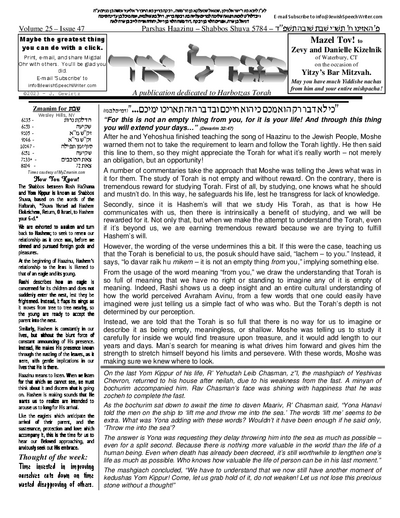
(ZM:BL OYRBD) ‰...OKYMY WKYRAT HZH RBDBW OKYYX AWH YK OKM AWH QR RBD AL YK‰
“For this is not an empty thing from you, for it is your life! And through this thing you will extend your days...” (Devarim 32:47)

After he and Yehoshua finished teaching the song of Haazinu to the Jewish People, Moshe warned them not to take the requirement to learn and follow the Torah lightly. He then said this line to them, so they might appreciate the Torah for what it’s really worth – not merely an obligation, but an opportunity!

A number of commentaries take the approach that Moshe was telling the Jews what was in it for them. The study of Torah is not empty and without reward. On the contrary, there is tremendous reward for studying Torah. First of all, by studying, one knows what he should and mustn’t do. In this way, he safeguards his life, lest he transgress for lack of knowledge.

Secondly, since it is Hashem’s will that we study His Torah, as that is how He communicates with us, then there is intrinsically a benefit of studying, and we will be rewarded for it. Not only that, but when we make the attempt to understand the Torah, even if it’s beyond us, we are earning tremendous reward because we are trying to fulfill Hashem’s will.

However, the wording of the verse undermines this a bit. If this were the case, teaching us that the Torah is beneficial to us, the posuk should have said, “lachem – to you.” Instead, it says, “lo davar raik hu mikem – it is not an empty thing from you,” implying something else.

From the usage of the word meaning “from you,” we draw the understanding that Torah is so full of meaning that we have no right or standing to imagine any of it is empty of meaning. Indeed, Rashi shows us a deep insight and an entire cultural understanding of how the world perceived Avraham Avinu, from a few words that one could easily have imagined were just telling us a simple fact of who was who. But the Torah’s depth is not determined by our perception.

Instead, we are told that the Torah is so full that there is no way for us to imagine or describe it as being empty, meaningless, or shallow. Moshe was telling us to study it carefully for inside we would find treasure upon treasure, and it would add length to our years and days. Man’s search for meaning is what drives him forward and gives him the strength to stretch himself beyond his limits and persevere. With these words, Moshe was making sure we knew where to look.

On the last Yom Kippur of his life, R’ Yehudah Leib Chasman, z”l, the mashgiach of Yeshivas Chevron, returned to his house after neilah, due to his weakness from the fast. A minyan of bochurim accompanied him. Rav Chasman’s face was shining with happiness that he was zocheh to complete the fast.

As the bochurim sat down to await the time to daven Maariv, R’ Chasman said, “Yona Hanavi told the men on the ship to ‘lift me and throw me into the sea.’ The words ‘lift me’ seems to be extra. What was Yona adding with these words? Wouldn’t it have been enough if he said only, ‘Throw me into the sea’?

The answer is Yona was requesting they delay throwing him into the sea as much as possible – even for a split second. Because there is nothing more valuable in the world than the life of a human being. Even when death has already been decreed, it’s still worthwhile to lengthen one’s life as much as possible. Who knows how valuable the life of person can be in his last moment.”

The mashgiach concluded, “We have to understand that we now still have another moment of kedushas Yom Kippur! Come, let us grab hold of it, do not weaken! Let us not lose this precious stone without a thought!”

©2023 – J. Gewirtz

PDF Preview