Haazinu Shabbos Teshuva
Project Likkutei Sichos | September 21, 2023
Print This Article
View Original PDF

Haazinu Shabbos Teshuva

Project Likkutei Sichos | December 31, 2025

The Rambam:
The Levites would sing a different psalm every day, during the procedure of the communal sacrifices.
“For the Musaf offering of Shabbos, the song Haazinu (Devarim ch.32) is recited. It is divided into six segments... just as it is read in the synagogue. One segment is recited each Sabbath. After the song is completed on six Sabbaths, they would return to the beginning.” (Temidin U’Musafim 6:9)

The Question:

The content of Haazinu is a rebuke. Moshe exhorts the people to not forget G-d, and warns them of the calamities that will follow if they do. Why is this a fitting “song” to accompany the offering of sacrifices?

The Explanation:

Rambam’s language here differs from his Talmudic source, which is more concise: “They would say haziv lach (an acronym for the words which begin the verses of the six segments).” Rambam adds the phrase, “For the Musaf offering of Shabbos, the song Haazinu is recited. It is divided into six segments...” In other words, the Rambam is stressing that even though a single section is read each week, it should be seen as being part of the entire song of Haazinu. Just like in the synagogue, the entire song is read, so, too, in the Beis Hamikdash, the entire song is recited, only in piecemeal.

When we consider the arc of the song, we see that G-d promises to remember His people and to redeem them. The theme of the song as a whole is not the individual calamities, but that even those hardships are intended only to bring us to redemption.

The Deeper Dimension:

Why, though, do we divide the song into six sections? Because they correspond to the themes of the songs from the first six days of the week. The songs of the workweek emphasize how G-d is implicit within various elements of the created world. On Shabbos, when we transcend the material world and its concerns, we sing of how G-d is revealed within the Jewish people and the Torah. The six chapters of Haazinu correspond to the six songs of the workweek.

Sunday:

“The earth and its fullness is G-d's” (Tehillim 24). This is a general description of the world as G-d’s possession which He directs.
Ch.1: “He has made you and established you (32:6)” The Jewish people are G-d’s possession.

Monday:

“G-d is great and exceedingly praised in the city of our Lord” (Tehillim 48). This describes how G-d’s kingship was manifest in the division of the waters, the creation of the second day.
Ch.2: “He set up the boundaries of peoples according to the number of the children of Israel (32:8).” G-d set the Jewish people apart, because they accepted His kingship.

Tuesday:

“G-d stands in the council of judges, among the judges, He delivers judgment” (Tehillim 82). This alludes to G-d’s concealment and judgment.
Ch.3: “You forgot the God Who delivered you. (32:18)” G-d is concealed from us because of our distance.

Wednesday:

“G-d is a G-d of retribution” (Tehillim 94).
Ch.4: This section speaks about the calamitous consequences of G-d’s concealment.

Thursday:

“Raise joyous song to G-d our strength; sound the shofar to the G-d of Jacob” (Tehillim 81).
Ch.5: This section describes how G-d will avenge the Jewish people’s enemies, causing them to “Sing out praise.”

Friday:

“G-d is King. He clothes Himself with grandeur.” (Tehillim 93).
Ch.6: This describes the future redemption, when G-d’s kingship will be fully revealed.

Haazinu thus represents the possibility of doing teshuva with joy and song, of seeing the past hardship as an impetus for coming closer to G-d. This is why it is often read on the week of Shabbos Shuva, whose theme is “elevated teshuva,” done with joy.

The objective of the song of Haazinu is that it should enhance all of a person’s mitzvos, which is why it is the 32nd chapter of the book, the numerical equivalent of “heart.” This aligns with the theme of teshuva as well, for teshuva is a phenomenon which illuminates and uplifts all of a person’s Torah and mitzvot.
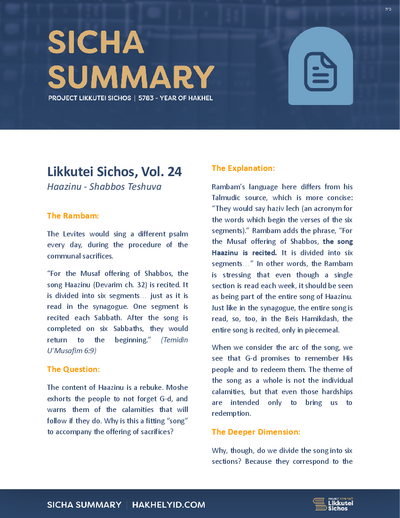

The Rambam:
The Levites would sing a different psalm every day, during the procedure of the communal sacrifices.
“For the Musaf offering of Shabbos, the song Haazinu (Devarim ch.32) is recited. It is divided into six segments... just as it is read in the synagogue. One segment is recited each Sabbath. After the song is completed on six Sabbaths, they would return to the beginning.” (Temidin U’Musafim 6:9)

The Question:

The content of Haazinu is a rebuke. Moshe exhorts the people to not forget G-d, and warns them of the calamities that will follow if they do. Why is this a fitting “song” to accompany the offering of sacrifices?

The Explanation:

Rambam’s language here differs from his Talmudic source, which is more concise: “They would say haziv lach (an acronym for the words which begin the verses of the six segments).” Rambam adds the phrase, “For the Musaf offering of Shabbos, the song Haazinu is recited. It is divided into six segments...” In other words, the Rambam is stressing that even though a single section is read each week, it should be seen as being part of the entire song of Haazinu. Just like in the synagogue, the entire song is read, so, too, in the Beis Hamikdash, the entire song is recited, only in piecemeal.

When we consider the arc of the song, we see that G-d promises to remember His people and to redeem them. The theme of the song as a whole is not the individual calamities, but that even those hardships are intended only to bring us to redemption.

The Deeper Dimension:

Why, though, do we divide the song into six sections? Because they correspond to the themes of the songs from the first six days of the week. The songs of the workweek emphasize how G-d is implicit within various elements of the created world. On Shabbos, when we transcend the material world and its concerns, we sing of how G-d is revealed within the Jewish people and the Torah. The six chapters of Haazinu correspond to the six songs of the workweek.

Sunday:

“The earth and its fullness is G-d's” (Tehillim 24). This is a general description of the world as G-d’s possession which He directs.
Ch.1: “He has made you and established you (32:6)” The Jewish people are G-d’s possession.

Monday:

“G-d is great and exceedingly praised in the city of our Lord” (Tehillim 48). This describes how G-d’s kingship was manifest in the division of the waters, the creation of the second day.
Ch.2: “He set up the boundaries of peoples according to the number of the children of Israel (32:8).” G-d set the Jewish people apart, because they accepted His kingship.

Tuesday:

“G-d stands in the council of judges, among the judges, He delivers judgment” (Tehillim 82). This alludes to G-d’s concealment and judgment.
Ch.3: “You forgot the God Who delivered you. (32:18)” G-d is concealed from us because of our distance.

Wednesday:

“G-d is a G-d of retribution” (Tehillim 94).
Ch.4: This section speaks about the calamitous consequences of G-d’s concealment.

Thursday:

“Raise joyous song to G-d our strength; sound the shofar to the G-d of Jacob” (Tehillim 81).
Ch.5: This section describes how G-d will avenge the Jewish people’s enemies, causing them to “Sing out praise.”

Friday:

“G-d is King. He clothes Himself with grandeur.” (Tehillim 93).
Ch.6: This describes the future redemption, when G-d’s kingship will be fully revealed.

Haazinu thus represents the possibility of doing teshuva with joy and song, of seeing the past hardship as an impetus for coming closer to G-d. This is why it is often read on the week of Shabbos Shuva, whose theme is “elevated teshuva,” done with joy.

The objective of the song of Haazinu is that it should enhance all of a person’s mitzvos, which is why it is the 32nd chapter of the book, the numerical equivalent of “heart.” This aligns with the theme of teshuva as well, for teshuva is a phenomenon which illuminates and uplifts all of a person’s Torah and mitzvot.

PDF Preview


