Holidays in Yekatrinoslav
From the Memoirs of Rebbetzin Chana Schneerson
Mother of the Lubavitcher Rebbe, zt”l
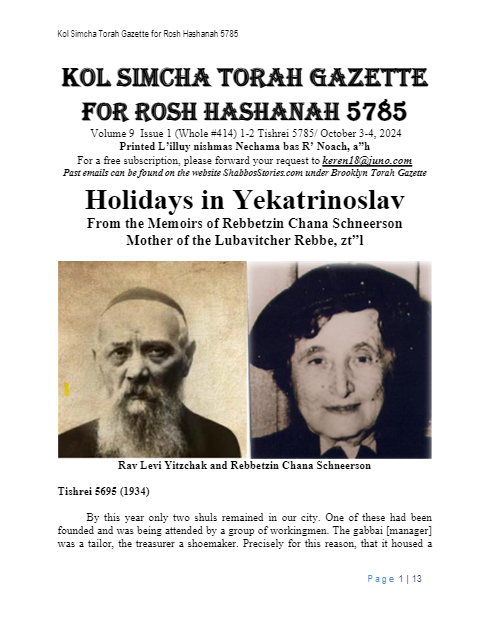
Rav Levi Yitzchak and Rebbetzin Chana Schneerson
Tishrei 5695 (1934)
By this year only two shuls remained in our city. One of these had been founded and was being attended by a group of workingmen. The gabbai [manager] was a tailor, the treasurer a shoemaker. Precisely for this reason, that it housed a congregation of manual laborers - proletariat - it had not been seized by the Communists. It was in this shul that my husband, the Rav prayed.
Once the Rav affiliated himself with this congregation, many other people joined as well. As most of these newcomers were from higher levels of society, it became somewhat difficult for the administrators of the shul to carry out their functions. Even so, they had to remain in their positions to ensure that it would be exclusively a "rule by the proletariat." (Indeed, I could relate many amusing incidents from their term of office, but it would be out of place here.)
The Rav Accorded Him Great Respect
The administrators and trustees of the shul asserted that they felt small and insignificant in the presence of the Rav, and they accorded him great respect. Although they had not been acquainted with him previously, once they came to know him they recognized that he was a person of noble character who was not at all part of the bourgeoisie, a man whom they could trust completely.
By this time there were very few professional cantors in Russia. Those men who had a strong and pleasant voice, were able to carry a tune aand knew well the mode of the prayers would hire themselves out to lead the prayer-services for Rosh Hashana and Yom Kippur.
Most of these men worked at government positions and were therefore entitled to a month's vacation each year which they would strive to have coincide with the month of festivals, Tishrei. Then they would leave their homes to be employed in cities other than their own.
These Cantors Were Paid Very Well
In their prayers they would give vent to all the emotions that had built up in their hearts over the course of the year. These cantors were paid very well, but in secret; to avoid the exorbitant tax levied on religious functionaries, their salaries were officially recorded as the bare minimum.
One day, two such gentlemen came to Yekatrinoslav. The first, Mr. Lieber, was a highly-regarded opera singer. His clothes resembled those of a theater performer. However, he was a Jew of illustrious ancestry, a descendant of the Maggid of Mezritch, successor of the Baal Shem Tov. He occasionally related stories that he had heard for his grandfather and other Chassidic stories too, but he would tell them in a halting awkward manner.
The second, whose appearance was closer to that of a typical cantor, was employed as an accountant for a government company. He was knowledgeable in the study of Torah and an offspring of the well-known rabbinical family Shapiro of Slavitta.
These two candidates declared that a proper Jewish atmosphere for prayer was of the utmost importance to them. Therefore, when the reputation of Rabbi Schneerson reached them, they decided to travel to Yekatrinoslav. Upon arrival, they immediately went to see the Rav and requested his advice on how to do well in this profession, as well as how to best utilize their talents to inspire people and strengthen their Jewish consciousness, an identity that the government was determined to eradicate.
A Result of the Influence of the Rav and Those Two Cantors
The Rav discussed with them their concerns and invited them to Yekatrinoslav for the month of Tishrei to lead the prayers in his shul during the Days of Awe and the festival of Sukkot. Words are inadequate to describe the special mood and the overwhelming spiritual out-pouring which pervaded the congregation during the Days of Awe that year, a result of the influence of the Rav and those two cantors.
On Rosh Hashana and Yom Kippur a considerable number of the members had to be present at their places of employment. The Rav arranged a special service for them that began very early in the morning, in order that by eight o'clock they would have completed the morning prayers and be on their way.
On Yom Kippur all of these people returned to the shul immediately after work and arrived just in time for the closing prayer, Neilah. By then the synagogue was so packed with people that many of them were forced to pray outside in the street. Weak from the twenty-four hour fast, weary from having walked great distances, and full of distress and sorrow from having had to work on these holiest of days, these Jews stood, crushed in spirit, and prayed from the depths of their broken hearts.
“See, This is a Jew!”
All of these congregants were grateful to the Rav for having made the special efforts which enabled them to pray communally. For his part, he would cry bitterly whenever he discussed the situation with them. On the other hand, he was pleased by their tremendous spiritual arousal. With joy and amazement, he would exclaim, "See, this is a Jew!"
When Yom Kippur ended, it was always difficult for him to return to a regular week-day existence. Instead, he would break his fast with a glass of tea and would sit and talk until late at night with the many people who came to be with him and hear his words during those hours. His discussions would deal primarily with the exalted nature of the Jewish soul and the extraordinary power of self-sacrifice that is hidden in every Jew.
The same scene would be repeated on Simchat Torah. Anyone who wished to truly enjoy the festival would make sure to pass by our house as soon as darkness fell, young people-with whom the government was even stricter in religious matters- would also arrive, each person trying his best to not be seen entering the building. When they entered, the Rav would speak with each one personally; after a short time, they would forget about which country they were living in and the lives that they led there.
Reprinted from the Parashat Nitzavim-Vayelech 5762/2002 edition of L’Chaim Weekly, a publication of the Lubavitch Youth Organization.