Making a Dwelling Place for G-d through the Physical
It is specifically from the physical that we can make a dwelling place for G-d and not through the spiritual. This dwelling place is created primarily from the material, and not so much through Torah, or even by praising G-d for the study of Torah.
The reason being, that the study of Torah mainly involves the higher element of the Jew, his G-dly soul, and not the lower parts, his physical body. Rather, through praising G-d for the fact that He provides physical sustenance, things which the body derives benefit from, it is at this time that we are able to create a dwelling place for Him.
When the Jewish people recognize and feel that their physical needs come from G-d and they praise Him for them, it is then that they create a dwelling place for G-d in this world.
Therefore, when the Baal Shem Tov observed that this sage was an ascetic, secluded from all physical things, and did not at all involve himself from worldly matters—to the point that even his eating was just for basic sustenance and not to refine the physical—he then reprimanded him, questioning, “Why do you withhold the livelihood of the Holy one Blessed be He?”
Meaning to say, that being that G-d desires a dwelling place in this world, why do you withhold it from him? Only when the sage praised G-d in the realm of the physical, could he begin to make a dwelling place for G-d in this world.
The fifth year
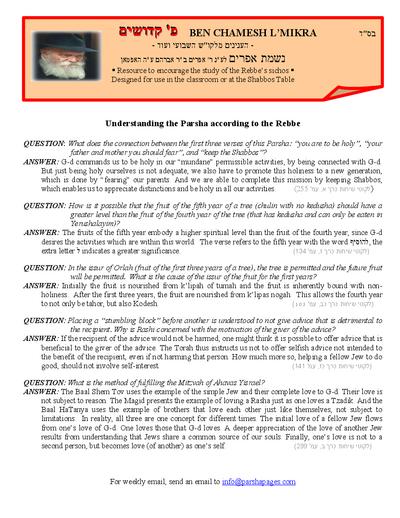
According to the above, the advantage of the fruits of the fifth year over the fruits of the fourth year can be appreciated, despite the fact that the fourth year’s yield are holy and must be consumed in a state of purity in Jerusalem.
For, it is specifically when a Jew realizes that even his fruit which are not holy are also dependent on G-d’s blessing, and he praises G-d for what He has given him, does it cause that G-d Himself should dwell in this physical abode.
So, although the fruits of the fourth year are indeed holy, they are not expressive of G-d’s ultimate intent in creating the world. G-d’s objective in creating the universe was not for holiness per se, but to reveal G-dliness in the mundane.
It is therefore specifically the fruit of the fifth year that have a true increase in G-dliness, as it within them that G-d’s purpose in creating the world is most felt.
(Based on Likutei Sichos 7, Kedoshim 1, reworked by Rabbi Dovid Markel. To see other projects and to partner in our work, see: www.Neirot.com.)
Related Articles