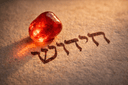
Elul The Power and Present of Elul
“Dirshu Hashem behematzo” – Seek Hashem when He can be found! “Kera’uhu behiyoso karov” – Call out to Him when He is close! Says the gemara, “Seek Hashem when He can be found” – when is that? During aseres yimei teshuva, the ten days of repentance. Says the Panim Yafos, what about the second half of the pasuk, “Call out to Him when He is close”? Says the Panim Yafos, “Seek Hashem when He can be found” is during Aseres Yimei teshuva, but don’t wait until then! “Call out to Him when He is close” – that is the month of Elul! We have that opportunity right now – don’t let these golden days slip by. It’s now chodesh Elul and Hashem is right here. We must use the opportunity to call out, to come close.
It says in Parshas Nitzovim, “Umal Hashem Elokecha es levavcha v’es l’vav zarecha” – Hashem will purify your hearts and the hearts of your children. The Baal Haturim teaches that the words “Es Levavcha V’es L’vav Zarecha” are roshei teivos Elul, which teaches us that Elul is a time when Hashem purifies the heart of a yid. That’s the avoda of Elul, to remove the “arlas halev” – the impurities of the heart.
The Chidushei Harim says that teshuva overrides Shabbos, even though teshuva has some sadness within it. One of the steps of teshuva is charata, regret, and when one regrets his sins he feels pain and sadness. So why is it permitted to do teshuva on Shabbos? The answer is that teshuva is an inyan of mila, just like we saw in the pasuk we mentioned previously. And just as mila overrides Shabbos, so too teshuva overrides Shabbos.
The Sfas Emes brings another remez with the roshei teivos of Elul. By Pharoh, Hashem told Moshe Rabeinu, “Bo el Pharoah ki ani hichbaditi es libo v’es lev avadav” – come to Pharoah, since I have hardened his heart and the hearts of his servants. The words “Es Libo V’es Lev” are roshei teivos Elul. This pasuk is referring to hardening a heart, so that a person will not repent.
So here we have two pesukim with hints to Elul. We easily understand how the first pasuk connects to Elul, as the essence of Elul is repentance and removing the impurities of our heart. However, the second pasuk is just the opposite! It’s talking about being stubborn, hardening the heart to the point where the person refuses to repent. So how can this pasuk be hinting to the month of Elul?
There is no question that the month of Elul is the opportune time to do teshuva. As the Baal Haturim says, a yid has a lot of siyata di’shmaya then to leave his bad ways and come close to Hashem. And so, the Satan is very afraid of Chodesh Elul. He sees the tremendous power, the incredible potential of this month of Elul. He is aware of the special siyata di’shmaya that we are given to do teshuva. He is afraid, so what does he do? He does what he does best! He works overtime to block our hearts from inspiration, to harden our hearts so that we should not tap into the wondrous power of this month. As Hashem is opening our hearts to make it easier for us to do teshuva, the Satan is working hard to close our hearts so we should not do teshuva! That’s why there are two opposing pesukim alluding to Elul, because there are indeed two opposing forces tugging at our hearts during this awesome month. And that’s why, sadly enough, so many of us remain uninspired and unafraid during Elul. It’s because we are not fighting strongly enough to drive away the force of the Satan who is hardening our hearts.
Rav Yaakov Galinsky once went into Rav Chaim Kanievsky and asked him, “What message should I deliver to the people of Eretz Yisroel about chodesh Elul? Rav Chaim answered, “Tell them that all the tzaros of the world is their fault”. Rav Yaakov thought, “How can I say this?” But then he realized there’s a gemara in Kiddushin 40 that says that every person has to imagine that the world is hanging on a scale which is exactly balanced; half guilty and half innocent. Your next action is the deciding factor - if you do one mitzva, you tip the scale and save the world, and if you do one aveira, then you tip the scale in the opposite direction.
He says that the Chasam Sofer says this very concept on the pasuk, “Re’eh anochi nosen lifneichem”. The question is why does the pasuk begin with lashon yachid, as “re’eh” is singular language, and then continues with lashon rabim, as “lifneichem” is plural? The Chasam Sofer answers based on what the gemara says, that by doing one mitzva a person can tip the scale for the entire world. The world is hanging in the balance, and one individual yid has the power to push it in either direction. So, the pasuk begins with the word “re’eh”, see, Hashem is speaking to the individual yid. You, as an individual, “anochi nosen lifneichem”, Hashem is giving you the power to tip the entire world through your free choice. You – singular you – give the entire plural of the world either brocha or klala. It’s up to you.
The Chofetz Chaim says in Sefer Shmiras Haloshon: who knows how many people became poor because of you, and how many people died because of you. Yes, one person can determine the fate of the entire world. It’s a tremendous responsibility that every individual has, a responsibility that we must remember especially during this month.
The Panim Yafos says in Parshas Achrei Mos that there’s a tremendous chesed in chodesh Elul – that one hour of chodesh Elul corresponds to one day of a year. If a day has twelve hours, that represents twelve days. A month has thirty days, so 30 x 12 = over 600. That means the hours of Elul can be mesaken the entire year. That’s the power and present of Elul.
In the time of Mishna, the eirusin and nissuin of marriage were not done together like today. A besula was given twelve months between the eirusin and nissuin in order to give her time to acquire her needs. Says the Panim Yafos, the mazel of chodesh Elul is besula, a maiden. Hashem gave a gift to chodesh Elul, which is the mazel of besula, a gift of twelve months. This means that in the month of Elul you can fix up an entire year. Just as a kallah needs ornaments and jewelry to adorn herself, we are given the opportunity to adorn ourselves before Hashem. How do we do that? Only through teshuva. Let us use this gift wisely and chose life for ourselves as individuals and for the entire world