Making This Years Teshuva a Different and Powerful Experience
By Daniel Keren
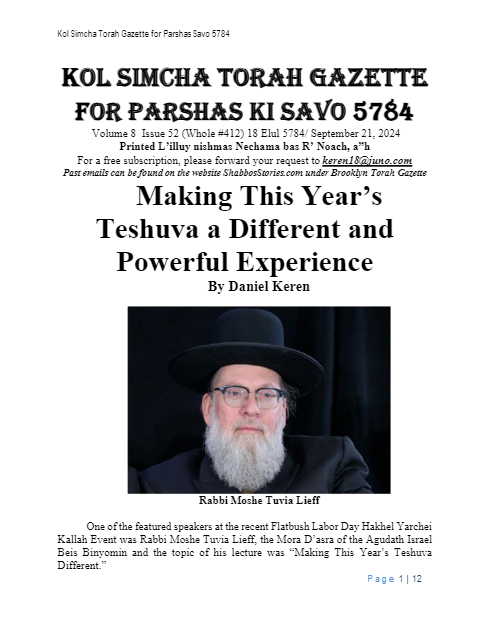
One of the featured speakers at the recent Flatbush Labor Day Hakhel Yarchei Kallah Event was Rabbi Moshe Tuvia Lieff, the Mora D’asra of the Agudath Israel Beis Binyomin and the topic of his lecture was “Making This Year’s Teshuva Different.”
He began with a story that reflected on the importance of the month of Elul. Back in Kelm there was a Yid who went to a non-Jewish lumber merchant to negotiate the purchase of certain amount of lumber that he needed for a certain project. After coming to terms on the cost, he instructed the goy to deliver the lumber to his home and he would pay him COD (cash on delivery.) The non-Jew refused and insisted on being paid in full before he would make any delivery. He had too many times been burned by people who had promised to pay him after he delivered the desired lumber. The Jew and lumber merchant’s argument began getting more heated and it appeared that they would start actually physically attacking each other. All of a sudden, another goy ran up and tapped his fellow non-Jew on the shoulder and explained to him that he had nothing to fear from doing such an arrangement with the Jew that day. He said that it is impossible for a Jew to dare even think of doing anything wrong and going back on his word as it was the Jewish month of Elul and as all the Jews in town were busily preparing to get ready for the awesome days of Rosh Hashanah and Yom Kippur. Therefore, no Yid would ever do anything dishonest even to a goy in these days of Elul.
The Jew Who Only Came to Shul on Rosh Hashanah and Yom Kippur
Rabbi Lieff told another story about a Jew who was not frum, but to honor his father’s memory would always come to the shul on three days a year on Rosh Hashanah and Yom Kippur. One day, a few weeks ahead of the holy days in the month of Elul he called the rabbi of the shul to tell him that he wasn’t anymore coming to shul to pray on those days. The rabbi, of course, asked why and was told by the simple Jew that he had just purchased an ArtScroll Machsor for the Yomim Noraim. The Jew noticed in the translation that we pray to Hashem to put His fear or dread upon us. “Why do I need this!? I already fear my wife. I fear my boss. At times I fear my kids. I fear my investments in the Dow Jones going down. Why do I need another thing to fear or dread?”
Hashem Can Help You with Your Mundane Fears
The rabbi explained that if you have a pachad because of Hashem, you should know that He is merciful and forgiving, especially if you do teshuvah. And consequently, you won’t have to worry about the mundane fears as He can easily help you out in those areas of your life. Rabbi Lieff spoke of the Yud Gimmel Middos of Rachamim (Hashem’s 13 Attributes of Mercy.) It can be compared to a soda dispensary that has many buttons. One is for Coke or Pepsi, another is for seltzer, a third for Sprite, etc. The object is focus on each of the middos of Hashem’s attributes of mercy. Each time we sincerely press a button for a particular middos, Hashem reacts by forgiving us, allowing us to turn aveiros (sins) into mitzvos (merits).
We Should Not Allow Others to Put Out Our Spiritual Light
The yesod (foundation) of this Tekufah [period in the Jewish calendar of Chodesh Elul and the Yomim Noraim] is to take advantage of the flash of lightening that Hashem gives us at this unique time of the year. Our avoda (spiritual service) and challenges at this time is not to allow others to put out our spiritual light (desire to do teshuvah and come closer to Hashem) because they themselves don’t want to improve themselves. Rabbi Lieff concluded by explaining that if one increases at this time one’s learning of Torah, this is an excellent method to be mechaper (atone for one’s sins or spiritual failures.) Today when we don’t have the Beis Hamikdosh to bring karbones (sacrificial offerings to atone for specific sins), our learning Torah can be a replacement because Talmud Torah both refines and elevates us. May we all be worthy for a sweet and good new year.
Reprinted from this week’s edition of The Flatbush Jewish Journal.