Parshas Ki Savo and Chai Elul Insights
Parsha Pages | September 19, 2024
Print This Article
View Original PDF

Parshas Ki Savo and Chai Elul Insights

Parsha Pages | June 27, 2025

Chai Elul

Shared birthday of the Baal Shem Tov and of the Baal HaTanya
Beginning of the 12 (one for each month) days prior to Rosh HaShana
Usually occurs within the week of Parshas Ki Savo

Time Mitzvah of First Fruits Beganהודאה Thankfulness Type of ServiceImmediately upon entering the Land מידUpon waking מודה אני Pure faith בעל שם טוב Increase of faithAfter the conquest and division of the entire Land; 14 years after enteringAt the conclusion of one’s prayers לשמך יודו אך צדיקים Intellectual contemplation אדמו"ר הזקן Chabad – primacy of the intellect עבודת פרטית

לקוטי שיחות חלק לד

Connection Between First Fruits and Yaacov and Lavan

דברים פרק כו, ה אֲרַמִׁי אֹבֵד אָבִׁי
T.T. Many commentators on the Torah and on the Hagadah comment on this connection between the offering of the first fruits and the special saying that begins with Yaacov and Lavan. Yet none seem to explain clearly.
Perhaps, a little bit of understanding begins with the concept that Hashem just promised the Jews the Land of Israel, This gift is to occur against the natural order of the world, that a nation that has escaped servitude and wandered for 40 years, should now depose the many strong nations that occupy the land, and then the Jews would live in peace and tranquility afterwards. This example begins from the era of Yaacov and all the travails of his life, symbolized from his conflict with Lavan. Yaacov left his father’s house and moved to Lavan’s house and faced many types of conflict there. And even after returning to Israel, he was constantly on the move and then the entire nation ending up moving to Egypt. Nevertheless, his children now stood on the brink of reentering the land of Israel - overturning of the natural order of the world.

Tefillin of the Head

דברים פרק כח, י וְרָאוּ כָל-עַמֵי הָאָרֶׁץ כִׁי שֵם ה' נִׁקְרָא עָלֶׁיךָ וְיָרְ אוּ מִׁמֶׁךָ:
מסכת מנחות דף לה/ב ר"א הגדול אומר אלו תפילין שבראש
The Tefillin have the majority of G-d’s name, the Shin and the Daled (without the Yud). Tosfos explains that the word לטטפת is a expression indicating power, as if to say that the Tefillin are witness for plus a reproach from HaShem that He is revealed through the Tefillin and people would see the Tefillin and fear G-d. In Brachos, the derasha is made that Tefillin are a source of strength for the Jews. Similarly, the verse in Yeshayahu, G-d swore with His right hand (this is Torah) and with His (other) strong arm (this is Tefillin that is a source of strength to the Jews). In reality, the left hand symbolizes the weak arm. Thus, even though the left hand is not the source of power, yet the left hand is the place of the source of strength (Tefillin which rest on the left arm).

Properly Standing Up the Torah

דברים פרק כז, כו אָרוּר אֲשֶׁר לֹא-יָקִׁים אֶׁת -דִׁבְרֵי הַתוֹרָה -הַזֹאת
ירושלמי מסכת סוטה פרק ז הלכה ד וכי יש תורה נופלת. שמעון בן יקים אומר זה החזן שהוא עומד
Many attempt to explain this saying. Most say it refers to the lifting of the Sefer Torah after its being read in public, that all should see the words that were written in the Sefer Torah. However, the Ramban explains this refers to the Chazan (gabbai) that does not properly secure the Sefer Torah in the Aron upon its return, so that it may fall. Others wish to explain this refers to the teachers of young children (sometimes called Chazan-director) and the language of עומד indicates guidance; thus, the teacher that fails to properly guide the students is the one subject to this curse.

Speech and Slander in Egypt

תהלים פרק קיד, א בְצֵאת יִׁשְרָאֵל מִׁמִׁצְרָיִׁם בֵית יַעֲקֹב מֵעַם לֹעֵז: (הלל)
According to most commentators the words מעם לעז (referring to the Egyptians) indicates a people that does not speak the Holy Language. And this seems to be the intent of Rashi throughout his comments on the Chumash and the Gemara, when he translates a word from Hebrew to another language he writes "בלע"ז", which is an abbreviation for "בלשון עם זר", indicating not the Holy Language.
But this explanation does not seem to assist us in understanding this verse, for what is the connection between the Jews and another nation that does not speak the Holy language. If the verse is attempting to disgrace the Egyptians since they do not speak Hebrew, what is the disgrace since all the other nations of the world also do not speak Hebrew, and none of them are called by this term?
A weak answer would be that the verse is attempting to reinforce the praise of the Jews that they continued to speak Hebrew while enslaved in Egypt and did not change their language. But why praise the Jews with this item, when the same Medrosh also mentions they did not change their pattern of clothing or their names.
Perhaps, the word לעז has a different meaning. The Gemara frequently uses the phrase מוציא לעז which implies gossip and perverse speech. Thus, it would be possible that this verse from Tehillim implies that the Jews went out specifically from a place where impure speech was the norm.
In order to fully understand this connection, one needs to explain another verse found in Parsha Ki Savo (26, 6) וירעו אותנו המצרים ויענונו ויתנו עלינו עבודה קשה. In many other places in the Torah, when describing how the Jews were treated by the Egyptians, the verses use לי, לנו, לעם. All of those verses use a relationship ל, and not the connection את that is found in Devarim אותנו.
One can explain that the וירעו אותנו alludes to the Aggadah that the Egyptians were embarrassed in front of the civilized world that they were afflicting the Jews, a quiet and harmless nation, that did not seem to warrant the hatred of the Egyptians. Therefore, the Egyptians sought to justify their behavior to the world by slandering the Jews whenever possible, taking actions out of context, and applying higher than normal standards to the Jews (similar to what we find today).
Now one can understand the verse in Devarim. The Egyptians first made the Jews appear to be bad and evil and then, with apparent justification, they afflicted the Jews.
Now, one can understand the verse in Hallel that describes the Jews leaving a land where the people slander and viciously disgrace the truth.

Prayer for Removal of Death Blow

וְהָסֵר מִׁמֶׁנוּ מַכַת הַמָוֶׁ ת (לתפילת תחנון)
The term מכת המות is not clear, since the simple term death is not connected to the term מכות, since death is the natural way of the world for all people. Also, the word הסר is not understood, since death has not been removed from the people saying this prayer.
Therefore, in this context the word מכות is to be understood as the punishment and reproach from Heaven, and not the usual manner of death. This is similar to the use found in Ki Savo והפלא ה' את מכותיך.
Thus, in this prayer the concept is that one appreciates the many methods of punishment which can be afflicted from the Heavens to cause death to a person, and we beseech G-d to not apply any of these manners of punishment.
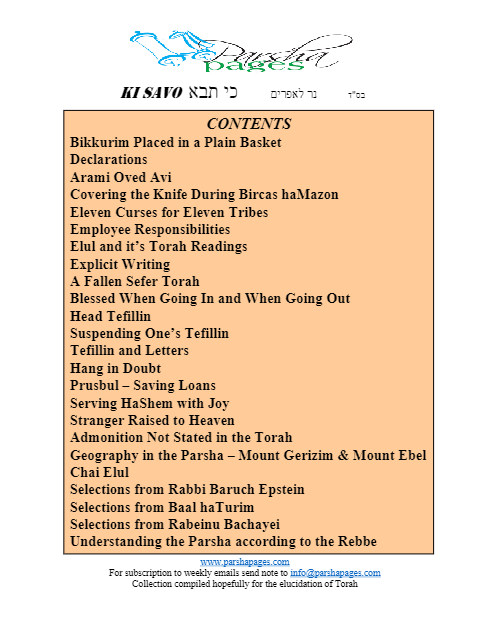
Chai Elul

Shared birthday of the Baal Shem Tov and of the Baal HaTanya
Beginning of the 12 (one for each month) days prior to Rosh HaShana
Usually occurs within the week of Parshas Ki Savo

Time Mitzvah of First Fruits Beganהודאה Thankfulness Type of ServiceImmediately upon entering the Land מידUpon waking מודה אני Pure faith בעל שם טוב Increase of faithAfter the conquest and division of the entire Land; 14 years after enteringAt the conclusion of one’s prayers לשמך יודו אך צדיקים Intellectual contemplation אדמו"ר הזקן Chabad – primacy of the intellect עבודת פרטית

לקוטי שיחות חלק לד

Connection Between First Fruits and Yaacov and Lavan

דברים פרק כו, ה אֲרַמִׁי אֹבֵד אָבִׁי
T.T. Many commentators on the Torah and on the Hagadah comment on this connection between the offering of the first fruits and the special saying that begins with Yaacov and Lavan. Yet none seem to explain clearly.
Perhaps, a little bit of understanding begins with the concept that Hashem just promised the Jews the Land of Israel, This gift is to occur against the natural order of the world, that a nation that has escaped servitude and wandered for 40 years, should now depose the many strong nations that occupy the land, and then the Jews would live in peace and tranquility afterwards. This example begins from the era of Yaacov and all the travails of his life, symbolized from his conflict with Lavan. Yaacov left his father’s house and moved to Lavan’s house and faced many types of conflict there. And even after returning to Israel, he was constantly on the move and then the entire nation ending up moving to Egypt. Nevertheless, his children now stood on the brink of reentering the land of Israel - overturning of the natural order of the world.

Tefillin of the Head

דברים פרק כח, י וְרָאוּ כָל-עַמֵי הָאָרֶׁץ כִׁי שֵם ה' נִׁקְרָא עָלֶׁיךָ וְיָרְ אוּ מִׁמֶׁךָ:
מסכת מנחות דף לה/ב ר"א הגדול אומר אלו תפילין שבראש
The Tefillin have the majority of G-d’s name, the Shin and the Daled (without the Yud). Tosfos explains that the word לטטפת is a expression indicating power, as if to say that the Tefillin are witness for plus a reproach from HaShem that He is revealed through the Tefillin and people would see the Tefillin and fear G-d. In Brachos, the derasha is made that Tefillin are a source of strength for the Jews. Similarly, the verse in Yeshayahu, G-d swore with His right hand (this is Torah) and with His (other) strong arm (this is Tefillin that is a source of strength to the Jews). In reality, the left hand symbolizes the weak arm. Thus, even though the left hand is not the source of power, yet the left hand is the place of the source of strength (Tefillin which rest on the left arm).

Properly Standing Up the Torah

דברים פרק כז, כו אָרוּר אֲשֶׁר לֹא-יָקִׁים אֶׁת -דִׁבְרֵי הַתוֹרָה -הַזֹאת
ירושלמי מסכת סוטה פרק ז הלכה ד וכי יש תורה נופלת. שמעון בן יקים אומר זה החזן שהוא עומד
Many attempt to explain this saying. Most say it refers to the lifting of the Sefer Torah after its being read in public, that all should see the words that were written in the Sefer Torah. However, the Ramban explains this refers to the Chazan (gabbai) that does not properly secure the Sefer Torah in the Aron upon its return, so that it may fall. Others wish to explain this refers to the teachers of young children (sometimes called Chazan-director) and the language of עומד indicates guidance; thus, the teacher that fails to properly guide the students is the one subject to this curse.

Speech and Slander in Egypt

תהלים פרק קיד, א בְצֵאת יִׁשְרָאֵל מִׁמִׁצְרָיִׁם בֵית יַעֲקֹב מֵעַם לֹעֵז: (הלל)
According to most commentators the words מעם לעז (referring to the Egyptians) indicates a people that does not speak the Holy Language. And this seems to be the intent of Rashi throughout his comments on the Chumash and the Gemara, when he translates a word from Hebrew to another language he writes "בלע"ז", which is an abbreviation for "בלשון עם זר", indicating not the Holy Language.
But this explanation does not seem to assist us in understanding this verse, for what is the connection between the Jews and another nation that does not speak the Holy language. If the verse is attempting to disgrace the Egyptians since they do not speak Hebrew, what is the disgrace since all the other nations of the world also do not speak Hebrew, and none of them are called by this term?
A weak answer would be that the verse is attempting to reinforce the praise of the Jews that they continued to speak Hebrew while enslaved in Egypt and did not change their language. But why praise the Jews with this item, when the same Medrosh also mentions they did not change their pattern of clothing or their names.
Perhaps, the word לעז has a different meaning. The Gemara frequently uses the phrase מוציא לעז which implies gossip and perverse speech. Thus, it would be possible that this verse from Tehillim implies that the Jews went out specifically from a place where impure speech was the norm.
In order to fully understand this connection, one needs to explain another verse found in Parsha Ki Savo (26, 6) וירעו אותנו המצרים ויענונו ויתנו עלינו עבודה קשה. In many other places in the Torah, when describing how the Jews were treated by the Egyptians, the verses use לי, לנו, לעם. All of those verses use a relationship ל, and not the connection את that is found in Devarim אותנו.
One can explain that the וירעו אותנו alludes to the Aggadah that the Egyptians were embarrassed in front of the civilized world that they were afflicting the Jews, a quiet and harmless nation, that did not seem to warrant the hatred of the Egyptians. Therefore, the Egyptians sought to justify their behavior to the world by slandering the Jews whenever possible, taking actions out of context, and applying higher than normal standards to the Jews (similar to what we find today).
Now one can understand the verse in Devarim. The Egyptians first made the Jews appear to be bad and evil and then, with apparent justification, they afflicted the Jews.
Now, one can understand the verse in Hallel that describes the Jews leaving a land where the people slander and viciously disgrace the truth.

Prayer for Removal of Death Blow

וְהָסֵר מִׁמֶׁנוּ מַכַת הַמָוֶׁ ת (לתפילת תחנון)
The term מכת המות is not clear, since the simple term death is not connected to the term מכות, since death is the natural way of the world for all people. Also, the word הסר is not understood, since death has not been removed from the people saying this prayer.
Therefore, in this context the word מכות is to be understood as the punishment and reproach from Heaven, and not the usual manner of death. This is similar to the use found in Ki Savo והפלא ה' את מכותיך.
Thus, in this prayer the concept is that one appreciates the many methods of punishment which can be afflicted from the Heavens to cause death to a person, and we beseech G-d to not apply any of these manners of punishment.

PDF Preview