Picking Up the Shovel
The Torah Anytimes | September 12, 2025
Print This Article
View Original PDF

Picking Up the Shovel

The Torah Anytimes | December 10, 2025

In Communist Russia, where winters were brutal, the government enforced strict laws requiring citizens to keep the sidewalks in front of their homes and stores clear. Failure to do so came with steep fines.

To ensure compliance, each neighborhood had an appointed enforcer who would patrol the streets. If snow wasn’t cleared, he issued penalties. No excuses.

Now, no one wanted to shovel. It was exhausting, cold and time-consuming. But they didn’t have a choice. So people adapted. But the shopkeepers developed a clever tactic: instead of clearing the snow right away, they’d wait for foot traffic to pack it down, making the job easier. But they knew they had to be careful. If the inspector showed up and caught them idle, they’d be fined.

So they devised a system. They’d sit outside, chatting, keeping their shovels nearby. The moment someone spotted the inspector, they’d all jump up, grab their shovels, and pretend they were hard at work.

And it worked. After all, how could the officer fine someone who was actively shoveling?

But one storekeeper wasn’t playing along. He watched his peers fake their efforts and decided not to bother with the charade. One day, the inspector came by and fined him on the spot.

“Why me?” the storekeeper protested. “Nobody’s actually shoveling! They’re all just pretending when you show up!” The officer responded simply. “Maybe. But at least they were holding a shovel. You weren’t even trying.”

Rav Chatzkel Levenstein zt”l, the legendary Mashgiach of Mir and Ponovezh, shared this story with a profound spiritual message for Elul. He quoted the Reishis Chochmah, who cites an astounding concept. When a Jew merely thinks about doing teshuvah—when the thought enters their heart to return to Hashem—that thought alone ascends directly to the Kisei HaKavod, the Heavenly Throne. As it says in Hoshea, “Shuva Yisrael ad Hashem Elokecha—Return, O Israel, all the way to Hashem your God” (Hoshea 14:1).

Even if we haven’t yet acted, even if we haven’t yet changed, the intention to change is immensely precious in Hashem’s eyes. The moment we “pick up the shovel,” even if the snow isn’t yet cleared, we are already reaching the highest heavens.

Elul is not just about massive transformation overnight. It’s about beginning the journey by picking up the shovel, starting to think about change and planning the path forward.

We’re not yet in the thick of Rosh Hashanah or the awe of Yom Kippur. We may still be surrounded by noise, distractions and spiritual clutter. But we have this month of Elul to reflect, to plan and to slowly shift.

Let’s not be the storekeeper who sits idly while others, at the very least, lift their shovels. Let’s not wait until the Day of Judgment arrives to panic and scramble. Let’s start now. You don’t have to become a tzaddik overnight. Just show Hashem that you’re thinking about coming home.
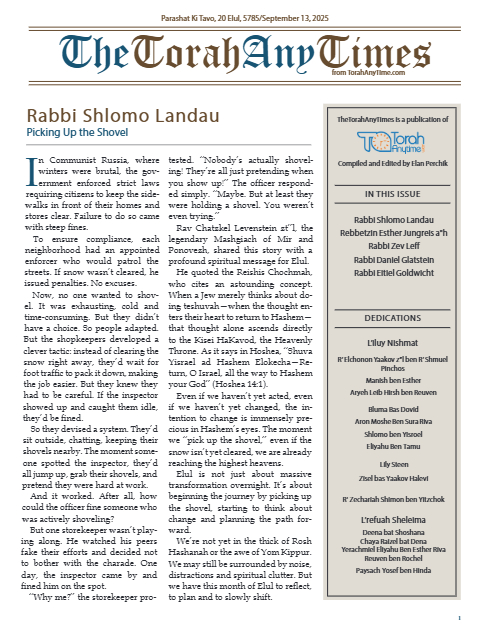

In Communist Russia, where winters were brutal, the government enforced strict laws requiring citizens to keep the sidewalks in front of their homes and stores clear. Failure to do so came with steep fines.

To ensure compliance, each neighborhood had an appointed enforcer who would patrol the streets. If snow wasn’t cleared, he issued penalties. No excuses.

Now, no one wanted to shovel. It was exhausting, cold and time-consuming. But they didn’t have a choice. So people adapted. But the shopkeepers developed a clever tactic: instead of clearing the snow right away, they’d wait for foot traffic to pack it down, making the job easier. But they knew they had to be careful. If the inspector showed up and caught them idle, they’d be fined.

So they devised a system. They’d sit outside, chatting, keeping their shovels nearby. The moment someone spotted the inspector, they’d all jump up, grab their shovels, and pretend they were hard at work.

And it worked. After all, how could the officer fine someone who was actively shoveling?

But one storekeeper wasn’t playing along. He watched his peers fake their efforts and decided not to bother with the charade. One day, the inspector came by and fined him on the spot.

“Why me?” the storekeeper protested. “Nobody’s actually shoveling! They’re all just pretending when you show up!” The officer responded simply. “Maybe. But at least they were holding a shovel. You weren’t even trying.”

Rav Chatzkel Levenstein zt”l, the legendary Mashgiach of Mir and Ponovezh, shared this story with a profound spiritual message for Elul. He quoted the Reishis Chochmah, who cites an astounding concept. When a Jew merely thinks about doing teshuvah—when the thought enters their heart to return to Hashem—that thought alone ascends directly to the Kisei HaKavod, the Heavenly Throne. As it says in Hoshea, “Shuva Yisrael ad Hashem Elokecha—Return, O Israel, all the way to Hashem your God” (Hoshea 14:1).

Even if we haven’t yet acted, even if we haven’t yet changed, the intention to change is immensely precious in Hashem’s eyes. The moment we “pick up the shovel,” even if the snow isn’t yet cleared, we are already reaching the highest heavens.

Elul is not just about massive transformation overnight. It’s about beginning the journey by picking up the shovel, starting to think about change and planning the path forward.

We’re not yet in the thick of Rosh Hashanah or the awe of Yom Kippur. We may still be surrounded by noise, distractions and spiritual clutter. But we have this month of Elul to reflect, to plan and to slowly shift.

Let’s not be the storekeeper who sits idly while others, at the very least, lift their shovels. Let’s not wait until the Day of Judgment arrives to panic and scramble. Let’s start now. You don’t have to become a tzaddik overnight. Just show Hashem that you’re thinking about coming home.

PDF Preview