Rabeinu Bachyei on the Eleven Curses
Parsha Pages | September 19, 2024
Print This Article
View Original PDF

Rabeinu Bachyei on the Eleven Curses

Parsha Pages | June 27, 2025

The Eleven Curses - Devarim 27,15 “cursed be the man who will construct a hewn image, etc.”

Among the eleven sins listed here, the sin of idolatry is mentioned first as it is equivalent to all other sins combined (Chulin 8). This is followed by the sin of belittling father or mother, seeing that G’d, father, and mother, are the three partners who between them produce another human being (Kidushin 30). This is why the Torah is insistent that all of these three be treated with honor and respect. The reason the Torah singled out these eleven sins from among all the others, is that they result in exile for the people if they become habitually guilty of these sins. Now that the people were about to enter the Holy Land, it was important for them to realize which sins, if committed knowingly, would result in their forfeiting the land.

According to the plain meaning of the text, the selection of these eleven sins was due to their being capable of being perpetrated without the sinner having to expose himself publicly and therefore facing either the court or the disapproval of his peers. The Torah started by listing the worst of these sins, a sin committed vis-a-vis one’s Creator only. It followed with sins which are perpetrated between man and his parents, not necessarily involving anyone else. Who would know if the son belittled his parents? Similarly, the sin of השגת גבול, making adjustments (illegal) to the boundary between one’s property and that of one’s neighbor, is one committed surreptitiously, not publicly. Misleading a blind person by causing him to go astray is also something which the person against whom the sin has been committed is unable to pinpoint and accuse the sinner of. Perverting the judgment of proselytes, orphans, or widows also belongs into this category as these people have no one who will take up their cause; the sinner expects to get away with what he does. Perverting justice is altogether something that is covered up by the one doing it. The various examples of illicit sexual relations are in the nature of something secretive seeing they are perpetrated between consenting adults, neither of which is liable to admit to having been involved in such acts. Moreover, the examples of which the Torah speaks here are the kind that no one would be suspected of in the first place, thus preserving the likelihood that it will go undetected except by G’d. The Torah lists sleeping with an animal, as the animal, if raped, cannot protest its treatment, so that in effect the deed has been committed in secret. The accepting of bribes is also, by definition, something secretive seeing that it is neither in the interest of the judge nor the litigant involved to publicize what he has done. Thus far Ibn Ezra.

A Midrashic approach to the above. The eleven sins listed here correspond to eleven virtues mentioned by King David in Psalms 15 as determining who is entitled to sojourn in G’d’s tent, i.e. Temple. Anyone residing outside the land of Israel is obligated to practice these virtues; they are the very opposite of the sins listed in our chapter here. When David demands that the person be הולך תמים, live without blame, this parallels the Torah’s demand in Deut. 18,13 תמים תהיה עם ה' אלוקיך, “you shall be wholehearted with the Lord your G’d.” David’s demand to be קפועל צד, “do what is right,” means he must not rob or steal anything belonging to his fellow. Our sages (Baba Batra 88) phrased it as “righteousness should emanate from you, you should give a little extra to your customer rather than a little less than called for by the scales.” This is the opposite of adjusting boundaries in one’s favor. The next stipulation of David, i.e. “speaking the truth in one’s heart,” means that one’s heart and one’s mouth, one’s pronouncements, should by in harmony with one another. This is the reverse of steering the blind person the wrong way, pretending to be helpful to him. The words לא רגל על לשונו, “his tongue is not given to evil,” is the opposite of “striking his fellow in secret” (verse 25). This is a form of slander, הולך רכיל. The words לא עשה לרעהו רעה, “he has not committed any harm to his fellow,” is the reverse of perverting justice, listed in our chapter in verse 20. The words וחרפה לא נשא על קרובו, “he has not brought shame on his relative,” mean that he has not perpetrated deeds which result in his relative becoming guilty of a sin, i.e. the reverse of the sexual acts described in our chapter. The words נבזה בעיניו נמאס “a contemptible man is abhorrent in his eyes,” mentioned by David (verse 4) as a qualification required to entitle one to be at home in the Temple, is the opposite of the sin of belittling one’s father and mother. The cause of such belittling is that one feels haughty and superior. Honoring those who are G’d-fearing, another prerequisite listed by David as part of the entrance fee to the Lord’s Sanctuary, is the reverse of belittling one’s parents. “Not having lent money to a fellow Jew and charging interest on it nor accepting a bribe against the innocent” (verse 5), is in stark contrast to the sin of spilling blood. People who take David’s moral/ethical demands to heart will be sure not to become shaky in their faith and fair conduct, ever.
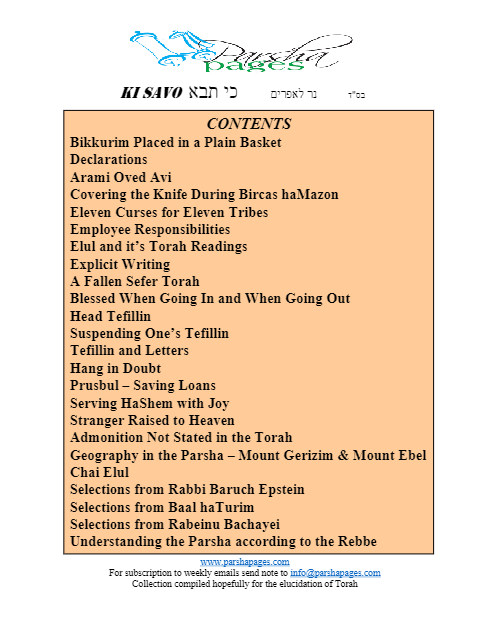
The Eleven Curses - Devarim 27,15 “cursed be the man who will construct a hewn image, etc.”

Among the eleven sins listed here, the sin of idolatry is mentioned first as it is equivalent to all other sins combined (Chulin 8). This is followed by the sin of belittling father or mother, seeing that G’d, father, and mother, are the three partners who between them produce another human being (Kidushin 30). This is why the Torah is insistent that all of these three be treated with honor and respect. The reason the Torah singled out these eleven sins from among all the others, is that they result in exile for the people if they become habitually guilty of these sins. Now that the people were about to enter the Holy Land, it was important for them to realize which sins, if committed knowingly, would result in their forfeiting the land.

According to the plain meaning of the text, the selection of these eleven sins was due to their being capable of being perpetrated without the sinner having to expose himself publicly and therefore facing either the court or the disapproval of his peers. The Torah started by listing the worst of these sins, a sin committed vis-a-vis one’s Creator only. It followed with sins which are perpetrated between man and his parents, not necessarily involving anyone else. Who would know if the son belittled his parents? Similarly, the sin of השגת גבול, making adjustments (illegal) to the boundary between one’s property and that of one’s neighbor, is one committed surreptitiously, not publicly. Misleading a blind person by causing him to go astray is also something which the person against whom the sin has been committed is unable to pinpoint and accuse the sinner of. Perverting the judgment of proselytes, orphans, or widows also belongs into this category as these people have no one who will take up their cause; the sinner expects to get away with what he does. Perverting justice is altogether something that is covered up by the one doing it. The various examples of illicit sexual relations are in the nature of something secretive seeing they are perpetrated between consenting adults, neither of which is liable to admit to having been involved in such acts. Moreover, the examples of which the Torah speaks here are the kind that no one would be suspected of in the first place, thus preserving the likelihood that it will go undetected except by G’d. The Torah lists sleeping with an animal, as the animal, if raped, cannot protest its treatment, so that in effect the deed has been committed in secret. The accepting of bribes is also, by definition, something secretive seeing that it is neither in the interest of the judge nor the litigant involved to publicize what he has done. Thus far Ibn Ezra.

A Midrashic approach to the above. The eleven sins listed here correspond to eleven virtues mentioned by King David in Psalms 15 as determining who is entitled to sojourn in G’d’s tent, i.e. Temple. Anyone residing outside the land of Israel is obligated to practice these virtues; they are the very opposite of the sins listed in our chapter here. When David demands that the person be הולך תמים, live without blame, this parallels the Torah’s demand in Deut. 18,13 תמים תהיה עם ה' אלוקיך, “you shall be wholehearted with the Lord your G’d.” David’s demand to be קפועל צד, “do what is right,” means he must not rob or steal anything belonging to his fellow. Our sages (Baba Batra 88) phrased it as “righteousness should emanate from you, you should give a little extra to your customer rather than a little less than called for by the scales.” This is the opposite of adjusting boundaries in one’s favor. The next stipulation of David, i.e. “speaking the truth in one’s heart,” means that one’s heart and one’s mouth, one’s pronouncements, should by in harmony with one another. This is the reverse of steering the blind person the wrong way, pretending to be helpful to him. The words לא רגל על לשונו, “his tongue is not given to evil,” is the opposite of “striking his fellow in secret” (verse 25). This is a form of slander, הולך רכיל. The words לא עשה לרעהו רעה, “he has not committed any harm to his fellow,” is the reverse of perverting justice, listed in our chapter in verse 20. The words וחרפה לא נשא על קרובו, “he has not brought shame on his relative,” mean that he has not perpetrated deeds which result in his relative becoming guilty of a sin, i.e. the reverse of the sexual acts described in our chapter. The words נבזה בעיניו נמאס “a contemptible man is abhorrent in his eyes,” mentioned by David (verse 4) as a qualification required to entitle one to be at home in the Temple, is the opposite of the sin of belittling one’s father and mother. The cause of such belittling is that one feels haughty and superior. Honoring those who are G’d-fearing, another prerequisite listed by David as part of the entrance fee to the Lord’s Sanctuary, is the reverse of belittling one’s parents. “Not having lent money to a fellow Jew and charging interest on it nor accepting a bribe against the innocent” (verse 5), is in stark contrast to the sin of spilling blood. People who take David’s moral/ethical demands to heart will be sure not to become shaky in their faith and fair conduct, ever.

PDF Preview