Singing My Sins
BET Journal | September 01, 2023
Print This Article
View Original PDF

Singing My Sins

BET Journal | December 31, 2025

I want to achieve an ambitious goal with this essay: I want to bring back confession to Judaism. People attribute confession to Catholicism; they think it is the job of the priests. I believe it is time to bring it back to our people. I am going to ask of each of my readers that during the following day you should make at least one confession.

Here is a story:

The Baal Shem Tov once visited a town in which the people complained that their chazzan behaved strangely. It seems that on Yom Kippur, he would chant the al chet, confession of sins, in a merry melody, rather than in a more appropriately somber tune. When questioned by the Baal Shem Tov, the chazzan explained:

"Rebbe, a king has many servants who serve him. Some of them prepare the royal meals, others serve the food, while others place the royal crown on the king’s head, and yet others are in charge of running the affairs of the country, etc. Each of them rejoices in his work and the privilege he has to serve and to be so close to the king.

“Now the palace also has a janitor, charged with the duty of removing the rubbish and filth from the palace. The janitor looks and deals with filth all day. He approaches it, gathers it, and removes it. Do you think that he should be depressed because he is looking at dirt all day? No! He is happy because he is also serving the king. He is removing the dirt from the king’s palace, ensuring that the palace is beautiful! It is not the dirt he is focused on, it is the King’s palace and its beauty.

“When a Jew sins, he amasses some dirt on his soul. When he is confessing his sins, it is not the sins, the guilt, the darkness, and the negativity, that he is focused on; it is the holiness and beauty of his soul. He is removing the layers of dirt that are eclipsing the soul; he is allowing his inner light to shine in its full glory. Is that not a reason to sing and rejoice?”

The Baal Shem Tov was deeply moved by this response because it captures one of his essential ideas. While other approaches in Jewish ethics focused often on the negativity of sin and its dire consequences in this world and even more in the next world, the Baal Shem Tov and the teachings of Chassidus focus primarily on the infinite holiness of every soul and heart.

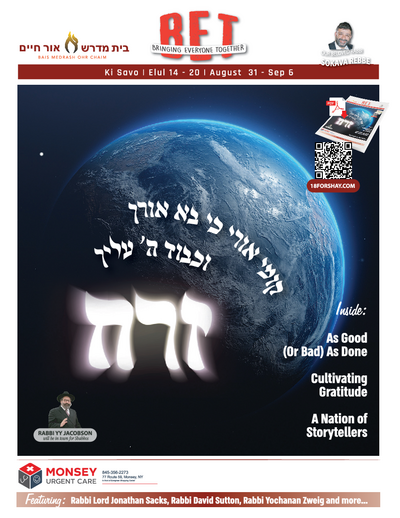
“Just as when you look at the earth you can never estimate how many treasures are hidden beneath its crust, so when you look at a Jew you can never estimate how many treasures lie beneath his or her crust,” the Baal Shem Tov once said.

This was one of the most important ideas of the Baal Shem Tov (1698-1760), whose birthday we celebrate on the 18th of Elul.

When you encounter a fellow Jew – and that includes yourself – who may have many a blemish, and committed many a sin and mistake, don’t tell him how bad he is; tell him how good he is and how good he can be; how much Hashem loves him and needs him, and then he automatically he will want to remove the clouds blacking his inner sunlight.

It is interesting, that even to this day today, in most Jewish communities, the confession is done with a melody: “Ashamanu, Bagadnu...” “Veal kulam Eloka Selechos...” Our confession of sins is inspired by the confession in Parshas Ki Savo.

An Exercise

I want each of you to make a confession today. Tell someone—your rabbi, your friend, your spouse—something very positive about yourself. One positive thing about your soul and your life. Something you are proud of. Not in an arrogant way, but as a “confession.” Because when you realize how good and capable you are, you might ask yourself the question, why I’m I not living up to my potential.

Rabbi YY Jacobson
I want to achieve an ambitious goal with this essay: I want to bring back confession to Judaism. People attribute confession to Catholicism; they think it is the job of the priests. I believe it is time to bring it back to our people. I am going to ask of each of my readers that during the following day you should make at least one confession.

Here is a story:

The Baal Shem Tov once visited a town in which the people complained that their chazzan behaved strangely. It seems that on Yom Kippur, he would chant the al chet, confession of sins, in a merry melody, rather than in a more appropriately somber tune. When questioned by the Baal Shem Tov, the chazzan explained:

"Rebbe, a king has many servants who serve him. Some of them prepare the royal meals, others serve the food, while others place the royal crown on the king’s head, and yet others are in charge of running the affairs of the country, etc. Each of them rejoices in his work and the privilege he has to serve and to be so close to the king.

“Now the palace also has a janitor, charged with the duty of removing the rubbish and filth from the palace. The janitor looks and deals with filth all day. He approaches it, gathers it, and removes it. Do you think that he should be depressed because he is looking at dirt all day? No! He is happy because he is also serving the king. He is removing the dirt from the king’s palace, ensuring that the palace is beautiful! It is not the dirt he is focused on, it is the King’s palace and its beauty.

“When a Jew sins, he amasses some dirt on his soul. When he is confessing his sins, it is not the sins, the guilt, the darkness, and the negativity, that he is focused on; it is the holiness and beauty of his soul. He is removing the layers of dirt that are eclipsing the soul; he is allowing his inner light to shine in its full glory. Is that not a reason to sing and rejoice?”

The Baal Shem Tov was deeply moved by this response because it captures one of his essential ideas. While other approaches in Jewish ethics focused often on the negativity of sin and its dire consequences in this world and even more in the next world, the Baal Shem Tov and the teachings of Chassidus focus primarily on the infinite holiness of every soul and heart.

“Just as when you look at the earth you can never estimate how many treasures are hidden beneath its crust, so when you look at a Jew you can never estimate how many treasures lie beneath his or her crust,” the Baal Shem Tov once said.

This was one of the most important ideas of the Baal Shem Tov (1698-1760), whose birthday we celebrate on the 18th of Elul.

When you encounter a fellow Jew – and that includes yourself – who may have many a blemish, and committed many a sin and mistake, don’t tell him how bad he is; tell him how good he is and how good he can be; how much Hashem loves him and needs him, and then he automatically he will want to remove the clouds blacking his inner sunlight.

It is interesting, that even to this day today, in most Jewish communities, the confession is done with a melody: “Ashamanu, Bagadnu...” “Veal kulam Eloka Selechos...” Our confession of sins is inspired by the confession in Parshas Ki Savo.

An Exercise

I want each of you to make a confession today. Tell someone—your rabbi, your friend, your spouse—something very positive about yourself. One positive thing about your soul and your life. Something you are proud of. Not in an arrogant way, but as a “confession.” Because when you realize how good and capable you are, you might ask yourself the question, why I’m I not living up to my potential.

Rabbi YY Jacobson

PDF Preview