ABSTRACT Likkutei Sichos
ABSTRACT לקוטי שיחות
- One needs to submit one’s own vitality to Kabalas Ol and yet imbue the Kabalas Ol with vitality
- Everyone must do teshuvah, which will light the way also for other Jews to do so
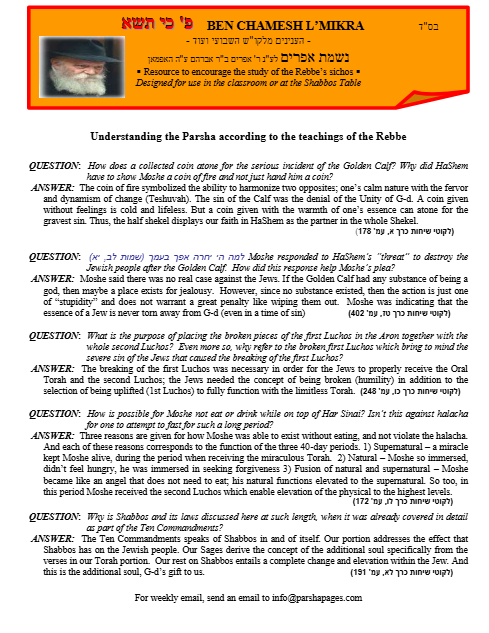
Coin of fire atones for the Calf; harmonize two opposing qualities (טבע – אש)
Sin of the Golden Calf was a denial of the Unity of HaShem; the half shekel affirms the unity; “coin of fire” shows one’s deeds need to be fired by the G-dly soul; & the “half” shekel shows one can not be alone, but needs unity with HaShem
Unity expressed in marriage of Jews and G-d; two halves of one whole
To build HaShem’s home we need to elevate even the lowest aspects
Moshe felt Tabernacle only to be a spiritually transparent act – totally pure & holy (not the Kiyor since it is reflective, not totally pure). G-d countered, a spiritually opaque act (mundane with good motives) is more precious and effective in G-d’s Desire to be found in the lowest of places
Not to be cruel to animals and even more so to humans
בחלב אמ ו initial concept of avoiding cruelty to animals; since 2nd time mentioned, expands to all animals and the rabbinical issur of fowl and milk
Through emunah and Kabalas Ol, which is most prevalent in women and children, one avoids disunity even in Torah
Aharon did not worship the Golden Calf, and thus, had no forbidden involvement with it at all. However, multiple views to Torah allows the possibility of the breaking of Unity, leading to the position from which the Golden Calf can occur
The 13 attributes bring the Shechina to dwell in the world
Moshe hurried and immediately bowed when HaShem first appeared, at the beginning of the revelation, and only “noise” alone was heard
To get another Jew to do a Mitzvah even though done as a “weight” משקלה without interest or passion, G-d shows that really it is a fiery coin and the inherent passion will be revealed
How did the half shekel (the fiery coin) atone? Rashi – use for the communal sacrifices, resulted in a collective atonement. Rambam – the donation itself is an atonement for the individual (as if an individual offering). By showing a fiery gold coin (and not silver), G-d indicated to Moshe that even the coin is given by “force” still reflects the fire of love of G-d