And He Gave to Moshe
מגדל אור | March 12, 2025
Print This Article
View Original PDF

And He Gave to Moshe

מגדל אור | June 27, 2025

“And He gave to Moshe, when He finished speaking to him on Mount Sinai, two tablets of testimony, tablets of stone, written with the finger of G-d. (Shmos 31:18)

The Torah tells us that on the day Moshe completed his forty days on the mountain, Hashem gave him the two stone tablets containing the Ten Commandments. The reason it wasn’t given before was because all the 613 commandments, which Moshe was given on Sinai in those forty days, are contained within the Ten Commandments. Until he'd learned all of them, it wasn’t correct to give Moshe the tablets, as he wouldn’t be able to appreciate their depth and what they represented.

The very next verse tells us that the Jews noticed Moshe was late in coming down, and they ganged up on Aharon, demanding that he make them a “god,” for they didn’t know what had happened to Moshe. The sin of the Golden Calf ensued, which almost spelled total disaster for the Jews, and we are still suffering from it today.

The original luchos, say Chazal, would have made it impossible for any of us to forget the Torah. There would have been a concrete (so-to-speak) proof that Hashem was with us, and the tablets would have outlived Moshe or any mortal, so they would be an eternal sign. Alas, it was not to be because (some of) the Jews were impatient and anxious.

Instead, the tablets were broken. So what do we have as proof that Hashem is in our midst? For that, we have to go back another verse or two. The pesukim just before mention of the tablets spoke of Shabbos. There, Hashem tells Moshe to convey to the Jews that building the Mishkan doesn’t override Shabbos, because Shabbos is a perpetual sign between Hashem and the Jews that He is the G-d Who sanctifies us.

Now, the proof of Hashem’s presence in our lives would not be the external, physical manifestation of the stone tablets. Rather, it would be something much more powerful. It would be an internal understanding, born of faith and working on our service of Hashem. We can only truly know Hashem from within our minds and hearts, and our job is to build that sanctuary within ourselves, where Hashem can dwell eternally.

Had the Jews been able to wait, to not lose faith, by strengthening themselves and finding explanations for Moshe’s delay, they would have mastered the internalization of Hashem’s eternity and presence, and been able to have an external sign for all to see. Because they were not able to do this, Hashem left them no choice but to focus on Him, and use things like Shabbos to cement their relationship with Him. The second tablets were hewn by human hands, a sign that it was up to us.

At the time of Purim, we likewise put all our faith in Hashem, and He saved us. It all looked so natural, though, because Hashem entrusts us with making the connection that is permanent, and He will respond to that which we do.

The students of R’ Chaim Brisker asked him to tell them, “Purim Torah,” a sort of whimsical, humorous Torah lecture, and he agreed. As the students gathered around, R’ Chaim began.

He quoted a Rambam, then compared it to a different quote from the Rambam which seemed to contradict it. For the next forty-five minutes, he wove a powerful shiur with proofs and sources from all over the Talmud, rebutted many of them, and finally ended with a single, brilliant explanation. The students were stunned by the intricacy of his lecture, but wondered about it. “Rebbi,” they said. “We asked you to say Purim Torah.”

“That was Purim Torah,” he smiled. “The second Rambam I quoted doesn’t exist!”

©2025 – J. Gewirtz
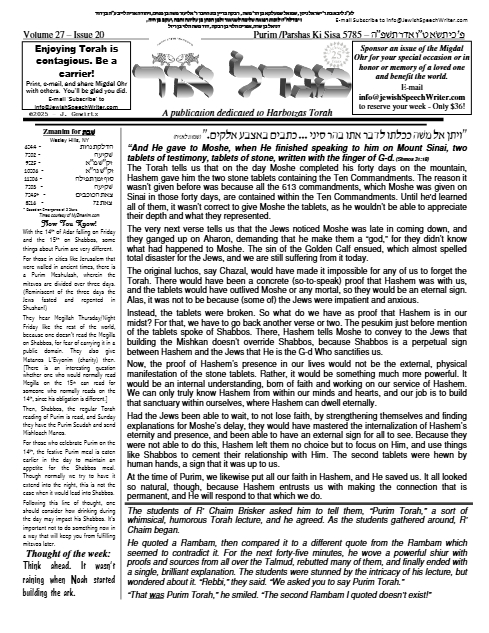
“And He gave to Moshe, when He finished speaking to him on Mount Sinai, two tablets of testimony, tablets of stone, written with the finger of G-d. (Shmos 31:18)

The Torah tells us that on the day Moshe completed his forty days on the mountain, Hashem gave him the two stone tablets containing the Ten Commandments. The reason it wasn’t given before was because all the 613 commandments, which Moshe was given on Sinai in those forty days, are contained within the Ten Commandments. Until he'd learned all of them, it wasn’t correct to give Moshe the tablets, as he wouldn’t be able to appreciate their depth and what they represented.

The very next verse tells us that the Jews noticed Moshe was late in coming down, and they ganged up on Aharon, demanding that he make them a “god,” for they didn’t know what had happened to Moshe. The sin of the Golden Calf ensued, which almost spelled total disaster for the Jews, and we are still suffering from it today.

The original luchos, say Chazal, would have made it impossible for any of us to forget the Torah. There would have been a concrete (so-to-speak) proof that Hashem was with us, and the tablets would have outlived Moshe or any mortal, so they would be an eternal sign. Alas, it was not to be because (some of) the Jews were impatient and anxious.

Instead, the tablets were broken. So what do we have as proof that Hashem is in our midst? For that, we have to go back another verse or two. The pesukim just before mention of the tablets spoke of Shabbos. There, Hashem tells Moshe to convey to the Jews that building the Mishkan doesn’t override Shabbos, because Shabbos is a perpetual sign between Hashem and the Jews that He is the G-d Who sanctifies us.

Now, the proof of Hashem’s presence in our lives would not be the external, physical manifestation of the stone tablets. Rather, it would be something much more powerful. It would be an internal understanding, born of faith and working on our service of Hashem. We can only truly know Hashem from within our minds and hearts, and our job is to build that sanctuary within ourselves, where Hashem can dwell eternally.

Had the Jews been able to wait, to not lose faith, by strengthening themselves and finding explanations for Moshe’s delay, they would have mastered the internalization of Hashem’s eternity and presence, and been able to have an external sign for all to see. Because they were not able to do this, Hashem left them no choice but to focus on Him, and use things like Shabbos to cement their relationship with Him. The second tablets were hewn by human hands, a sign that it was up to us.

At the time of Purim, we likewise put all our faith in Hashem, and He saved us. It all looked so natural, though, because Hashem entrusts us with making the connection that is permanent, and He will respond to that which we do.

The students of R’ Chaim Brisker asked him to tell them, “Purim Torah,” a sort of whimsical, humorous Torah lecture, and he agreed. As the students gathered around, R’ Chaim began.

He quoted a Rambam, then compared it to a different quote from the Rambam which seemed to contradict it. For the next forty-five minutes, he wove a powerful shiur with proofs and sources from all over the Talmud, rebutted many of them, and finally ended with a single, brilliant explanation. The students were stunned by the intricacy of his lecture, but wondered about it. “Rebbi,” they said. “We asked you to say Purim Torah.”

“That was Purim Torah,” he smiled. “The second Rambam I quoted doesn’t exist!”

©2025 – J. Gewirtz

PDF Preview