Chillul Shabbos to Avoid Giving a Heart Attack
Limuday Moshe | February 29, 2024
Print This Article
View Original PDF

Chillul Shabbos to Avoid Giving a Heart Attack

Limuday Moshe | December 10, 2025

Rav Shlomah Zalman Auerbach presents an interesting discussion (Minchas Shlomah 1:7): A factory is engulfed in flames, and while not endangering anyone directly, the owner is at risk of getting a heart attack from the loss. Is extinguishing the flames permitted? Could extinguishing a fire be permitted on Shabbos so the owner doesn’t die from heartache? The Aderes mentions an actual case which resulted in death (Over Orach 334): Rav A. Charlap was a rabbi in Bialystk who died of heartbreak after his chiddushei Torah, which had not yet been printed, were consumed by a fire on Shabbos.

The Shemiras Shabbos Kehilchosah adds to the question (41:8): When delivering bad news, the laws of pikuach nefesh require the presence of a doctor and social worker to ensure the news is divulged properly. If that’s the case, why can’t we simply do what it takes (like calling the fire department) to prevent the disaster (where there is no direct risk to human life) in the first place?

Rav Shlomah Zalman Auerbach answers: In regard to finances, one must trust Hashem and strengthen his emunah. A heart attack suffered due to lost possessions is equal to committing suicide. Since the loss did not kill its bereft owner, extinguishing the fire does not fall in the category of pikuach nefesh. This is similar to other Torah-mandated procedures which cause people discomfort (e.g. putting a sinner to death; requiring a thief to repay his theft) for which we do not take into consideration adverse side effects (such as the widow or parents dying from shame).

To make this point clearer let us take a look at a real-life example: Beis Din rules that a respondent owes a million dollars to his claimant. Halachically, the claimant is permitted to demand his money, even though people who lose a lot of money often suffer heart attacks. Once, Rav Pinchas Epstein ruled a that Yerushalayma widow owed a large sum of money to someone else. The widow, not wanting to lose her money, countered that if they actually took the money, she would die of a heart attack. The Rav, who wanted to make a point, told her that a Dayan is prohibited from taking such claims into consideration. “Indeed,” he answered, “Chazal said: ‘Better die innocent rather than guilty”.

To summarize this point: we are certainly required to make every effort, both financially and emotionally, to support our fellow Jews. One who decides to waive a debt because of the detrimental effect it could have on his debtor will certainly be rewarded in this world and the next, but no such halachic obligation exists.

Demanding payment is permitted, despite the indirect effects that might result from it — whether it is a heart attack, depression, etc. Hilchos Shabbos, just like a Din Torah, does not take into consideration indirect risks to permit Shabbos desecration.

The Chazon Ish adds that considering indirect results for Shabbos desecration is a very slippery slope. Almost anything might eventually result in possibility of life-threatening danger, and all the mitzvos can be negated under this umbrella, if the halachos of pikuach nefesh are misapplied.
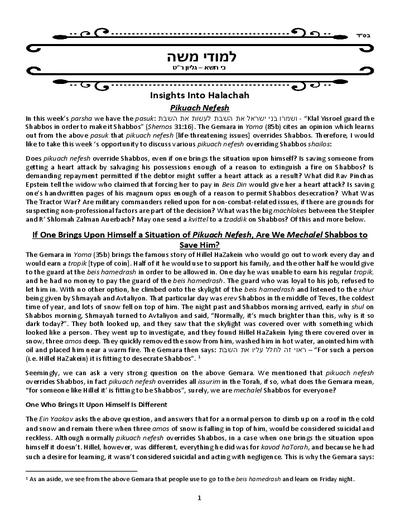

Rav Shlomah Zalman Auerbach presents an interesting discussion (Minchas Shlomah 1:7): A factory is engulfed in flames, and while not endangering anyone directly, the owner is at risk of getting a heart attack from the loss. Is extinguishing the flames permitted? Could extinguishing a fire be permitted on Shabbos so the owner doesn’t die from heartache? The Aderes mentions an actual case which resulted in death (Over Orach 334): Rav A. Charlap was a rabbi in Bialystk who died of heartbreak after his chiddushei Torah, which had not yet been printed, were consumed by a fire on Shabbos.

The Shemiras Shabbos Kehilchosah adds to the question (41:8): When delivering bad news, the laws of pikuach nefesh require the presence of a doctor and social worker to ensure the news is divulged properly. If that’s the case, why can’t we simply do what it takes (like calling the fire department) to prevent the disaster (where there is no direct risk to human life) in the first place?

Rav Shlomah Zalman Auerbach answers: In regard to finances, one must trust Hashem and strengthen his emunah. A heart attack suffered due to lost possessions is equal to committing suicide. Since the loss did not kill its bereft owner, extinguishing the fire does not fall in the category of pikuach nefesh. This is similar to other Torah-mandated procedures which cause people discomfort (e.g. putting a sinner to death; requiring a thief to repay his theft) for which we do not take into consideration adverse side effects (such as the widow or parents dying from shame).

To make this point clearer let us take a look at a real-life example: Beis Din rules that a respondent owes a million dollars to his claimant. Halachically, the claimant is permitted to demand his money, even though people who lose a lot of money often suffer heart attacks. Once, Rav Pinchas Epstein ruled a that Yerushalayma widow owed a large sum of money to someone else. The widow, not wanting to lose her money, countered that if they actually took the money, she would die of a heart attack. The Rav, who wanted to make a point, told her that a Dayan is prohibited from taking such claims into consideration. “Indeed,” he answered, “Chazal said: ‘Better die innocent rather than guilty”.

To summarize this point: we are certainly required to make every effort, both financially and emotionally, to support our fellow Jews. One who decides to waive a debt because of the detrimental effect it could have on his debtor will certainly be rewarded in this world and the next, but no such halachic obligation exists.

Demanding payment is permitted, despite the indirect effects that might result from it — whether it is a heart attack, depression, etc. Hilchos Shabbos, just like a Din Torah, does not take into consideration indirect risks to permit Shabbos desecration.

The Chazon Ish adds that considering indirect results for Shabbos desecration is a very slippery slope. Almost anything might eventually result in possibility of life-threatening danger, and all the mitzvos can be negated under this umbrella, if the halachos of pikuach nefesh are misapplied.

PDF Preview