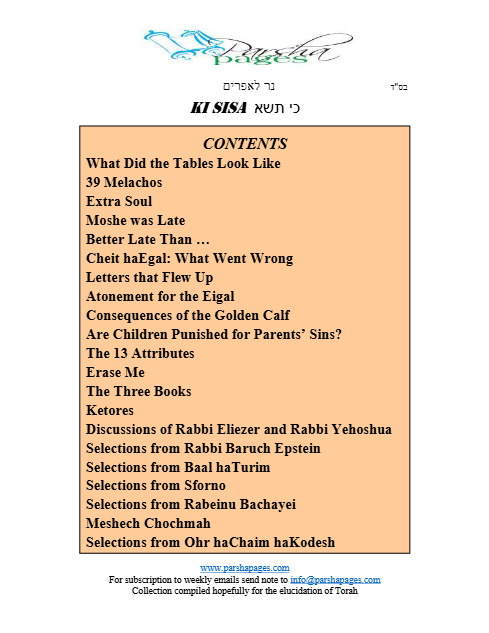
Erase Me
Parsha Pages | March 12, 2025
Print This Article
View Original PDF

Erase Me

Parsha Pages | June 27, 2025

שמות לב, לב וְׁעַתָה אִּם־תִּשָא חַטָאתָם וְׁאִּם־אַיִּן מְׁחֵּנִּי נָא מִּסִּפְׁרְׁ ךָ אֲשֶר כָתָבְׁתָ:

When Moshe told HaShem if You do not forgive the Jewish people that You erase me from your Sefer, the Medrash states that Moshe was answered on the dispute with Korach. What is the connection?

1. Avnei Nezer stated this was a huge item (as he emphasized on banging on the table). Moshe offered to be taken from the world and this was like a thin string between existence and non-existence. However, according to the Ariza”l Moshe had advanced from level to level (and not all at once). Therefore, Moshe now reached the highest level and offered to lose both worlds (this world and the future world) G-d forbid. Moshe was telling HaShem (per Chaza”l) better to lose a thousand Moshes than destroy the Jewish people. Thus, Moshe had the moral ability to later tell HaShem that Korach should be destroyed from the world as a result of their dispute.

2. Pardes Yosef discusses first another Medrash that Moshe’s face shined since he wiped his head with the left over ink from the ink well provided by Hashem to write the Second Luchos (or the entire Sefer Torah). How is it possible that there should be left-over ink, since HaShem would know the exact amount to be needed for Moshe to use? However, after Moshe said to erase him from HaShem’s sefer, to fulfill to some degree the words of a Tzadik, Moshe’s name was removed from Parsha Tetzaveh. Thus, the left-over ink (from not writing the name of Moshe) was used as a reward to Moshe for his selfless defense of the Jewish people. Why did this occur after the Second Luchos and not the first Luchos? After the first Luchos, all the Jews were true believers for they had seen the miracles in Egypt, and at the Sea, and more at the Giving of the Torah. They did not need any signs to be assured of the greatness of Moshe and his connection to HaShem. However, after the big sin and the removal of the Divine Presence (to some extent) the people needed the additional step to believe in Moshe and his connection to HaShem, which was provided by the radiance from his face. Later when Korach delivered his dispute that everyone was equally able to lead disputing the prophecy of Moshe, all were able to see the evidence as clear as the light from the face of Moshe.

3. Chidushei haRim asks since Moshe was mesiras nefesh on behalf of the Jewish people how is it possible that he was “punished” by the removal of his name from Parshas Tetzaveh. Rather, since Moshe was mesiras nefesh he achieved a higher level where he became one with the Torah. This concept is displayed in multiple means. First, he is not named in Parshas Tetzvah because this reflected his complete connection with the Torah (that he was called “you” אתה ). Second, we refer to the Torah as Toras Moshe. And third, Moshe and the later leaders in every generation (a bit of Moshe in each) added fences and protection to the Torah (like Muktzah and Yichud) and mitzvos (like Chanukah and Purim) which the Jews needed to observe as a part of the Torah itself. Therefore, when later Korach disputed and said that Moshe said words that were not from HaShem, Moshe already had the authority and ability to answer these charges.

4. The Chida cites the holy Zohar which says that Moshe was ready to give away his olam hazeh and olam habah for the atonement of the bnei Yisroel. Noach, however, did not pray for the forgiveness of the sinners in his generation. The Ari z'l expands that Noach's not beseeching Hashem for forgiveness for the sinners of his generation caused the Prophet Yeshayohu to attribute the great deluge to Noach, calling it "MEI NOACH" (Yeshayohu 54:9). On the other hand, Moshe's highest level of self-negation was likely his statement of "Mecheini noh." He was ready to have his name erased from the Torah, a colossal spiritual loss, for the purpose of attaining atonement for the bnei Yisrael. His selflessness was a correction for the self-concern of Noach, as mentioned in the above Zohar, who says that upon hearing of the great deluge, Noach asked, "What will be of me?" Moshe's "MeCHeiNI" was a tikkun for "Mei Noach," both containing the same letters, Mem-Ches-Yud-Nun. The same tikkun Moshe (the gilgul of Hevel whose blood were swallowed by the earth) applied in the events of Korach (who was the gilgul of Kayin now that he was swallowed by the earth).

שמות לב, לב וְׁעַתָה אִּם־תִּשָא חַטָאתָם וְׁאִּם־אַיִּן מְׁחֵּנִּי נָא מִּסִּפְׁרְׁ ךָ אֲשֶר כָתָבְׁתָ:

When Moshe told HaShem if You do not forgive the Jewish people that You erase me from your Sefer, the Medrash states that Moshe was answered on the dispute with Korach. What is the connection?

1. Avnei Nezer stated this was a huge item (as he emphasized on banging on the table). Moshe offered to be taken from the world and this was like a thin string between existence and non-existence. However, according to the Ariza”l Moshe had advanced from level to level (and not all at once). Therefore, Moshe now reached the highest level and offered to lose both worlds (this world and the future world) G-d forbid. Moshe was telling HaShem (per Chaza”l) better to lose a thousand Moshes than destroy the Jewish people. Thus, Moshe had the moral ability to later tell HaShem that Korach should be destroyed from the world as a result of their dispute.

2. Pardes Yosef discusses first another Medrash that Moshe’s face shined since he wiped his head with the left over ink from the ink well provided by Hashem to write the Second Luchos (or the entire Sefer Torah). How is it possible that there should be left-over ink, since HaShem would know the exact amount to be needed for Moshe to use? However, after Moshe said to erase him from HaShem’s sefer, to fulfill to some degree the words of a Tzadik, Moshe’s name was removed from Parsha Tetzaveh. Thus, the left-over ink (from not writing the name of Moshe) was used as a reward to Moshe for his selfless defense of the Jewish people. Why did this occur after the Second Luchos and not the first Luchos? After the first Luchos, all the Jews were true believers for they had seen the miracles in Egypt, and at the Sea, and more at the Giving of the Torah. They did not need any signs to be assured of the greatness of Moshe and his connection to HaShem. However, after the big sin and the removal of the Divine Presence (to some extent) the people needed the additional step to believe in Moshe and his connection to HaShem, which was provided by the radiance from his face. Later when Korach delivered his dispute that everyone was equally able to lead disputing the prophecy of Moshe, all were able to see the evidence as clear as the light from the face of Moshe.

3. Chidushei haRim asks since Moshe was mesiras nefesh on behalf of the Jewish people how is it possible that he was “punished” by the removal of his name from Parshas Tetzaveh. Rather, since Moshe was mesiras nefesh he achieved a higher level where he became one with the Torah. This concept is displayed in multiple means. First, he is not named in Parshas Tetzvah because this reflected his complete connection with the Torah (that he was called “you” אתה ). Second, we refer to the Torah as Toras Moshe. And third, Moshe and the later leaders in every generation (a bit of Moshe in each) added fences and protection to the Torah (like Muktzah and Yichud) and mitzvos (like Chanukah and Purim) which the Jews needed to observe as a part of the Torah itself. Therefore, when later Korach disputed and said that Moshe said words that were not from HaShem, Moshe already had the authority and ability to answer these charges.

4. The Chida cites the holy Zohar which says that Moshe was ready to give away his olam hazeh and olam habah for the atonement of the bnei Yisroel. Noach, however, did not pray for the forgiveness of the sinners in his generation. The Ari z'l expands that Noach's not beseeching Hashem for forgiveness for the sinners of his generation caused the Prophet Yeshayohu to attribute the great deluge to Noach, calling it "MEI NOACH" (Yeshayohu 54:9). On the other hand, Moshe's highest level of self-negation was likely his statement of "Mecheini noh." He was ready to have his name erased from the Torah, a colossal spiritual loss, for the purpose of attaining atonement for the bnei Yisrael. His selflessness was a correction for the self-concern of Noach, as mentioned in the above Zohar, who says that upon hearing of the great deluge, Noach asked, "What will be of me?" Moshe's "MeCHeiNI" was a tikkun for "Mei Noach," both containing the same letters, Mem-Ches-Yud-Nun. The same tikkun Moshe (the gilgul of Hevel whose blood were swallowed by the earth) applied in the events of Korach (who was the gilgul of Kayin now that he was swallowed by the earth).

PDF Preview