Moshe’s Perspective on Holiness and Temptation
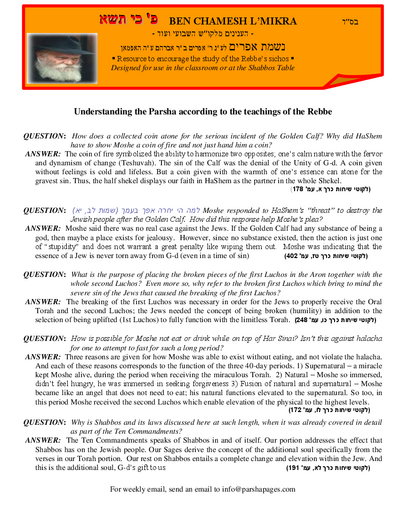
Moshe despised them
Moshe did not want G-dliness to be expressed also in negativity, he desired that there shouldn’t be negativity at all.
Moshe’s wish was to uplift the Israelites to a level as they were prior to when they had sinned with the Golden Calf, and that they should be similar to way the world stood prior to the sin of the Tree of Knowledge. In such a reality, G-dliness was not expressed even in temptation, as there was no temptation to speak of.
Text 13
Before [the sin] they were naked and occupied in copulation to have children yet they were not ashamed, just as [they were not ashamed] to eat or drink. [They were occupied in it] as it was a mitzvah and they did not know that there was any temptation in it. After they sinned though, and ate from the Tree of Knowledge and they knew temptation, then it is difficult to abstain from it. It was for this reason that G-d did not wish that man should eat from the Tree of Knowledge, because it is damaging, as mentioned. [G-d] wished that they would not know at all of the existence of evil and [wished that he should be] entirely holy.
Torah Ohr, 5:4b
Moshe wished to bring them back to this reality, where holiness is completely separate from temptation. He did not wish that they should use negativity for a holy purpose, he wished that temptation cease to exist.
Moshe wished this from the Jewish people, as this was similar to the way that he himself experienced G-dliness.
Text 14
Moshe prophesied with, “So says the Lord, 'At the dividing point of the night... ’”, and the prophets prophesied with [the phrase] “So says the Lord.” But Moshe surpassed them, for he prophesied with the expression, “This is the thing.”
Rashi, Bamidbar, 30:2
The difference between “So says the Lord” and “This is the thing,” is that the other prophets did not see G-dliness clearly and they were therefore only able to say “so”. Moshe however, experienced G-dliness directly and therefore said “this is the thing” that G-d said.
Moshe experienced a revelation of G-dliness in a direct way, and he desired that the Israelites experience G-dliness in the same manner.
It is for this reason that Moshe despised the mirrors that the women bequeathed to the Mishkan. These mirrors served the purpose of temptation. No matter how refined they may become, they remain a tool of the animal soul. They remain a means to a positive end, but they are not the end itself.
Although Moshe knew that the purpose of the Mishkan was that G-dliness should reside in the lowest of places, on the level in which Moshe stood, the other physical objects in the Mishkan were sufficiently low. He desired that G-dliness should reside in the lower abode in the same manner as it would have were man never to have sinned.
In his perspective, the copper donated for the mirrors would bring this holiness extremely low. Using these mirrors in the Mishkan expresses that G-dliness is not directly expressed but is instead expressed through an intermediary. Moshe therefore despised their use in the Mishkan.