No Justification
זכרון יעקב | March 01, 2024
Print This Article
View Original PDF

No Justification

זכרון יעקב | December 10, 2025

AVROHOM YAAKOV

“Now Moshe turned and went down from the mountain [bearing] the two tablets of the testimony in his hand, tablets inscribed from both their sides; on one side and on the other side they were inscribed.” (32:15)

Rashi explains, based on the Talmud (Shabbos 104a, Megillah 2b), that the letters on the Tablets could be read from any direction.

The story is told of a Jew who had hit financially rocky times and approached a Rebbe for advice.

Since times were tough and the situation was dire, would it be possible to dabble in activities that could generate funds which were not quite kosher?

The Rebbe quoted the above posuk and Rashi that the words on the Tablets could be read equally in any direction and the reason why this was so was because irrespective of the situation or motivation, you still cannot commit a crime.

Unfortunately, we all find ourselves in situations where we are ‘moreh heter’, we justify our actions because of the uniqueness of the situation (at least in our minds). While this often relates to money and parnossoh, it can involve anything. We know what we are doing is pushing the envelope, but ‘under the circumstances ...’

In a macro sense the world operates in a similar manner. People know right from wrong, good from evil, long term benefit versus short term gain, and yet they make decisions based on perceived short term solutions or benefits.

Or as is more common, if the cause is seen as righteous, any means can be employed to achieve that goal. Even mass murder and brutalisation. The end justifies the means.

However the Torah is clear – the Tablets were written such that whichever way you slice or dice it, you cannot steal, and you cannot commit murder. Nothing justifies activities that are evil or criminal.
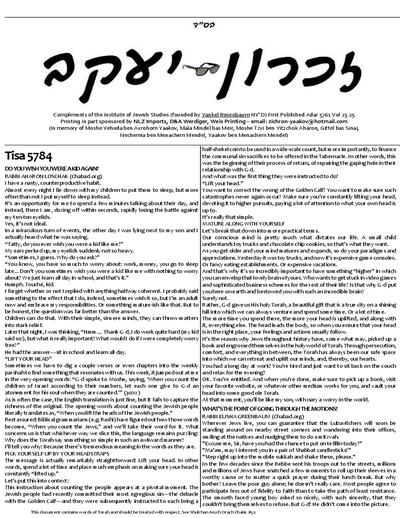
AVROHOM YAAKOV

“Now Moshe turned and went down from the mountain [bearing] the two tablets of the testimony in his hand, tablets inscribed from both their sides; on one side and on the other side they were inscribed.” (32:15)

Rashi explains, based on the Talmud (Shabbos 104a, Megillah 2b), that the letters on the Tablets could be read from any direction.

The story is told of a Jew who had hit financially rocky times and approached a Rebbe for advice.

Since times were tough and the situation was dire, would it be possible to dabble in activities that could generate funds which were not quite kosher?

The Rebbe quoted the above posuk and Rashi that the words on the Tablets could be read equally in any direction and the reason why this was so was because irrespective of the situation or motivation, you still cannot commit a crime.

Unfortunately, we all find ourselves in situations where we are ‘moreh heter’, we justify our actions because of the uniqueness of the situation (at least in our minds). While this often relates to money and parnossoh, it can involve anything. We know what we are doing is pushing the envelope, but ‘under the circumstances ...’

In a macro sense the world operates in a similar manner. People know right from wrong, good from evil, long term benefit versus short term gain, and yet they make decisions based on perceived short term solutions or benefits.

Or as is more common, if the cause is seen as righteous, any means can be employed to achieve that goal. Even mass murder and brutalisation. The end justifies the means.

However the Torah is clear – the Tablets were written such that whichever way you slice or dice it, you cannot steal, and you cannot commit murder. Nothing justifies activities that are evil or criminal.

PDF Preview