Pikuach Nefesh
Limuday Moshe | February 29, 2024
Print This Article
View Original PDF

Pikuach Nefesh

Limuday Moshe | December 10, 2025

In this week’s parsha we have the pasuk:ושמרו בני ישראל את השבת לעשות את השבת - “Klal Yisroel guard the Shabbos in order to make it Shabbos” (Shemos 31:16). The Gemara in Yoma (85b) cites an opinion which learns out from the above pasuk that pikuach nefesh [life-threatening issues] overrides Shabbos. Therefore, I would like to take this week ‘s opportunity to discuss various pikuach nefesh overriding Shabbos shailos:

Does pikuach nefesh override Shabbos, even if one brings the situation upon himself? Is saving someone from getting a heart attack by salvaging his possessions enough of a reason to extinguish a fire on Shabbos? Is demanding repayment permitted if the debtor might suffer a heart attack as a result? What did Rav Pinchas Epstein tell the widow who claimed that forcing her to pay in Beis Din would give her a heart attack? Is saving one’s handwritten pages of his magnum opus enough of a reason to permit Shabbos desecration? What Was The Tractor War? Are military commanders relied upon for non-combat-related issues, if there are grounds for suspecting non-professional factors are part of the decision? What was the big machlokes between the Steipler and R’ Shlomah Zalman Auerbach? May one send a kvittel to a tzaddik on Shabbos? Of this and more below.

If One Brings Upon Himself a Situation of Pikuach Nefesh, Are We Mechalel Shabbos to Save Him?

The Gemara in Yoma (35b) brings the famous story of Hillel HaZakein who would go out to work every day and would earn a tropik [type of coin]. Half of it he would use to support his family, and the other half he would give to the guard at the beis hamedrash in order to be allowed in. One day he was unable to earn his regular tropik, and he had no money to pay the guard of the beis hamedrash. The guard who was loyal to his job, refused to let him in. With no other option, he climbed onto the skylight of the beis hamedrash and listened to the shiur being given by Shmayah and Avtaliyon. That particular day was erev Shabbos in the middle of Teves, the coldest time of year, and lots of snow fell on top of him. The night past and Shabbos morning arrived, early in shul on Shabbos morning, Shmayah turned to Avtaliyon and said, “Normally, it’s much brighter than this, why is it so dark today?”. They both looked up, and they saw that the skylight was covered over with something which looked like a person. They went up to investigate, and they found Hillel HaZakein lying there covered over in snow, three amos deep. They quickly removed the snow from him, washed him in hot water, anointed him with oil and placed him near a warm fire. The Gemara then says: ראוי זה לחלל עליו את השבת – “For such a person (i.e. Hillel HaZakein) it is fitting to desecrate Shabbos”.

Seemingly, we can ask a very strong question on the above Gemara. We mentioned that pikuach nefesh overrides Shabbos, in fact pikuach nefesh overrides all issurim in the Torah, if so, what does the Gemara mean, “for someone like Hillel it’ is fitting to be Shabbos”, surely, we are mechalel Shabbos for everyone?

One Who Brings It Upon Himself Is Different

The Ein Yaakov asks the above question, and answers that for a normal person to climb up on a roof in the cold and snow and remain there when three amos of snow is falling in top of him, would be considered suicidal and reckless. Although normally pikuach nefesh overrides Shabbos, in a case when one brings the situation upon himself it doesn’t. Hillel, however, was different, everything he did was for kavod haTorah, and because he had such a desire for learning, it wasn’t considered suicidal and acting with negligence. This is why the Gemara says:

“For such a person it is fitting to desecrate Shabbos”, as only for someone like Hillel are we mechalel Shabbos in such a case. If a normal person would do such a thing, we wouldn’t be mechalel Shabbos, as it is suicidal to do such a thing, and if one acts suicidally, we aren’t mechalel Shabbos to save him.

R’ Shlomah Kluger in his Chochmas Shlomah (Orach Chaim 329) concurs with the above, and writes that if one brings the circumstances of pikuach nefesh upon himself, we aren’t mechalel Shabbos to try and save him (see also Minchas Chinuch 237).

Most Poskim Disagree

However, most poskim argue on the above. The Yeshuas Yisroel (Choshen Mishpot 21) writes clearly that we are mechalel Shabbos to save someone from a situation of pikuach nefesh, even if he brought it upon himself.

The Yeshuas Yisroel cites a seemingly strong rayah [proof] to his position. The Gemara in Sanhedrin (72b) teaches: If one tunnels into another person’s house on Shabbos, and the building collapses on him, even though it’s his fault we rescue him. There is no bigger negligence than the above case – the ganav [burglar] dug a tunnel on Shabbos whilst trying to steal, yet we save him. We see that even if one brings the danger upon himself, we are still mechalel Shabbos and we do our best to try and save him.

However, perhaps we can refute this proof, as perhaps just like we said by Hillel HaZakein that he had such desire to learn and because of this great desire it wasn’t considered negligence, perhaps the same thing is the other way round. This ganav had such a teivah for money, and he couldn’t hold himself back from stealing, therefore, it’s not really his fault and he isn’t considered negligent.

Similarly, the Klei Chemda (Ki Seitzei 190) writes, that even if one was negligent, we are mechalel Shabbos to save him. One of the mekoras [sources] from which we learn that pikuach nefesh overrides Shabbos is the pasuk: וחי בהם – “you shall live by them”, Chazal darshen: “The Torah is given to live by, not to die by”. Therefore, says the Klei Chemda, as long as one still wants to live, we are mechalel Shabbos to save him, even if he brought the dangerous situation upon himself.

R’ Moshe (Igros Moshe, Orach Chaim 1:127) also writes, that even if one brings the danger upon himself, we are still mechalel Shabbos to save him.

How Do These Poskim Explain the Gemara in Yoma?

The poskim who learn that we are mechalel Shabbos even for one who brings the danger upon himself, have to learn the Gemara in Yoma differently. I have seen various alternative peshotim, we will mention one:

The Ein Eliyohu explains: That by a regular person, if we would see that three amos of snow had fallen on top of him, we could safely assume that he is long dead, and there would be no point trying to save him. However, someone like Hillel HaZakein who was moser nefesh for Torah, for such a person the snow is: שלג מן השמים – “Snow from Shomayim”. Snow from Shomayim is a good type of snow and is abundant with berachah, unlike snow from the ground which comes with klolah [curse]. Since the snow that fell on Hillel HaZakein was “Snow from Shomayim”, there was still a good chance that he was alive, therefore it was fitting to be mechalel Shabbos to try and save him.

Proof from the Chida

Some want to prove that we are mechalel Shabbos even if one brings the danger upon himself from a Chida. The Chida in Birkay Yosef (Orach Chaim 301:6) was asked, if one is allowed to be mechalel Shabbos to save a girl who swallowed poison. If, in cases of negligence we aren’t mechalel Shabbos, what is the shailah, obviously one isn’t allowed to? We see, that even in cases of negligence we are mechalel Shabbos. (See Klei Chemda, Ki Seitzei)

However, the Shu”t Divrei Yatziv (Orach Chaim 167:9) writes, that the above is no proof, as who said the case was that the girl drank poison on her own accord, perhaps we are talking about a case where she was tricked, or someone forced her to drink it.

Conclusion

Although a number of poskim maintain that we aren’t mechalel Shabbos in a case when one brings the danger upon himself, most poskim disagree. Therefore, if one is ever faced with such a case, he should be mechalel Shabbos without hesitation and should do all he can to help save the person. Doing so is a mitzvah, and no questions should be asked. Of this we are told – “he who asks is considered having shed blood.”
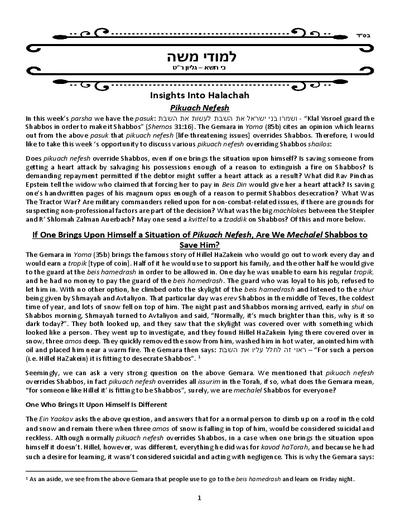

In this week’s parsha we have the pasuk:ושמרו בני ישראל את השבת לעשות את השבת - “Klal Yisroel guard the Shabbos in order to make it Shabbos” (Shemos 31:16). The Gemara in Yoma (85b) cites an opinion which learns out from the above pasuk that pikuach nefesh [life-threatening issues] overrides Shabbos. Therefore, I would like to take this week ‘s opportunity to discuss various pikuach nefesh overriding Shabbos shailos:

Does pikuach nefesh override Shabbos, even if one brings the situation upon himself? Is saving someone from getting a heart attack by salvaging his possessions enough of a reason to extinguish a fire on Shabbos? Is demanding repayment permitted if the debtor might suffer a heart attack as a result? What did Rav Pinchas Epstein tell the widow who claimed that forcing her to pay in Beis Din would give her a heart attack? Is saving one’s handwritten pages of his magnum opus enough of a reason to permit Shabbos desecration? What Was The Tractor War? Are military commanders relied upon for non-combat-related issues, if there are grounds for suspecting non-professional factors are part of the decision? What was the big machlokes between the Steipler and R’ Shlomah Zalman Auerbach? May one send a kvittel to a tzaddik on Shabbos? Of this and more below.

If One Brings Upon Himself a Situation of Pikuach Nefesh, Are We Mechalel Shabbos to Save Him?

The Gemara in Yoma (35b) brings the famous story of Hillel HaZakein who would go out to work every day and would earn a tropik [type of coin]. Half of it he would use to support his family, and the other half he would give to the guard at the beis hamedrash in order to be allowed in. One day he was unable to earn his regular tropik, and he had no money to pay the guard of the beis hamedrash. The guard who was loyal to his job, refused to let him in. With no other option, he climbed onto the skylight of the beis hamedrash and listened to the shiur being given by Shmayah and Avtaliyon. That particular day was erev Shabbos in the middle of Teves, the coldest time of year, and lots of snow fell on top of him. The night past and Shabbos morning arrived, early in shul on Shabbos morning, Shmayah turned to Avtaliyon and said, “Normally, it’s much brighter than this, why is it so dark today?”. They both looked up, and they saw that the skylight was covered over with something which looked like a person. They went up to investigate, and they found Hillel HaZakein lying there covered over in snow, three amos deep. They quickly removed the snow from him, washed him in hot water, anointed him with oil and placed him near a warm fire. The Gemara then says: ראוי זה לחלל עליו את השבת – “For such a person (i.e. Hillel HaZakein) it is fitting to desecrate Shabbos”.

Seemingly, we can ask a very strong question on the above Gemara. We mentioned that pikuach nefesh overrides Shabbos, in fact pikuach nefesh overrides all issurim in the Torah, if so, what does the Gemara mean, “for someone like Hillel it’ is fitting to be Shabbos”, surely, we are mechalel Shabbos for everyone?

One Who Brings It Upon Himself Is Different

The Ein Yaakov asks the above question, and answers that for a normal person to climb up on a roof in the cold and snow and remain there when three amos of snow is falling in top of him, would be considered suicidal and reckless. Although normally pikuach nefesh overrides Shabbos, in a case when one brings the situation upon himself it doesn’t. Hillel, however, was different, everything he did was for kavod haTorah, and because he had such a desire for learning, it wasn’t considered suicidal and acting with negligence. This is why the Gemara says:

“For such a person it is fitting to desecrate Shabbos”, as only for someone like Hillel are we mechalel Shabbos in such a case. If a normal person would do such a thing, we wouldn’t be mechalel Shabbos, as it is suicidal to do such a thing, and if one acts suicidally, we aren’t mechalel Shabbos to save him.

R’ Shlomah Kluger in his Chochmas Shlomah (Orach Chaim 329) concurs with the above, and writes that if one brings the circumstances of pikuach nefesh upon himself, we aren’t mechalel Shabbos to try and save him (see also Minchas Chinuch 237).

Most Poskim Disagree

However, most poskim argue on the above. The Yeshuas Yisroel (Choshen Mishpot 21) writes clearly that we are mechalel Shabbos to save someone from a situation of pikuach nefesh, even if he brought it upon himself.

The Yeshuas Yisroel cites a seemingly strong rayah [proof] to his position. The Gemara in Sanhedrin (72b) teaches: If one tunnels into another person’s house on Shabbos, and the building collapses on him, even though it’s his fault we rescue him. There is no bigger negligence than the above case – the ganav [burglar] dug a tunnel on Shabbos whilst trying to steal, yet we save him. We see that even if one brings the danger upon himself, we are still mechalel Shabbos and we do our best to try and save him.

However, perhaps we can refute this proof, as perhaps just like we said by Hillel HaZakein that he had such desire to learn and because of this great desire it wasn’t considered negligence, perhaps the same thing is the other way round. This ganav had such a teivah for money, and he couldn’t hold himself back from stealing, therefore, it’s not really his fault and he isn’t considered negligent.

Similarly, the Klei Chemda (Ki Seitzei 190) writes, that even if one was negligent, we are mechalel Shabbos to save him. One of the mekoras [sources] from which we learn that pikuach nefesh overrides Shabbos is the pasuk: וחי בהם – “you shall live by them”, Chazal darshen: “The Torah is given to live by, not to die by”. Therefore, says the Klei Chemda, as long as one still wants to live, we are mechalel Shabbos to save him, even if he brought the dangerous situation upon himself.

R’ Moshe (Igros Moshe, Orach Chaim 1:127) also writes, that even if one brings the danger upon himself, we are still mechalel Shabbos to save him.

How Do These Poskim Explain the Gemara in Yoma?

The poskim who learn that we are mechalel Shabbos even for one who brings the danger upon himself, have to learn the Gemara in Yoma differently. I have seen various alternative peshotim, we will mention one:

The Ein Eliyohu explains: That by a regular person, if we would see that three amos of snow had fallen on top of him, we could safely assume that he is long dead, and there would be no point trying to save him. However, someone like Hillel HaZakein who was moser nefesh for Torah, for such a person the snow is: שלג מן השמים – “Snow from Shomayim”. Snow from Shomayim is a good type of snow and is abundant with berachah, unlike snow from the ground which comes with klolah [curse]. Since the snow that fell on Hillel HaZakein was “Snow from Shomayim”, there was still a good chance that he was alive, therefore it was fitting to be mechalel Shabbos to try and save him.

Proof from the Chida

Some want to prove that we are mechalel Shabbos even if one brings the danger upon himself from a Chida. The Chida in Birkay Yosef (Orach Chaim 301:6) was asked, if one is allowed to be mechalel Shabbos to save a girl who swallowed poison. If, in cases of negligence we aren’t mechalel Shabbos, what is the shailah, obviously one isn’t allowed to? We see, that even in cases of negligence we are mechalel Shabbos. (See Klei Chemda, Ki Seitzei)

However, the Shu”t Divrei Yatziv (Orach Chaim 167:9) writes, that the above is no proof, as who said the case was that the girl drank poison on her own accord, perhaps we are talking about a case where she was tricked, or someone forced her to drink it.

Conclusion

Although a number of poskim maintain that we aren’t mechalel Shabbos in a case when one brings the danger upon himself, most poskim disagree. Therefore, if one is ever faced with such a case, he should be mechalel Shabbos without hesitation and should do all he can to help save the person. Doing so is a mitzvah, and no questions should be asked. Of this we are told – “he who asks is considered having shed blood.”

PDF Preview