The Power of Tefillah Like an Orphan
Torah Papers | March 13, 2025
Print This Article
View Original PDF

The Power of Tefillah Like an Orphan

Torah Papers | June 27, 2025

What does he do there? There, it’s צְ עֲקוּ. He has nothing else to do other than to let out a צְ עָ קָ ה to Hakadosh Baruch Hu. Rabbotai, Esther enters the house of Achashveirosh and says: אֵ -לִ י אֵ -לִי לָמָה עֲזַבְתָּנִי רָחוֹק מִישׁ וּעָתִי דִּ בְרֵ י שׁ ַאֲגָתִי – “My G-d, my G-d, why have You forsaken me? Far from my salvation are the words of my cry.” She also says, “Ribbono Shel Olam, remember that I’m an orphan.” Not that she wanted to point out that she was an orphan – it was already clear to all from the time she was a day old. At 75, nearly all of us are orphans. What does she mean here by orphan? What Esther is saying is: “Remember that the Tefillot I offer are not because I trust in someone – I don’t trust in anything. What do I trust in? Only in אֵ -לִ י אֵ -לִ י. Only in You!

יְהִ י חַסְדְּ ך ה' עָלֵינוּ כַּאֲשׁ ֶר יִחַלְנוּ לָך – May Your kindness be upon us, just as we have hoped in You.” This is the essence of Tehillim 22 and Esther saying, “If I called him a dog, I ask forgiveness.” The Maharsha asks: If Esther had called him a lion, wouldn’t she then need to ask forgiveness even more? After all, unlike a dog, the lion is a positive symbol. It’s Rabbi Yehuda ben Teima who famously says: הֱוֵי עַז כַּנָּמֵר, וְקַל כַּנֶּשׁ ֶר, וְרָ ץ כַּצוְ גִ בּ וֹר כָּאֲ רִ י (Avot 5:20). And we also find great people named Aryeh, whereas no one is named Kelev. The Maharsha asks: Is “dog” not the most fitting name for this wicked king?

He says Esther asked forgiveness for a very simple reason. Here, in the holy city of Bnei Brak, we’re not used to dogs, Baruch Hashem. We have plenty of mice, but not dogs. But I just came back from Ness Ziona, where there are dogs the size of people! Their length is the same as their width! You see people walking with such creatures, and one of them even had כְּנֶגֶד אַרְ בָּעָה בָנִים דִּ בְרָ ה תוֹרָ ה – four walking together to go hear the Megillah! They were taking a night tour!

What happens if later tonight you step outside and encounter such dogs? What do you do? The first thing you do is stay on the steps – don’t go down just yet. You let them pass and then continue on your way. But what do you do on Rabbi Akiva Street, when suddenly a Rottweiler appears down the block, and you immediately realize it doesn’t suffer from asthma? You can hear it breathing just fine – no Covid, and no Ventolin needed. And now it’s coming toward you – what do you do?

First things first, you take off your shoe. You tell yourself, better safe than sorry. If it charges at you, you’ll throw it. And if it jumps on you? Even if it jumps on you, not terrible – it’ll give you a bite, at most two, and that’s it. Will a dog kill you? That’s extremely rare. So, you try to fight it off, reach for your second shoe, and also call Yedidim and Chaveirim to send some guys for backup.

Now, what do you do if you’re walking on HaRoeh Street in Ramat Gan, and the five o’clock news announces that a lion has escaped from the zoo? Not only that, but the lion isn’t feeling well either. It has a cough, the flu, and it’s quite angry. You’re told not to leave the house until they catch it – but it’s too late, and you now see it coming straight toward you. What do you do? Do you take off your shoe again? Don’t waste precious time with the shoe – you won’t have any time left for Shema Yisrael! Also, don’t try to phone anyone to say goodbye. Better that the phone stays in your pocket so they’ll know where you are (inside the lion’s belly, that is). So, what does a person do when a lion comes at him? Does he do something? He does nothing! He says Shema Yisrael and whatever other Pesukim he can sneak in – whether Ashamnu Bagadnu or Dam Tzfardeya Kinim. He says, “It’s over. The story’s finished.”

Esther says, “If I called him a dog, I ask forgiveness.” Why? “Because I thought I could overcome him.” A dog can be contended with. But when a lion comes at you, there’s nothing you can do. Esther was essentially saying, “Ribbono Shel Olam, I know why You removed the Shechinah from me.” וַ תִּ לְ בּ ַ שׁ אֶ סְ תּ ֵ ר מַ לְ כוּ ת – When Esther put on royal apparel, she was enwrapped with Ruach HaKodesh (Megillah 14b). But when she passed by the house of idols, suddenly, the Ruach HaKodesh departed from her. Why? Because if you think you can manage with a dog – go and manage on your own! Thus, Esther cried out: אֵ -לִ י אֵ -לִ י לָמָ ה עֲזַבְ תָּ נִ י – “I know why You forsook me. It is because I called Achashveirosh a dog. If I called him a dog, it means I thought I could overcome him, and so You left me to it! Ribbono Shel Olam, I can’t manage on my own – I’m an orphan!”

Esther pleaded with Hakadosh Baruch Hu: "Ribbono Shel Olam, remember that I’m an orphan – and not because I am without parents at age seventy-five. Remember that I’m an orphan in that my prayer is like an orphan who has neither father nor mother. I rely only on You, Hakadosh Baruch Hu!" This is why Hakadosh Baruch Hu says כׇּל אַלְמָנָה וְיָתוֹם לֹא תְעַנּוּן, according to the Ramban. Because they turn to no one – only directly to Him, and He answers them.

Rabbotai, this is the secret of Purim. Esther taught us the power of Tefillah beyond the י״ג מִדּוֹת הַרַ חֲמִים. What did she teach us beyond the Thirteen Attributes of Mercy? She taught us how to daven to Hakadosh Baruch Hu like an orphan – like one who relies on no one else.

The Haftarah of Shabbat Shuva

In the Haftarah of Shabbat Shuva, we read:

שׁ וּבָה יִשְׂרָאֵל עַד ה' אֱ -׃ כִּי כָשׁ ַלְתָּ בַּעֲוֺנֶך לֹהֶיך

Return, Yisrael, to Hashem your G-d, for you have stumbled in your iniquity.

What is said there in Sefer Hoshea? The Haftarah of Shabbat Shuva – what does it actually have to do with Teshuva and Yom Kippur?

א ַ שׁ ּ ו ּ ר לֹא יוֹשִׁיעֵנוּ עַל־סוּס לֹא נִ רְ כּ ָ ב וְ לֹא־נֹאמַ ר עוֹד אֱ לֹהֵינוּ לְ מַ עֲ שֵׂ ה יָ דֵינוּ א ֲ שׁ ֶ ר ־ ב ּ ְ ך יְ רֻ חַ ם יָתוֹם׃

Assyria will not save us, on horses we will not ride, and we will no longer say ‘our gods’ to the work of our hands – in You the orphan finds mercy.

The Navi is telling us: As long as we place trust in our money and wealth, confidence in our health, and faith in our friends and protection – we are not talking to Hakadosh Baruch Hu like an orphan. We’re simply asking Hakadosh Baruch Hu to leave everything as is, to keep our lives and setup intact. The Navi says, “You want to return in complete repentance? Remember this – nothing is certain. Not your wealth, not your assets, not your health, not anything.” Even if you eat carrots and lettuce and jog all day around the block, I’ve known people who jogged and eventually got run over by a motorcycle – together with their jogging. So, they died healthy – full of lettuce and cabbage but not touching anything spiritual.

Nothing is certain. יְרֻ חַם יָתוֹם אֲשׁ ֶר בְּך – In You, the orphan finds mercy. A person must say, “Only You, Ribbono Shel Olam. I turn only to You. יְהִ י חַסְדְּ ך ה' עָלֵינוּ כַּאֲשׁ ֶר יִחַלְנוּ לָך – May Your kindness be upon us just as we have hoped in You, because I have nothing else that can save me.”

This is the Tefillah of Esther. This is the Tefillah she davened. “I am an orphan,” not because she had no parents, but because her Tefillah was that of an orphan. She asked forgiveness for calling the king a dog and committed to calling him a lion. This is the power of a תְּ פִ לַת יָתוֹם. Sefer Minchat Ani says this type of Tefillah is what’s called צְ עָ קָ ה – where a person has nothing to rely on and trusts only in Hakadosh Baruch Hu. אֱ - לֹהַי בְּך בָטַחְתִּי – My G-d, in You I have trusted.

The Parable of the King and the Curfew

Chazal, in the Midrash (Shocher Tov, Tehillim), provide a parable about a king who imposed a strict curfew. He announced, “Whoever leaves the house between eight o’clock at night and eight o’clock in the morning will be shot.” He gave clear orders to the soldiers: “Shoot and shoot again – no games!” He then passed through the streets with a loudspeaker, warning everyone of the new curfew.

The Midrash says that there was one person who just had to confirm whether the rule was real. You know, like people who always check if the paint is really wet upon seeing a “Wet Paint” sign. Why? Because they need to know – if it’s not really wet, then take the note down! So, people check – one puts a finger, another something else... that’s just the nature of Jews. In America, on the other hand, if a sign says, “Caution: Wet Paint,” it stays up for twelve years. No one takes it down. Why? Because no one checks if it’s wet – if the sign says wet, fine, all good. But in Israel? Maybe it’s just to scare people. Maybe it’s wet, maybe it’s not. So, let’s check – and if not, let’s take the sign down.

Rabbotai, the Midrash says that the king announced there would be no exceptions, but one person just had to check. He sees a soldier on the street and stops to look. The soldier fires in his direction, and he shouts back, “What’s wrong with you?! I’m a relative of the king! Are you crazy? If they caught you shooting me, they’d hang you!” The soldier puts the man in handcuffs and takes him to the station. In the morning, the king calls his security minister, along with the general and chief of staff, and asks them, “Tell me – how did the night go?” They tell him, “It was a quiet night, except for one crazy guy we almost shot until he let us know he was your relative.” The king responds, “Really? I’m not aware of any relative who lives in that part of town. Bring him to me!” The handcuffed man is brought before the king, who asks why he stepped out at night despite the strict curfew. He replies, “Because I was bored at home – I wanted to see what was happening downstairs, so I went down.” The king then asks why he told the soldiers he was a relative, to which he answers, “I know I’m not your relative, but I knew that if I didn’t say that, they’d shoot me on the spot!” The Midrash says that the king responded, “Since this man relied on me, I will release him.” Meaning – “If a person places his full and undivided trust in the king and says he has nothing else, no one will touch him.”

This is the great merit we have on Purim. We are now going to enter before the King; each and every one of us can enter before the King! Rabbotai, let’s recall the well-known rule:

כׇּל־עַבְדֵי הַמֶּלֶךְ וְעַם־מְדִ ינוֹת הַמֶּלֶךְ יֹדְ עִים אֲשׁ ֶר כׇּל־אִישׁ וְאִשָּׁה אֲשׁ ֶר יָבוֹא־אֶ ל־הַ מֶּ לֶךְ אֶ ל־הֶ חָ צֵ ר הַ פְּ נִ ימִ ית אֲ שׁ ֶ ר לֹא־יִקָ רֵ א אַ חַ ת דָּ תוֹ לְהָמִית לְבַד מֵאֲשׁ ֶר יוֹשִׁיט־לוֹ הַמֶּלֶךְ אֶת־שׁ ַרְ בִיט הַזָּהָב

All the king’s courtiers and the people of the king’s provinces know that if any person, man or woman, enters the king’s presence in the inner court without having been summoned, there is but one law for him—that he be put to death. Only if the king extends the golden scepter to him may he live.

On Purim, you can come before the King! Even though it is normally forbidden to approach the King wearing sackcloth, the Ari HaKadosh says that the merit of Purim is even greater than Yom Kippur. A person can come before the King and extend his hand, just as Esther said: שׁ ְ א ֵ ל ָ תִ י ו ּ ב ַ קָ שׁ ָ תִ י – “My petition and my request.” What does she request? She asks that the king come to an additional feast tomorrow.

I want to give you a beautiful gift I saw in the sefer Shemen Rosh – a question so beautiful that you don’t even notice it. Rabbotai, Haman the wicked – yimach shemo v’zichro – came to the king with quite the idea. “This people,” he said, “have more expenses than income for the kingdom.” He went on to itemize just how much they eat and consume – on Shabbat, on Pesach, Shavuot, and Succot, on Chanukah, at engagements, aufrufs, weddings, Sheva Brachot, Brit Milahs, and Pidyon HaBens, and even after they die – on yahrzeits each year! Where did Haman know all this from? Where did he get all these details? From Mordechai! He was Mordechai’s servant, so he knew exactly when the holidays fell.

Haman had reasons why every month was inopportune for the plan, according to Targum Sheini. He even knew all the yahrzeits of each month. Where did he get all this information from? He was an assistant to Mordechai! Mordechai would tell him at the start of Sivan, “Go now and decorate the shul.” All the apples and flowers we use to decorate the shul on Shavuot – where do we learn that custom from? Targum Sheini says it’s from Haman!

With regards to Shabbat, he went on and on about our indulgence. “They’re eating all day! And already from Thursday, there are those who insist on tasting everything early! Cholent and kugel and gefilte fish, salad shops with endless combinations – they just eat and eat! And whoever eats from Thursday until Sunday ends up with stomach-aches and can’t come to work! In the end, they work only two hours over half a week, and there’s no revenue from them!”

Haman said to Achashveirosh, “They’re always eating, and they’re always sleeping. It’s not worth keeping them here – they bring more expenses than income!” That’s what Haman said, and how does the king respond? He asks for a proposal, and Haman is more than happy to provide one:

אִם־עַל־הַמֶּלֶךְ טוֹב יִכָּתֵב לְאַבְּדָם וַעֲשֶׂרֶ ת אֲלָפִים כִּ כַּר־כֶּסֶ ף אֶ שׁ ְ קוֹל עַל־יְדֵי עֹשֵׂי הַמְּלָאכָה לְהָבִיא אֶל־גִנְזֵי הַמֶּלֶךְ

If it please the king, let it be written that they may be destroyed: and I will weigh out ten thousand talents of silver into the hands of those who have the charge of the business, to bring it into the king’s treasuries.

I saw the most wonderful question in Shemen Rosh – a truly tremendous question. Is ten thousand talents of silver really an amount worth destroying all the Jews for? How would this look to the world? They’re going to wipe out all Jews across the 127 provinces? One Arab is killed, and the whole world goes crazy! Two Jews – two brothers – are killed, and there’s silence. But one Arab? Woe! Everyone is up in arms! And here, they want to kill every Jew across half the globe?!

Shemen Rosh writes that in the Megillah, there is a mistake in terms of what Haman said. On the second day, at the wine feast, we read that Achashveirosh asked Esther what was bothering her, to which she replied:

כִּי נִמְכַּרְ נוּ אֲנִי וְעַמִּי לְהַשְׁמִיד לַהֲרוֹג וּלְאַבֵּד וְאִלּוּ לַעֲבָדִ ים וְלִשְׁפָחוֹת נִמְכַּרְ נוּ הֶחֱרַ שְׁתִּי כִּי אֵין הַצָר שׁ ֹוֶה בְּנֵזֶק הַמֶּלֶךְ

For we were sold, I and my people, to be destroyed, slaughtered, and annihilated. Now, had we been sold as slaves and maidservants, I would have remained silent, but the oppressor has no regard for losses incurred by his majesty.

Esther told Achashveirosh, “I would have remained silent had it only been a case of selling the Jews into slavery, but someone wants to destroy, kill, and annihilate all the Jews!” And how does Achashveirosh respond to this revelation? He says to Esther: מִי הוּא זֶה וְאֵי־זֶה הוּא אֲשׁ ֶר־מְלָאוֹ לִבּוֹ לַעֲשׂוֹת כֵּן – "Who? Who has the audacity to act this way?"

Rabbotai, what’s going on here? Is he playing some sort of game? Is he pretending nothing happened? Did he himself not sign and seal Haman’s decree just prior? How can he now stand up and angrily ask, “Who has the audacity to suggest such a plan?!” He’s making a mockery of the throne! He himself signed off on it!

Shemen Rosh explains that Achashveirosh was not acting, nor was he lying or playing dumb. Haman had indeed sat down with him earlier and said, “I want to take all the Jews – but not to kill them.” Had he told the king outright that he wanted to exterminate them, he would have been the one executed on the spot. The king would have said, “Are you crazy?! You’re going to bring the whole world and its media down on us?!” What Haman proposed was, “I want to buy them as slaves, and I’ll give you ten thousand silver talents for it. Later, I’ll sell them and become a successful slave trader. Whoever wants to buy a Jewish slave – five thousand dollars. I’ll invest ten thousand now, and my company exit will come later.” What he originally wrote in the decree was לְ עַ בְּ דָ ם – with an ayin, meaning to enslave them.

Achashveirosh was fine with that. “No problem, go right ahead!” But as soon as Haman left the king’s quarters and was given the royal signet ring, he changed the wording to לְ אַ בְּ דָ ם – with an alef, meaning to destroy them. He sealed it and immediately sent it off to the printers and publicists. Achashveirosh did not know what was written in the decree – he thought it merely said לְ עַ בְּ דָ ם – to enslave the Jews.

וּמׇרְ דֳּכַי יָדַע אֶת־כׇּל־אֲשׁ ֶר נַעֲשָׂה – Mordechai knew exactly what had been done. The בַּ עַ ל הַ חֲ לוֹם – Master of Dreams told him, according to Rashi, and he then relayed it to Esther, who now informed Achashveirosh to his genuine surprise, “Wait, what? What are you talking about? That’s nonsense! Are you saying I signed to destroy, to kill, and to annihilate?” Esther responded, “Had we just been sold as slaves, I would have remained silent. If you, the king, want to sell your citizens – that’s perfectly fine. But to kill people without cause? People who did nothing wrong? What kind of deed is this?!” Achashveirosh replied, “What?! I signed to kill?! Where did you get that information from? Who allowed this to go through? Where is he?” Esther answered, “Here’s the letter – you signed it!” The king then explained, “Yes, I indeed signed it, but this was not my intent! What I signed was לְ עַ בְּ דָ ם – to enslave; not לְ אַ בְּ דָ ם – to destroy.”

Shemen Rosh explains that this is why Achashveirosh later said to Mordechai: וְאַתֶּם כִּתְ בוּ עַל הַיְהוּדִ ים כַּטּ וֹב בְּעֵינֵיכֶם – You may issue a writ concerning the Jews as you please. We write with our hands, not with our eyes, so what does בְּעֵינֵיכֶם mean here? Achashveirosh told Esther and Mordechai, “Just as Haman switched the ע for an א, you can now do the same in return. Instead of taking the followers of Haman as slaves, you can swap the letters and destroy them!”

What did we learn from all this? We learned that this Megillah has more nistar (hidden) than galui (revealed). Everything is hidden layer under layer, to the point where we don’t know what’s truly happening. There are more hidden things here than revealed things, and this is the great yesod of Purim.

Everyone sees hester panim – a hidden face, meaning a concealed Divine Providence. One sees it in matchmaking, and the other in parnassa. One sees it in health, and the other in livelihood. Each one feels a hester panim. We all need to know that Hakadosh Baruch Hu is behind everything – but He wants one thing from us.

אַל־תִּבְטְחוּ בִנְדִ יבִים בְּבֶן־אָדָם שׁ ֶ א ֵ י ן לוֹ תְ שׁ ו ּ ע ָ ה – Put not your trust in princes, nor in the son of man, in whom there is no help.

Don’t trust in princes. Not in security, not in economics, not in anything. “If I called him a dog – I ask forgiveness from You; I’ll call him a lion.” What does Hakadosh Baruch Hu want us to trust in?

יְהִ י חַסְדְּ ך ה' עָלֵינוּ כַּאֲשׁ ֶר יִחַלְנוּ לָך – Trust in His mercy and kindness, and He will match that level of trust. Ashur will not save us, on horses we will not ride, and we will no longer say “our gods” to the work of our hands. יְרֻ חַם יָתוֹם אֲשׁ ֶר בְּך – In Hakadosh Baruch Hu, the orphan finds mercy. Feel like one who has neither father nor mother. This feeling gives a person the ability to connect to Hakadosh Baruch Hu and say, “Ribbono Shel Olam, only You can help me.” And this is the great Tefillah we have on the days of Purim.

We have a few more hours until dawn. Whoever can rise and say this Perek of Tehillim at dawn – that is the best. Whoever
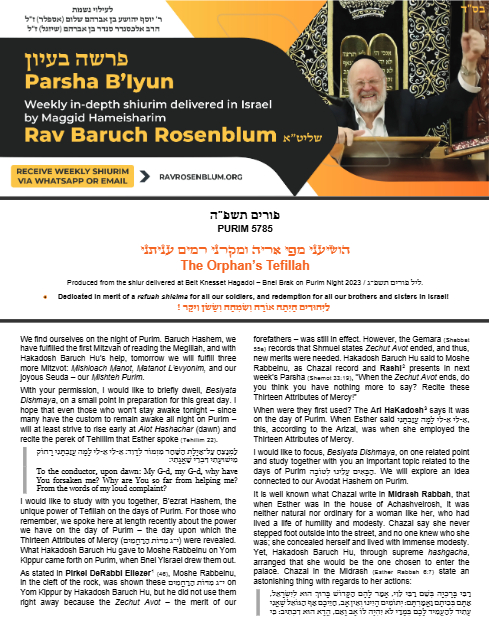

What does he do there? There, it’s צְ עֲקוּ. He has nothing else to do other than to let out a צְ עָ קָ ה to Hakadosh Baruch Hu. Rabbotai, Esther enters the house of Achashveirosh and says: אֵ -לִ י אֵ -לִי לָמָה עֲזַבְתָּנִי רָחוֹק מִישׁ וּעָתִי דִּ בְרֵ י שׁ ַאֲגָתִי – “My G-d, my G-d, why have You forsaken me? Far from my salvation are the words of my cry.” She also says, “Ribbono Shel Olam, remember that I’m an orphan.” Not that she wanted to point out that she was an orphan – it was already clear to all from the time she was a day old. At 75, nearly all of us are orphans. What does she mean here by orphan? What Esther is saying is: “Remember that the Tefillot I offer are not because I trust in someone – I don’t trust in anything. What do I trust in? Only in אֵ -לִ י אֵ -לִ י. Only in You!

יְהִ י חַסְדְּ ך ה' עָלֵינוּ כַּאֲשׁ ֶר יִחַלְנוּ לָך – May Your kindness be upon us, just as we have hoped in You.” This is the essence of Tehillim 22 and Esther saying, “If I called him a dog, I ask forgiveness.” The Maharsha asks: If Esther had called him a lion, wouldn’t she then need to ask forgiveness even more? After all, unlike a dog, the lion is a positive symbol. It’s Rabbi Yehuda ben Teima who famously says: הֱוֵי עַז כַּנָּמֵר, וְקַל כַּנֶּשׁ ֶר, וְרָ ץ כַּצוְ גִ בּ וֹר כָּאֲ רִ י (Avot 5:20). And we also find great people named Aryeh, whereas no one is named Kelev. The Maharsha asks: Is “dog” not the most fitting name for this wicked king?

He says Esther asked forgiveness for a very simple reason. Here, in the holy city of Bnei Brak, we’re not used to dogs, Baruch Hashem. We have plenty of mice, but not dogs. But I just came back from Ness Ziona, where there are dogs the size of people! Their length is the same as their width! You see people walking with such creatures, and one of them even had כְּנֶגֶד אַרְ בָּעָה בָנִים דִּ בְרָ ה תוֹרָ ה – four walking together to go hear the Megillah! They were taking a night tour!

What happens if later tonight you step outside and encounter such dogs? What do you do? The first thing you do is stay on the steps – don’t go down just yet. You let them pass and then continue on your way. But what do you do on Rabbi Akiva Street, when suddenly a Rottweiler appears down the block, and you immediately realize it doesn’t suffer from asthma? You can hear it breathing just fine – no Covid, and no Ventolin needed. And now it’s coming toward you – what do you do?

First things first, you take off your shoe. You tell yourself, better safe than sorry. If it charges at you, you’ll throw it. And if it jumps on you? Even if it jumps on you, not terrible – it’ll give you a bite, at most two, and that’s it. Will a dog kill you? That’s extremely rare. So, you try to fight it off, reach for your second shoe, and also call Yedidim and Chaveirim to send some guys for backup.

Now, what do you do if you’re walking on HaRoeh Street in Ramat Gan, and the five o’clock news announces that a lion has escaped from the zoo? Not only that, but the lion isn’t feeling well either. It has a cough, the flu, and it’s quite angry. You’re told not to leave the house until they catch it – but it’s too late, and you now see it coming straight toward you. What do you do? Do you take off your shoe again? Don’t waste precious time with the shoe – you won’t have any time left for Shema Yisrael! Also, don’t try to phone anyone to say goodbye. Better that the phone stays in your pocket so they’ll know where you are (inside the lion’s belly, that is). So, what does a person do when a lion comes at him? Does he do something? He does nothing! He says Shema Yisrael and whatever other Pesukim he can sneak in – whether Ashamnu Bagadnu or Dam Tzfardeya Kinim. He says, “It’s over. The story’s finished.”

Esther says, “If I called him a dog, I ask forgiveness.” Why? “Because I thought I could overcome him.” A dog can be contended with. But when a lion comes at you, there’s nothing you can do. Esther was essentially saying, “Ribbono Shel Olam, I know why You removed the Shechinah from me.” וַ תִּ לְ בּ ַ שׁ אֶ סְ תּ ֵ ר מַ לְ כוּ ת – When Esther put on royal apparel, she was enwrapped with Ruach HaKodesh (Megillah 14b). But when she passed by the house of idols, suddenly, the Ruach HaKodesh departed from her. Why? Because if you think you can manage with a dog – go and manage on your own! Thus, Esther cried out: אֵ -לִ י אֵ -לִ י לָמָ ה עֲזַבְ תָּ נִ י – “I know why You forsook me. It is because I called Achashveirosh a dog. If I called him a dog, it means I thought I could overcome him, and so You left me to it! Ribbono Shel Olam, I can’t manage on my own – I’m an orphan!”

Esther pleaded with Hakadosh Baruch Hu: "Ribbono Shel Olam, remember that I’m an orphan – and not because I am without parents at age seventy-five. Remember that I’m an orphan in that my prayer is like an orphan who has neither father nor mother. I rely only on You, Hakadosh Baruch Hu!" This is why Hakadosh Baruch Hu says כׇּל אַלְמָנָה וְיָתוֹם לֹא תְעַנּוּן, according to the Ramban. Because they turn to no one – only directly to Him, and He answers them.

Rabbotai, this is the secret of Purim. Esther taught us the power of Tefillah beyond the י״ג מִדּוֹת הַרַ חֲמִים. What did she teach us beyond the Thirteen Attributes of Mercy? She taught us how to daven to Hakadosh Baruch Hu like an orphan – like one who relies on no one else.

The Haftarah of Shabbat Shuva

In the Haftarah of Shabbat Shuva, we read:

שׁ וּבָה יִשְׂרָאֵל עַד ה' אֱ -׃ כִּי כָשׁ ַלְתָּ בַּעֲוֺנֶך לֹהֶיך

Return, Yisrael, to Hashem your G-d, for you have stumbled in your iniquity.

What is said there in Sefer Hoshea? The Haftarah of Shabbat Shuva – what does it actually have to do with Teshuva and Yom Kippur?

א ַ שׁ ּ ו ּ ר לֹא יוֹשִׁיעֵנוּ עַל־סוּס לֹא נִ רְ כּ ָ ב וְ לֹא־נֹאמַ ר עוֹד אֱ לֹהֵינוּ לְ מַ עֲ שֵׂ ה יָ דֵינוּ א ֲ שׁ ֶ ר ־ ב ּ ְ ך יְ רֻ חַ ם יָתוֹם׃

Assyria will not save us, on horses we will not ride, and we will no longer say ‘our gods’ to the work of our hands – in You the orphan finds mercy.

The Navi is telling us: As long as we place trust in our money and wealth, confidence in our health, and faith in our friends and protection – we are not talking to Hakadosh Baruch Hu like an orphan. We’re simply asking Hakadosh Baruch Hu to leave everything as is, to keep our lives and setup intact. The Navi says, “You want to return in complete repentance? Remember this – nothing is certain. Not your wealth, not your assets, not your health, not anything.” Even if you eat carrots and lettuce and jog all day around the block, I’ve known people who jogged and eventually got run over by a motorcycle – together with their jogging. So, they died healthy – full of lettuce and cabbage but not touching anything spiritual.

Nothing is certain. יְרֻ חַם יָתוֹם אֲשׁ ֶר בְּך – In You, the orphan finds mercy. A person must say, “Only You, Ribbono Shel Olam. I turn only to You. יְהִ י חַסְדְּ ך ה' עָלֵינוּ כַּאֲשׁ ֶר יִחַלְנוּ לָך – May Your kindness be upon us just as we have hoped in You, because I have nothing else that can save me.”

This is the Tefillah of Esther. This is the Tefillah she davened. “I am an orphan,” not because she had no parents, but because her Tefillah was that of an orphan. She asked forgiveness for calling the king a dog and committed to calling him a lion. This is the power of a תְּ פִ לַת יָתוֹם. Sefer Minchat Ani says this type of Tefillah is what’s called צְ עָ קָ ה – where a person has nothing to rely on and trusts only in Hakadosh Baruch Hu. אֱ - לֹהַי בְּך בָטַחְתִּי – My G-d, in You I have trusted.

The Parable of the King and the Curfew

Chazal, in the Midrash (Shocher Tov, Tehillim), provide a parable about a king who imposed a strict curfew. He announced, “Whoever leaves the house between eight o’clock at night and eight o’clock in the morning will be shot.” He gave clear orders to the soldiers: “Shoot and shoot again – no games!” He then passed through the streets with a loudspeaker, warning everyone of the new curfew.

The Midrash says that there was one person who just had to confirm whether the rule was real. You know, like people who always check if the paint is really wet upon seeing a “Wet Paint” sign. Why? Because they need to know – if it’s not really wet, then take the note down! So, people check – one puts a finger, another something else... that’s just the nature of Jews. In America, on the other hand, if a sign says, “Caution: Wet Paint,” it stays up for twelve years. No one takes it down. Why? Because no one checks if it’s wet – if the sign says wet, fine, all good. But in Israel? Maybe it’s just to scare people. Maybe it’s wet, maybe it’s not. So, let’s check – and if not, let’s take the sign down.

Rabbotai, the Midrash says that the king announced there would be no exceptions, but one person just had to check. He sees a soldier on the street and stops to look. The soldier fires in his direction, and he shouts back, “What’s wrong with you?! I’m a relative of the king! Are you crazy? If they caught you shooting me, they’d hang you!” The soldier puts the man in handcuffs and takes him to the station. In the morning, the king calls his security minister, along with the general and chief of staff, and asks them, “Tell me – how did the night go?” They tell him, “It was a quiet night, except for one crazy guy we almost shot until he let us know he was your relative.” The king responds, “Really? I’m not aware of any relative who lives in that part of town. Bring him to me!” The handcuffed man is brought before the king, who asks why he stepped out at night despite the strict curfew. He replies, “Because I was bored at home – I wanted to see what was happening downstairs, so I went down.” The king then asks why he told the soldiers he was a relative, to which he answers, “I know I’m not your relative, but I knew that if I didn’t say that, they’d shoot me on the spot!” The Midrash says that the king responded, “Since this man relied on me, I will release him.” Meaning – “If a person places his full and undivided trust in the king and says he has nothing else, no one will touch him.”

This is the great merit we have on Purim. We are now going to enter before the King; each and every one of us can enter before the King! Rabbotai, let’s recall the well-known rule:

כׇּל־עַבְדֵי הַמֶּלֶךְ וְעַם־מְדִ ינוֹת הַמֶּלֶךְ יֹדְ עִים אֲשׁ ֶר כׇּל־אִישׁ וְאִשָּׁה אֲשׁ ֶר יָבוֹא־אֶ ל־הַ מֶּ לֶךְ אֶ ל־הֶ חָ צֵ ר הַ פְּ נִ ימִ ית אֲ שׁ ֶ ר לֹא־יִקָ רֵ א אַ חַ ת דָּ תוֹ לְהָמִית לְבַד מֵאֲשׁ ֶר יוֹשִׁיט־לוֹ הַמֶּלֶךְ אֶת־שׁ ַרְ בִיט הַזָּהָב

All the king’s courtiers and the people of the king’s provinces know that if any person, man or woman, enters the king’s presence in the inner court without having been summoned, there is but one law for him—that he be put to death. Only if the king extends the golden scepter to him may he live.

On Purim, you can come before the King! Even though it is normally forbidden to approach the King wearing sackcloth, the Ari HaKadosh says that the merit of Purim is even greater than Yom Kippur. A person can come before the King and extend his hand, just as Esther said: שׁ ְ א ֵ ל ָ תִ י ו ּ ב ַ קָ שׁ ָ תִ י – “My petition and my request.” What does she request? She asks that the king come to an additional feast tomorrow.

I want to give you a beautiful gift I saw in the sefer Shemen Rosh – a question so beautiful that you don’t even notice it. Rabbotai, Haman the wicked – yimach shemo v’zichro – came to the king with quite the idea. “This people,” he said, “have more expenses than income for the kingdom.” He went on to itemize just how much they eat and consume – on Shabbat, on Pesach, Shavuot, and Succot, on Chanukah, at engagements, aufrufs, weddings, Sheva Brachot, Brit Milahs, and Pidyon HaBens, and even after they die – on yahrzeits each year! Where did Haman know all this from? Where did he get all these details? From Mordechai! He was Mordechai’s servant, so he knew exactly when the holidays fell.

Haman had reasons why every month was inopportune for the plan, according to Targum Sheini. He even knew all the yahrzeits of each month. Where did he get all this information from? He was an assistant to Mordechai! Mordechai would tell him at the start of Sivan, “Go now and decorate the shul.” All the apples and flowers we use to decorate the shul on Shavuot – where do we learn that custom from? Targum Sheini says it’s from Haman!

With regards to Shabbat, he went on and on about our indulgence. “They’re eating all day! And already from Thursday, there are those who insist on tasting everything early! Cholent and kugel and gefilte fish, salad shops with endless combinations – they just eat and eat! And whoever eats from Thursday until Sunday ends up with stomach-aches and can’t come to work! In the end, they work only two hours over half a week, and there’s no revenue from them!”

Haman said to Achashveirosh, “They’re always eating, and they’re always sleeping. It’s not worth keeping them here – they bring more expenses than income!” That’s what Haman said, and how does the king respond? He asks for a proposal, and Haman is more than happy to provide one:

אִם־עַל־הַמֶּלֶךְ טוֹב יִכָּתֵב לְאַבְּדָם וַעֲשֶׂרֶ ת אֲלָפִים כִּ כַּר־כֶּסֶ ף אֶ שׁ ְ קוֹל עַל־יְדֵי עֹשֵׂי הַמְּלָאכָה לְהָבִיא אֶל־גִנְזֵי הַמֶּלֶךְ

If it please the king, let it be written that they may be destroyed: and I will weigh out ten thousand talents of silver into the hands of those who have the charge of the business, to bring it into the king’s treasuries.

I saw the most wonderful question in Shemen Rosh – a truly tremendous question. Is ten thousand talents of silver really an amount worth destroying all the Jews for? How would this look to the world? They’re going to wipe out all Jews across the 127 provinces? One Arab is killed, and the whole world goes crazy! Two Jews – two brothers – are killed, and there’s silence. But one Arab? Woe! Everyone is up in arms! And here, they want to kill every Jew across half the globe?!

Shemen Rosh writes that in the Megillah, there is a mistake in terms of what Haman said. On the second day, at the wine feast, we read that Achashveirosh asked Esther what was bothering her, to which she replied:

כִּי נִמְכַּרְ נוּ אֲנִי וְעַמִּי לְהַשְׁמִיד לַהֲרוֹג וּלְאַבֵּד וְאִלּוּ לַעֲבָדִ ים וְלִשְׁפָחוֹת נִמְכַּרְ נוּ הֶחֱרַ שְׁתִּי כִּי אֵין הַצָר שׁ ֹוֶה בְּנֵזֶק הַמֶּלֶךְ

For we were sold, I and my people, to be destroyed, slaughtered, and annihilated. Now, had we been sold as slaves and maidservants, I would have remained silent, but the oppressor has no regard for losses incurred by his majesty.

Esther told Achashveirosh, “I would have remained silent had it only been a case of selling the Jews into slavery, but someone wants to destroy, kill, and annihilate all the Jews!” And how does Achashveirosh respond to this revelation? He says to Esther: מִי הוּא זֶה וְאֵי־זֶה הוּא אֲשׁ ֶר־מְלָאוֹ לִבּוֹ לַעֲשׂוֹת כֵּן – "Who? Who has the audacity to act this way?"

Rabbotai, what’s going on here? Is he playing some sort of game? Is he pretending nothing happened? Did he himself not sign and seal Haman’s decree just prior? How can he now stand up and angrily ask, “Who has the audacity to suggest such a plan?!” He’s making a mockery of the throne! He himself signed off on it!

Shemen Rosh explains that Achashveirosh was not acting, nor was he lying or playing dumb. Haman had indeed sat down with him earlier and said, “I want to take all the Jews – but not to kill them.” Had he told the king outright that he wanted to exterminate them, he would have been the one executed on the spot. The king would have said, “Are you crazy?! You’re going to bring the whole world and its media down on us?!” What Haman proposed was, “I want to buy them as slaves, and I’ll give you ten thousand silver talents for it. Later, I’ll sell them and become a successful slave trader. Whoever wants to buy a Jewish slave – five thousand dollars. I’ll invest ten thousand now, and my company exit will come later.” What he originally wrote in the decree was לְ עַ בְּ דָ ם – with an ayin, meaning to enslave them.

Achashveirosh was fine with that. “No problem, go right ahead!” But as soon as Haman left the king’s quarters and was given the royal signet ring, he changed the wording to לְ אַ בְּ דָ ם – with an alef, meaning to destroy them. He sealed it and immediately sent it off to the printers and publicists. Achashveirosh did not know what was written in the decree – he thought it merely said לְ עַ בְּ דָ ם – to enslave the Jews.

וּמׇרְ דֳּכַי יָדַע אֶת־כׇּל־אֲשׁ ֶר נַעֲשָׂה – Mordechai knew exactly what had been done. The בַּ עַ ל הַ חֲ לוֹם – Master of Dreams told him, according to Rashi, and he then relayed it to Esther, who now informed Achashveirosh to his genuine surprise, “Wait, what? What are you talking about? That’s nonsense! Are you saying I signed to destroy, to kill, and to annihilate?” Esther responded, “Had we just been sold as slaves, I would have remained silent. If you, the king, want to sell your citizens – that’s perfectly fine. But to kill people without cause? People who did nothing wrong? What kind of deed is this?!” Achashveirosh replied, “What?! I signed to kill?! Where did you get that information from? Who allowed this to go through? Where is he?” Esther answered, “Here’s the letter – you signed it!” The king then explained, “Yes, I indeed signed it, but this was not my intent! What I signed was לְ עַ בְּ דָ ם – to enslave; not לְ אַ בְּ דָ ם – to destroy.”

Shemen Rosh explains that this is why Achashveirosh later said to Mordechai: וְאַתֶּם כִּתְ בוּ עַל הַיְהוּדִ ים כַּטּ וֹב בְּעֵינֵיכֶם – You may issue a writ concerning the Jews as you please. We write with our hands, not with our eyes, so what does בְּעֵינֵיכֶם mean here? Achashveirosh told Esther and Mordechai, “Just as Haman switched the ע for an א, you can now do the same in return. Instead of taking the followers of Haman as slaves, you can swap the letters and destroy them!”

What did we learn from all this? We learned that this Megillah has more nistar (hidden) than galui (revealed). Everything is hidden layer under layer, to the point where we don’t know what’s truly happening. There are more hidden things here than revealed things, and this is the great yesod of Purim.

Everyone sees hester panim – a hidden face, meaning a concealed Divine Providence. One sees it in matchmaking, and the other in parnassa. One sees it in health, and the other in livelihood. Each one feels a hester panim. We all need to know that Hakadosh Baruch Hu is behind everything – but He wants one thing from us.

אַל־תִּבְטְחוּ בִנְדִ יבִים בְּבֶן־אָדָם שׁ ֶ א ֵ י ן לוֹ תְ שׁ ו ּ ע ָ ה – Put not your trust in princes, nor in the son of man, in whom there is no help.

Don’t trust in princes. Not in security, not in economics, not in anything. “If I called him a dog – I ask forgiveness from You; I’ll call him a lion.” What does Hakadosh Baruch Hu want us to trust in?

יְהִ י חַסְדְּ ך ה' עָלֵינוּ כַּאֲשׁ ֶר יִחַלְנוּ לָך – Trust in His mercy and kindness, and He will match that level of trust. Ashur will not save us, on horses we will not ride, and we will no longer say “our gods” to the work of our hands. יְרֻ חַם יָתוֹם אֲשׁ ֶר בְּך – In Hakadosh Baruch Hu, the orphan finds mercy. Feel like one who has neither father nor mother. This feeling gives a person the ability to connect to Hakadosh Baruch Hu and say, “Ribbono Shel Olam, only You can help me.” And this is the great Tefillah we have on the days of Purim.

We have a few more hours until dawn. Whoever can rise and say this Perek of Tehillim at dawn – that is the best. Whoever

PDF Preview