The Wealthy Man Shall Not Give More Nor The Poor Person Less
מגדל אור | February 28, 2024
Print This Article
View Original PDF

The Wealthy Man Shall Not Give More Nor The Poor Person Less

מגדל אור | December 10, 2025

“The wealthy man shall not give more, nor the poor person less, than half a shekel for Hashem’s tribute, to atone for your souls.” (Shmos 30:15)

At certain times in our history, it was necessary to take a census of the nation. There is, however, a prohibition against counting Jews. The reason for the prohibition, as explained by Rashi in our Parsha, is so that a plague not strike the Jews. Were people to be counted, this could lead to ayin hara, an evil eye, which could be dangerous.

This fear is explained elsewhere by commentaries, that when we are counted as a group, we are subject to more lenient judgment in Heaven. By avoiding counting people individually, we do not “separate” and perhaps become liable due to the stricter judgment applied to individuals. Instead, each person gives an item, and when the items are tallied, the count of the Jewish People is known.

[One nice idea why we don’t count Jews is that we cannot actually quantify the value of an individual, for there may be so much more to them than meets the eye. This prohibition reminds us that there is no real way to completely “count” a Jewish person.]

Since the purpose of giving the half-shekel was so the sum could be tallied and divided in half to give us the number of people in the nation, it makes sense that a rich person could not give more nor a poor person less. If they did so, it would throw off the count.

One might wonder, though, that there was a way for the count to come out correctly. If the rich man were to give two shekel, and “pay for” three poor people, they would all be counted. Why, then, can they not make such a deal? The census would work.

However, this is not the only reason. The census was part of it, but the Ibn Ezra says they could not vary the amount they gave because this was an atonement for their souls. Everyone needed to give. Therefore, the rich person couldn’t give to “cover” the responsibility of the poor one, so he could not give more.

Everyone gave the same amount because it was an atonement for their souls. Each soul is precious and special, regardless of what they possess, how they look, or any other physical attributes or disadvantages they might have. We are all creations of Hashem and must view ourselves and others this way.

Since we are put here to achieve a specific purpose and to rectify our souls, no one has it easier than anyone else so we don’t compare our missions. A rich man can’t get to the goal faster by giving more, and the poor man can’t take the easy way out by pleading poverty.

We each have to give whatever we can and make the most of who we are. I guess you could say, we are required to make our lives... count.

In 1948, When Babe Ruth died, a group of boys in the Mir Yeshiva in Brooklyn were huddled in a corner discussing the news. The Mashgiach, R’ Chatzkel Abramsky z”l came over and asked what was going on. They told him that the great baseball player had died.

Later that week, after maariv, R’ Chatzkel got up to speak. Surprisingly, his topic was none other than Babe Ruth! “I asked about his funeral,” said the sage. “And I asked what eulogizers said about him.”

“People said that since he had been an orphan, throughout his life he was kind to orphans.”

“Do you hear?” he asked the assemblage of boys. “Even the gentiles, to whom this man was royalty because of his baseball playing in this life, know that after death, it’s meaningless. What matters is how he treated other people!”

©2024 – J. Gewirtz
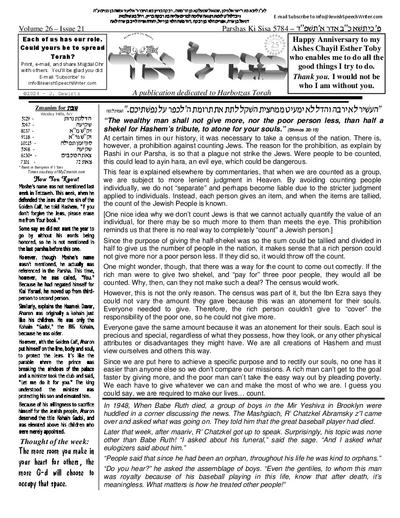
“The wealthy man shall not give more, nor the poor person less, than half a shekel for Hashem’s tribute, to atone for your souls.” (Shmos 30:15)

At certain times in our history, it was necessary to take a census of the nation. There is, however, a prohibition against counting Jews. The reason for the prohibition, as explained by Rashi in our Parsha, is so that a plague not strike the Jews. Were people to be counted, this could lead to ayin hara, an evil eye, which could be dangerous.

This fear is explained elsewhere by commentaries, that when we are counted as a group, we are subject to more lenient judgment in Heaven. By avoiding counting people individually, we do not “separate” and perhaps become liable due to the stricter judgment applied to individuals. Instead, each person gives an item, and when the items are tallied, the count of the Jewish People is known.

[One nice idea why we don’t count Jews is that we cannot actually quantify the value of an individual, for there may be so much more to them than meets the eye. This prohibition reminds us that there is no real way to completely “count” a Jewish person.]

Since the purpose of giving the half-shekel was so the sum could be tallied and divided in half to give us the number of people in the nation, it makes sense that a rich person could not give more nor a poor person less. If they did so, it would throw off the count.

One might wonder, though, that there was a way for the count to come out correctly. If the rich man were to give two shekel, and “pay for” three poor people, they would all be counted. Why, then, can they not make such a deal? The census would work.

However, this is not the only reason. The census was part of it, but the Ibn Ezra says they could not vary the amount they gave because this was an atonement for their souls. Everyone needed to give. Therefore, the rich person couldn’t give to “cover” the responsibility of the poor one, so he could not give more.

Everyone gave the same amount because it was an atonement for their souls. Each soul is precious and special, regardless of what they possess, how they look, or any other physical attributes or disadvantages they might have. We are all creations of Hashem and must view ourselves and others this way.

Since we are put here to achieve a specific purpose and to rectify our souls, no one has it easier than anyone else so we don’t compare our missions. A rich man can’t get to the goal faster by giving more, and the poor man can’t take the easy way out by pleading poverty.

We each have to give whatever we can and make the most of who we are. I guess you could say, we are required to make our lives... count.

In 1948, When Babe Ruth died, a group of boys in the Mir Yeshiva in Brooklyn were huddled in a corner discussing the news. The Mashgiach, R’ Chatzkel Abramsky z”l came over and asked what was going on. They told him that the great baseball player had died.

Later that week, after maariv, R’ Chatzkel got up to speak. Surprisingly, his topic was none other than Babe Ruth! “I asked about his funeral,” said the sage. “And I asked what eulogizers said about him.”

“People said that since he had been an orphan, throughout his life he was kind to orphans.”

“Do you hear?” he asked the assemblage of boys. “Even the gentiles, to whom this man was royalty because of his baseball playing in this life, know that after death, it’s meaningless. What matters is how he treated other people!”

©2024 – J. Gewirtz

PDF Preview