The World Is Created Anew Every Moment
Havineini | March 06, 2026
Print This Article
View Original PDF

The World Is Created Anew Every Moment

Havineini | March 06, 2026

Constant Creation

The Ramban (Sefer Emunah uBitachon) says that bitachon is an outgrowth of emunah. Only after a person has attained emunah in Hashem can he feel truly reliant upon Him. Emunah is the tree that sprouts the fruits of bitachon, he says. Let us therefore study an important yesod of emunah that applies to us each and every day—dozens or even hundreds of times throughout the day.

The Torah HaKedoshah begins with the words בראשית ברא אלהי-ם, and the ensuing pesukim tell of the creation of the heaven and the earth, the light and the darkness, and the myriad aspects of creation.

But this event of creation was not a one-time event; it recurs at every moment in time—as we say in davening, המחדש בטובו בכל יום תמיד מעשה בראשית, He Who renews in His goodness, every day continually, the work of creation. He constantly sustains and animates the entire creation. Were there an instant in which Hashem did not do so, it would all cease to exist. The time of בראשית was indeed the first time this creation took place, but it continues in every moment, to eternity. In fact, one of the meanings of the שם הוי”ה is that Hashem is constantly מהווה, keeps into being, the entire universe.

Like Body and Soul

The Ribbono shel Olam is, as it were, the neshamah, the animating force in creation. The Gemara (Berachos 10a) teaches us five ways in which HaKadosh Baruch Hu is like the neshamah of the universe (and these correspond to the five verses of ברכי נפשי that Dovid HaMelech said in Tehillim): Just as He fills the entire world, so too the neshamah fills the entire body; Hashem sees but isn’t seen, so too the neshamah is unseen; HaKadosh Baruch Hu sustains the universe and so too the neshamah sustains the guf; the Ribbono shel Olam is pure, and so too is the neshamah; and finally, just as HaKadosh Baruch Hu dwells in an inner sanctum, so too does the neshamah dwell in a person’s body.

Just as we know that without the neshamah, the body has no life or chiyus—when the neshamah leaves the body, it remains without life, because the neshamah is its lifeforce—so too, Dovid HaMelech understood, the entire universe cannot continue to exist without constant animation by its Creator.

This is why we say in davening יחיד חי העולמים, the Ribbono shel Olam is the life of the world. Similarly, we say לעשה אורים גדולים כי לעולם חסדו, To the One Who makes the great lights, for His kindness endures forever; we do not say “who made,” for we understand that Hashem is constantly recreating the world at every moment.

Existing by the Word of Hashem

The Midrash Tehillim says regarding the words (Tehillim 119:89) לעולם ה’ דברך נצב בשמים, Forever, Hashem, Your word stands firm in the heavens, that just as it was during the creation of the world that the word of Hashem brought the creations to life, so it is always: Hashem’s word constantly continues to animate and give life to every creation. This is the meaning of לעולם ה’ דברך נצב בשמים.

Indeed, the sefarim hakedoshim teach us that all foods and vegetation receive their chiyus from the words תדשא הארץ דשא. Later, when a person eats these foods, he receives sustenance from the devar Hashem that lies within these foods. Were they mere material objects, without the holy words of Hashem animating them, they would not have the ability to sustain us.

Furthermore, as we say in davening ואתה מחיה את כולם, the Ribbono shel Olam constantly gives life to all creations. The Zohar HaKadosh uses the term נשמתא דכל נשמתין, the neshamah of all neshamos, the lifeforce of all life.

Creator and Conductor

It is among the tenets of basic emunah that a Yid believe this, and this is the first of the Rambam’s Thirteen Principles of emunah—to believe that the Ribbono shel Olam is בורא ומנהיג, and that He Himself created, creates, and will create all creations.

The Rambam is teaching us here that when the Torah tells us that Hashem created the world, it means that He continues to create, and that He will create it forever. It wasn’t a one-time event, but a continuous project. If a person doesn’t understand this, then he hasn’t properly read the pesukim of the Creation.

Everything Is Hashem

This isn’t simply a nice idea... that when we see a table, we should know that it is Hashem Who gives life to this inanimate table; otherwise, it couldn’t stand—this is of course true. But even more importantly, this is also true regarding the hundreds of situations in which a person finds himself daily—and we must draw on this knowledge regarding the countless realities and situations that we encounter every single day, and to know that it’s all the Ribbono shel Olam. He alone creates and conducts the entire universe.

When It Succeeds and When It Doesn’t

A Yid ran to make the bus... he was there on time... but the bus left a few minutes early, and he missed it. He must believe that the Ribbono shel Olam is בורא ומנהיג! Later, he has a run-in with a person who demands money from him. Who made this person think this way? It’s all the Ribbono shel Olam, Who animates every aspect of creation!

The same applies when things do work out well. This Yid decided to build a table today. He thankfully has the skills to do it, he buys a hammer and wood, and he manages to construct a beautiful table. He’s proud of his table, and he says to himself, “Wow, I’m good at this... it’s built well.” But the Torah says differently: וזכרת את ה’ אלהי-ך כי הוא הנותן לך כח לעשות חיל, you should remember Hashem your G-d, for it is He who gives you the strength to accomplish (Devarim 8:17). When you’re successful, you must remember that it has nothing to do with you—it’s only due to Hashem. Likewise, when you’re unsuccessful, you must also know that it has nothing to do with you—it’s only due to Hashem.

These aren’t “inyanim” that we read about in sefarim of later generations; these are the basic tenets of emunah that we learn about in the first pesukim in the Torah, and they apply to every detail of our lives, in good times and in better times, in times of pain and in times of pleasure. We proclaim in Shemoneh Esrei three times a day, אתה חונן לאדם דעת: If we have ever had a good idea, if we ever thought of something clever or smart, it came from Him! The One Who created me continues to create and fashion my daily existence. He gives me the ability to do teshuvah, He sends me health and parnassah, and when there’s no parnassah, R”l, that situation is also sent by Him.

When we internalize this idea, then when we see that something’s missing, we remember another one of the Ani Ma’amin’s: There’s only one place to turn to—לו לבדו ראוי להתפלל—we must believe with a complete belief that we daven only to Hashem.

Constant Creation

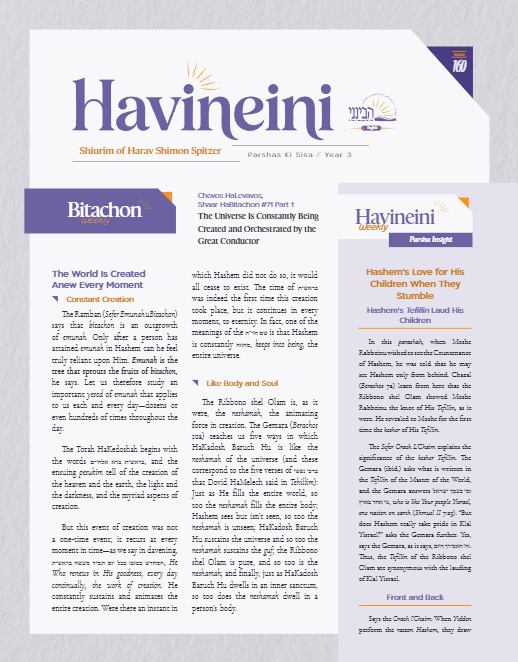
The Ramban (Sefer Emunah uBitachon) says that bitachon is an outgrowth of emunah. Only after a person has attained emunah in Hashem can he feel truly reliant upon Him. Emunah is the tree that sprouts the fruits of bitachon, he says. Let us therefore study an important yesod of emunah that applies to us each and every day—dozens or even hundreds of times throughout the day.

The Torah HaKedoshah begins with the words בראשית ברא אלהי-ם, and the ensuing pesukim tell of the creation of the heaven and the earth, the light and the darkness, and the myriad aspects of creation.

But this event of creation was not a one-time event; it recurs at every moment in time—as we say in davening, המחדש בטובו בכל יום תמיד מעשה בראשית, He Who renews in His goodness, every day continually, the work of creation. He constantly sustains and animates the entire creation. Were there an instant in which Hashem did not do so, it would all cease to exist. The time of בראשית was indeed the first time this creation took place, but it continues in every moment, to eternity. In fact, one of the meanings of the שם הוי”ה is that Hashem is constantly מהווה, keeps into being, the entire universe.

Like Body and Soul

The Ribbono shel Olam is, as it were, the neshamah, the animating force in creation. The Gemara (Berachos 10a) teaches us five ways in which HaKadosh Baruch Hu is like the neshamah of the universe (and these correspond to the five verses of ברכי נפשי that Dovid HaMelech said in Tehillim): Just as He fills the entire world, so too the neshamah fills the entire body; Hashem sees but isn’t seen, so too the neshamah is unseen; HaKadosh Baruch Hu sustains the universe and so too the neshamah sustains the guf; the Ribbono shel Olam is pure, and so too is the neshamah; and finally, just as HaKadosh Baruch Hu dwells in an inner sanctum, so too does the neshamah dwell in a person’s body.

Just as we know that without the neshamah, the body has no life or chiyus—when the neshamah leaves the body, it remains without life, because the neshamah is its lifeforce—so too, Dovid HaMelech understood, the entire universe cannot continue to exist without constant animation by its Creator.

This is why we say in davening יחיד חי העולמים, the Ribbono shel Olam is the life of the world. Similarly, we say לעשה אורים גדולים כי לעולם חסדו, To the One Who makes the great lights, for His kindness endures forever; we do not say “who made,” for we understand that Hashem is constantly recreating the world at every moment.

Existing by the Word of Hashem

The Midrash Tehillim says regarding the words (Tehillim 119:89) לעולם ה’ דברך נצב בשמים, Forever, Hashem, Your word stands firm in the heavens, that just as it was during the creation of the world that the word of Hashem brought the creations to life, so it is always: Hashem’s word constantly continues to animate and give life to every creation. This is the meaning of לעולם ה’ דברך נצב בשמים.

Indeed, the sefarim hakedoshim teach us that all foods and vegetation receive their chiyus from the words תדשא הארץ דשא. Later, when a person eats these foods, he receives sustenance from the devar Hashem that lies within these foods. Were they mere material objects, without the holy words of Hashem animating them, they would not have the ability to sustain us.

Furthermore, as we say in davening ואתה מחיה את כולם, the Ribbono shel Olam constantly gives life to all creations. The Zohar HaKadosh uses the term נשמתא דכל נשמתין, the neshamah of all neshamos, the lifeforce of all life.

Creator and Conductor

It is among the tenets of basic emunah that a Yid believe this, and this is the first of the Rambam’s Thirteen Principles of emunah—to believe that the Ribbono shel Olam is בורא ומנהיג, and that He Himself created, creates, and will create all creations.

The Rambam is teaching us here that when the Torah tells us that Hashem created the world, it means that He continues to create, and that He will create it forever. It wasn’t a one-time event, but a continuous project. If a person doesn’t understand this, then he hasn’t properly read the pesukim of the Creation.

Everything Is Hashem

This isn’t simply a nice idea... that when we see a table, we should know that it is Hashem Who gives life to this inanimate table; otherwise, it couldn’t stand—this is of course true. But even more importantly, this is also true regarding the hundreds of situations in which a person finds himself daily—and we must draw on this knowledge regarding the countless realities and situations that we encounter every single day, and to know that it’s all the Ribbono shel Olam. He alone creates and conducts the entire universe.

When It Succeeds and When It Doesn’t

A Yid ran to make the bus... he was there on time... but the bus left a few minutes early, and he missed it. He must believe that the Ribbono shel Olam is בורא ומנהיג! Later, he has a run-in with a person who demands money from him. Who made this person think this way? It’s all the Ribbono shel Olam, Who animates every aspect of creation!

The same applies when things do work out well. This Yid decided to build a table today. He thankfully has the skills to do it, he buys a hammer and wood, and he manages to construct a beautiful table. He’s proud of his table, and he says to himself, “Wow, I’m good at this... it’s built well.” But the Torah says differently: וזכרת את ה’ אלהי-ך כי הוא הנותן לך כח לעשות חיל, you should remember Hashem your G-d, for it is He who gives you the strength to accomplish (Devarim 8:17). When you’re successful, you must remember that it has nothing to do with you—it’s only due to Hashem. Likewise, when you’re unsuccessful, you must also know that it has nothing to do with you—it’s only due to Hashem.

These aren’t “inyanim” that we read about in sefarim of later generations; these are the basic tenets of emunah that we learn about in the first pesukim in the Torah, and they apply to every detail of our lives, in good times and in better times, in times of pain and in times of pleasure. We proclaim in Shemoneh Esrei three times a day, אתה חונן לאדם דעת: If we have ever had a good idea, if we ever thought of something clever or smart, it came from Him! The One Who created me continues to create and fashion my daily existence. He gives me the ability to do teshuvah, He sends me health and parnassah, and when there’s no parnassah, R”l, that situation is also sent by Him.

When we internalize this idea, then when we see that something’s missing, we remember another one of the Ani Ma’amin’s: There’s only one place to turn to—לו לבדו ראוי להתפלל—we must believe with a complete belief that we daven only to Hashem.

PDF Preview