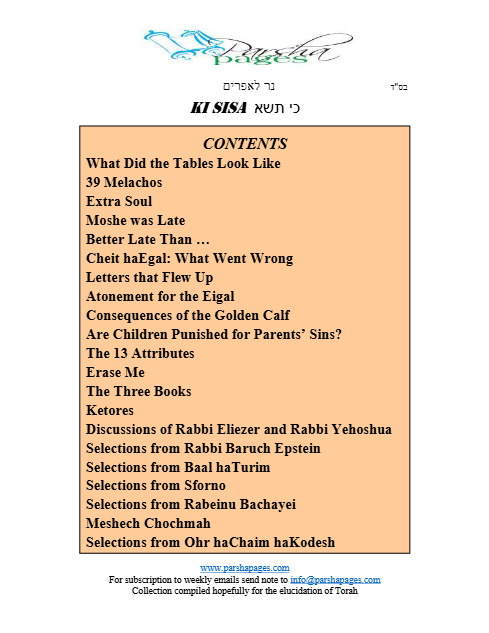
What Did the Luchos Look Like
Parsha Pages | March 12, 2025
Print This Article
View Original PDF

What Did the Luchos Look Like

Parsha Pages | June 27, 2025

The Dimensions:
Chaza”l tell us that they were thick cube-like blocks of stone, six handbreadths tall, six handbreadths wide, and three handbreadths deep. In modern measurements, that is just over 18”x18”x 9”. The sages of the Talmud demonstrate how Luchos of this size, with other items, fit neatly into the Ark of the Covenant in the Mishkan.
It is interesting to note that nowhere is there any mention of them having the rounded tops that are so common in the popular drawings of Moshe and the Luchos. This design appears to be the invention of non-Jewish artists. Many are strict not to portray the Luchos with rounded tops.

The Material:
The tradition is that both sets of Luchos were made of sapphire. After Moshe broke the first set, G-d revealed a large deposit of sapphire in Moshe' tent. Moshe used some of the stone to carve the second Luchos and was permitted to keep the remains.

The Letters Were Engraved All the Way Through:
שמות פרק לב טו וַיִּפֶן וַיֵּרֶד משֶה מִּן-הָהָר וּשְׁנֵּי לֻחֹת הָעֵּדֻת בְׁיָדוֹ לֻחֹת כְׁתֻבִּים מִּשְׁנֵּי עֶבְׁרֵּיהֶם מִּזֶה וּמִּזֶה הֵּם כְׁתֻבִּים :
"And Moshe turned and went down from the mountain and the two Luchos of the testimony were in his hand, inscribed from both their sides; they were inscribed on both sides."
This means that the inscription was engraved through and through. As such, the words were clearly legible on one side and written in mirror writing on the other. Now there are two Hebrew letters, the ם and the ס, that are closed from all sides. The centers of these letters must have been miraculously suspended in place.
Some explain that the writing was miraculously legible on each side. In other words, although the letters were engraved all the way through, they could nevertheless be read from right to left on both sides. (Rabenu Bachaye explains that this is because the Torah can be understood on two levels, one revealed and one hidden). Others explain that there was a space between each Commandment, where the same Commandment appeared backwards, engraved through from the other side.

How Many Commandments on Each Luach?
R’ Chanina ben Gamliel held according to our custom, that the Luchos had five commandments each.
The Chachomim held that each Luach had all Ten Commandments. R’ Shimon bar Yochai held that all Ten Commandments were written twice on each Luach, once on the front and once on the back. Finally, R’ Simai held that the Ten Commandments were written four times on each Luach.
The widely excepted explanation of R’ Simai’s opinion is that the Luchos were shaped like cubes, and the Ten Commandments were written on each of the four sides (not including the top and bottom). Some Acharonim explain that this was in order that the Commandments could be read from any side a person might view them. For this reason, it was unnecessary to write the Commandments on the top or bottom of the Luchos (see Korban Eida and Ra”sh Sirrilio here; Teshuvos Radvaz III, 549). Others explain that on each face of the Luchos, the Ten Commandments were written in a different direction; from top to bottom, or from bottom to top (see Ra”sh Sirrilio).

Each Luach had Five Commandments:
Some explain the latter opinions listed above to mean that all Ten Commandments were written once, or even numerous times, on each Luach. However, the Mabit (Beis Elokim, Shaar HaYesodos 12, s.v. U’mipnei) suggests that all opinions might agree that the first five Commandments were written on one Luach, while the second five were written on the other. They argued over how many times the five were written on each. According to R’ Chanina ben Gamliel they were written once on each. According to the Chachomim they were written twice on each, for a total of ten. According to R’ Shimon they were written four times on each, twice on the front and twice on the back. According to R’ Simai they were written twice on each of the four sides of the Luchos, for a total of forty commandments on each.

Reconciling All Four Opinions:
The Rama of Panno (Asara Maamaros: Chikur HaDin II, ch. 2) offers a fascinating explanation, which reconciles all four opinions in the Gemara. He writes that the Luchos were six tefachim wide by six tefachim high, and three tefachim thick. Thus, on the front and back sides of each Luach, there was a surface of six by six tefachim on which to write all Ten Commandments. However, on the sides, top and bottom of the Luchos, the surface was only three by six tefachim. Only five Commandments were written on the sides, top and bottom. It comes out that each Luach had Ten Commandments on front, ten on back, five on the top, bottom, right and left sides, for a total of forty commandments on each Luach.
When Moshe Rabbeinu descended from Har Sinai, he held the Luchos one in front of the other. The writing was visible only from the sides, where five Commandments were seen on each – hence R’ Chanina ben Gamliel’s opinon. Later, he separated them and revealed that on the front of each were all Ten Commandments – the opinion of the Chachomim. When he held them up for Bnei Yisroel to see, the Ten Commandments could be seen on both the front and back – R’ Shimon’s opinion. When he placed the Luchos before them to investigate more thoroughly, they saw that five Commandments were written on each side, a total of forty commandments on each – the opinion of R’ Simai.
Thus, all the opinions in our Gemara are correct; each referred to a different part of the Luchos. The Rama of Panno adds that Hashem wrote the Commandments on all sides of the Luchos, since Bnei Yisroel camped around the Mishkan from all four sides. Thus, from wherever they were camped they would be able to read the Luchos. From here it seems that the Luchos were taken out and displayed on at least one occasion, as Bnei Yisroel were encamped in their places around the Mishkan and gazed at the Luchos HaBris.

Symbolism of Two Luchos:
Standard explanation is that the Commandments consisted of two parts, Mitzvos between man and Hashem and Mitzvos between man and one’s fellow. Others relate the symbolism to the two types of Torah, the Written Torah and the Oral Torah.
The Rabbis also offer (Tanchuma Ekev 10) that the two Luchos reflect different aspects of creation: Heaven and Earth; Chasan and Kallah, two close friends, two worlds (all are one allusion).

The right-hand tablet bearing the duties to G-d consists of 146 words. The left-hand tablet listing our human responsibilities only has 26 words. Yet, tradition has it that both Luchos were filled with writing. There were no big, blank spaces. So how did 26 words equal the space of 146 words?
Well, anybody who uses a computer or word processor knows the answer. You simply adjust the font size. You can type in 10 point size or 24 point size. Take your pick. So if we apply that same principle to the Luchos we have a simple solution. The 26 words on the left, reflecting our moral and ethical human responsibilities were simply a bigger size than the 146 words on the right reflecting our G-dly, religious responsibilities. Thus, we must never underestimate the importance of the human relations side of the Commandments.
The Dimensions:
Chaza”l tell us that they were thick cube-like blocks of stone, six handbreadths tall, six handbreadths wide, and three handbreadths deep. In modern measurements, that is just over 18”x18”x 9”. The sages of the Talmud demonstrate how Luchos of this size, with other items, fit neatly into the Ark of the Covenant in the Mishkan.
It is interesting to note that nowhere is there any mention of them having the rounded tops that are so common in the popular drawings of Moshe and the Luchos. This design appears to be the invention of non-Jewish artists. Many are strict not to portray the Luchos with rounded tops.

The Material:
The tradition is that both sets of Luchos were made of sapphire. After Moshe broke the first set, G-d revealed a large deposit of sapphire in Moshe' tent. Moshe used some of the stone to carve the second Luchos and was permitted to keep the remains.

The Letters Were Engraved All the Way Through:
שמות פרק לב טו וַיִּפֶן וַיֵּרֶד משֶה מִּן-הָהָר וּשְׁנֵּי לֻחֹת הָעֵּדֻת בְׁיָדוֹ לֻחֹת כְׁתֻבִּים מִּשְׁנֵּי עֶבְׁרֵּיהֶם מִּזֶה וּמִּזֶה הֵּם כְׁתֻבִּים :
"And Moshe turned and went down from the mountain and the two Luchos of the testimony were in his hand, inscribed from both their sides; they were inscribed on both sides."
This means that the inscription was engraved through and through. As such, the words were clearly legible on one side and written in mirror writing on the other. Now there are two Hebrew letters, the ם and the ס, that are closed from all sides. The centers of these letters must have been miraculously suspended in place.
Some explain that the writing was miraculously legible on each side. In other words, although the letters were engraved all the way through, they could nevertheless be read from right to left on both sides. (Rabenu Bachaye explains that this is because the Torah can be understood on two levels, one revealed and one hidden). Others explain that there was a space between each Commandment, where the same Commandment appeared backwards, engraved through from the other side.

How Many Commandments on Each Luach?
R’ Chanina ben Gamliel held according to our custom, that the Luchos had five commandments each.
The Chachomim held that each Luach had all Ten Commandments. R’ Shimon bar Yochai held that all Ten Commandments were written twice on each Luach, once on the front and once on the back. Finally, R’ Simai held that the Ten Commandments were written four times on each Luach.
The widely excepted explanation of R’ Simai’s opinion is that the Luchos were shaped like cubes, and the Ten Commandments were written on each of the four sides (not including the top and bottom). Some Acharonim explain that this was in order that the Commandments could be read from any side a person might view them. For this reason, it was unnecessary to write the Commandments on the top or bottom of the Luchos (see Korban Eida and Ra”sh Sirrilio here; Teshuvos Radvaz III, 549). Others explain that on each face of the Luchos, the Ten Commandments were written in a different direction; from top to bottom, or from bottom to top (see Ra”sh Sirrilio).

Each Luach had Five Commandments:
Some explain the latter opinions listed above to mean that all Ten Commandments were written once, or even numerous times, on each Luach. However, the Mabit (Beis Elokim, Shaar HaYesodos 12, s.v. U’mipnei) suggests that all opinions might agree that the first five Commandments were written on one Luach, while the second five were written on the other. They argued over how many times the five were written on each. According to R’ Chanina ben Gamliel they were written once on each. According to the Chachomim they were written twice on each, for a total of ten. According to R’ Shimon they were written four times on each, twice on the front and twice on the back. According to R’ Simai they were written twice on each of the four sides of the Luchos, for a total of forty commandments on each.

Reconciling All Four Opinions:
The Rama of Panno (Asara Maamaros: Chikur HaDin II, ch. 2) offers a fascinating explanation, which reconciles all four opinions in the Gemara. He writes that the Luchos were six tefachim wide by six tefachim high, and three tefachim thick. Thus, on the front and back sides of each Luach, there was a surface of six by six tefachim on which to write all Ten Commandments. However, on the sides, top and bottom of the Luchos, the surface was only three by six tefachim. Only five Commandments were written on the sides, top and bottom. It comes out that each Luach had Ten Commandments on front, ten on back, five on the top, bottom, right and left sides, for a total of forty commandments on each Luach.
When Moshe Rabbeinu descended from Har Sinai, he held the Luchos one in front of the other. The writing was visible only from the sides, where five Commandments were seen on each – hence R’ Chanina ben Gamliel’s opinon. Later, he separated them and revealed that on the front of each were all Ten Commandments – the opinion of the Chachomim. When he held them up for Bnei Yisroel to see, the Ten Commandments could be seen on both the front and back – R’ Shimon’s opinion. When he placed the Luchos before them to investigate more thoroughly, they saw that five Commandments were written on each side, a total of forty commandments on each – the opinion of R’ Simai.
Thus, all the opinions in our Gemara are correct; each referred to a different part of the Luchos. The Rama of Panno adds that Hashem wrote the Commandments on all sides of the Luchos, since Bnei Yisroel camped around the Mishkan from all four sides. Thus, from wherever they were camped they would be able to read the Luchos. From here it seems that the Luchos were taken out and displayed on at least one occasion, as Bnei Yisroel were encamped in their places around the Mishkan and gazed at the Luchos HaBris.

Symbolism of Two Luchos:
Standard explanation is that the Commandments consisted of two parts, Mitzvos between man and Hashem and Mitzvos between man and one’s fellow. Others relate the symbolism to the two types of Torah, the Written Torah and the Oral Torah.
The Rabbis also offer (Tanchuma Ekev 10) that the two Luchos reflect different aspects of creation: Heaven and Earth; Chasan and Kallah, two close friends, two worlds (all are one allusion).

The right-hand tablet bearing the duties to G-d consists of 146 words. The left-hand tablet listing our human responsibilities only has 26 words. Yet, tradition has it that both Luchos were filled with writing. There were no big, blank spaces. So how did 26 words equal the space of 146 words?
Well, anybody who uses a computer or word processor knows the answer. You simply adjust the font size. You can type in 10 point size or 24 point size. Take your pick. So if we apply that same principle to the Luchos we have a simple solution. The 26 words on the left, reflecting our moral and ethical human responsibilities were simply a bigger size than the 146 words on the right reflecting our G-dly, religious responsibilities. Thus, we must never underestimate the importance of the human relations side of the Commandments.

PDF Preview