Why Moshe Could not Initially Remember the Torah That He Learned
Zera Shimshon | February 28, 2024
Print This Article
View Original PDF

Why Moshe Could not Initially Remember the Torah That He Learned

Zera Shimshon | December 10, 2025

He gave to Moshe - when He finished speaking with him on Har Sinai - the two Tablets of the Testimony, stone Tablets inscribed by the Finger of Hashem.

The word, ככלתו, which means 'when he finished', is usually spelled ככלותו with the letter ו, but in this Passuk it's written defectively, missing the letter ו. Rashi discusses what the Torah is alluding to by spelling it this way.

ככלתו כתיב חסר, שנמסרה לו תורה במתנה ככלה לחתן, שלא היה יכול ללמוד כולה בזמן מועט כזה. - The word ככלתו is spelled defectively, as if it were vowelized, ככלתו, which means 'like his bride', for the Torah was given over to Moshe like a gift, as a bride is to a groom, because he was unable to learn all of the Torah in such a short time. This concept that Moshe had a hard time learning the Torah until he received it as a gift, is discussed in the Gemara Nedarim (לח ע"א) which says as follows.

בתחלה היה משה למד תורה ומשכחה עד שניתנה לו במתנה שנאמר ויתן אל משה ככלתו לדבר אתו - When Moshe ascended Har Sinai to receive the Torah from Hashem, Moshe would, at the beginning, learn Torah and forget what he learned, time after time. This continued until the Torah was finally given to Moshe by Hashem as a gift.

This entire matter needs explanation. Firstly, why did Moshe initially have such hard time retaining the Torah, and what did his ultimately receiving the Torah as a gift have to do with him finally being able to remember the Torah that he learned? And secondly, Rashi's analogy is difficult to understand, for since when is the bride given over as a gift to the groom?!

The Mishna in Kesubos

The Mishna in Kesubos (מח ע"א) delineates the point during which a young girl's husband assumes the rights which had initially been in her father's domain up until then. A young girl is always in the domain of her father until she enters her husband's domain. Once the father presents her to the husband, she enters the domain of her husband. However, if the father accompanies the husband, she is still in the domain of the father. But once the father delivers her to the husband, she enters the domain of her husband.

Accordingly, the Shulchan Aruch (אבה"ע סי' נז) rules as follows. At what point does a husband precede all others in the inheritance of his wife? When she leaves the domain of her father and enters the domain of her husband. How so? A girl who dies after her father delivered her to her husband, is inherited by her husband even though the dowry is still in her father's house. But a girl who dies while still being accompanied by her father, is inherited by her father, even if the dowry is already in her husband's house.

The Torah is likened, so to speak, to Hashem's daughter. This idea is clearly pointed out in the following parable that The Midrash (שמו"ר לג א) illustrates. There was a king who had an only daughter. Another king came and took her as a wife. Subsequently, the husband sought to return to his land with his wife. The father-in-law king said to him, "My daughter whom I have given to you is an only daughter; thus, I am unable to part with her. But I am equally unable to tell you not to take her to your land, for she is your wife. Rather, do this favor for me: Any place that you go, prepare a room so that I may dwell near you, for I am unable to leave my daughter". So too did Hashem say to the Jewish People, "I have given you the Torah. I am unable to part from it, but I am also unable to tell you not to take it. Rather, do this favor for me: Any place that you go, prepare a house for Me that I may dwell therein". As it is stated, 'They shall make a Sanctuary for Me, so that I may dwell among them'.

In view of the fact that the Torah is regarded as 'the daughter of Hashem', we can understand why Moshe was unable to inherit the Torah and assume its rights, as long as he was in Heaven, which is, so to speak, the domain of the Torah's father - Hashem. Therefore, initially, as long as Moshe was learning Torah in Heaven, he could not remember the Torah that he learned, for it did not truly belong to him yet.

But when 'Hashem gave the Torah to Moshe after He finished speaking with him' and Moshe and the Torah, so to speak, left Hashem's domain, at that point the Torah entered the domain of Moshe, just as a bride enters the domain of her husband, and the Torah's rights and inheritance, which is remembering the Torah, was given over as a gift to Moshe, just as the rights and inheritance of the bride are gifted to the husband. And indeed, from that point onward, Moshe began to remember all the Torah that he learned.

('זרע שמשון' פרשתנו אות ט)
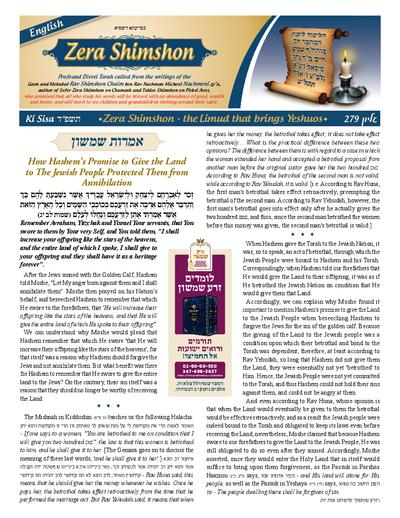
He gave to Moshe - when He finished speaking with him on Har Sinai - the two Tablets of the Testimony, stone Tablets inscribed by the Finger of Hashem.

The word, ככלתו, which means 'when he finished', is usually spelled ככלותו with the letter ו, but in this Passuk it's written defectively, missing the letter ו. Rashi discusses what the Torah is alluding to by spelling it this way.

ככלתו כתיב חסר, שנמסרה לו תורה במתנה ככלה לחתן, שלא היה יכול ללמוד כולה בזמן מועט כזה. - The word ככלתו is spelled defectively, as if it were vowelized, ככלתו, which means 'like his bride', for the Torah was given over to Moshe like a gift, as a bride is to a groom, because he was unable to learn all of the Torah in such a short time. This concept that Moshe had a hard time learning the Torah until he received it as a gift, is discussed in the Gemara Nedarim (לח ע"א) which says as follows.

בתחלה היה משה למד תורה ומשכחה עד שניתנה לו במתנה שנאמר ויתן אל משה ככלתו לדבר אתו - When Moshe ascended Har Sinai to receive the Torah from Hashem, Moshe would, at the beginning, learn Torah and forget what he learned, time after time. This continued until the Torah was finally given to Moshe by Hashem as a gift.

This entire matter needs explanation. Firstly, why did Moshe initially have such hard time retaining the Torah, and what did his ultimately receiving the Torah as a gift have to do with him finally being able to remember the Torah that he learned? And secondly, Rashi's analogy is difficult to understand, for since when is the bride given over as a gift to the groom?!

The Mishna in Kesubos

The Mishna in Kesubos (מח ע"א) delineates the point during which a young girl's husband assumes the rights which had initially been in her father's domain up until then. A young girl is always in the domain of her father until she enters her husband's domain. Once the father presents her to the husband, she enters the domain of her husband. However, if the father accompanies the husband, she is still in the domain of the father. But once the father delivers her to the husband, she enters the domain of her husband.

Accordingly, the Shulchan Aruch (אבה"ע סי' נז) rules as follows. At what point does a husband precede all others in the inheritance of his wife? When she leaves the domain of her father and enters the domain of her husband. How so? A girl who dies after her father delivered her to her husband, is inherited by her husband even though the dowry is still in her father's house. But a girl who dies while still being accompanied by her father, is inherited by her father, even if the dowry is already in her husband's house.

The Torah is likened, so to speak, to Hashem's daughter. This idea is clearly pointed out in the following parable that The Midrash (שמו"ר לג א) illustrates. There was a king who had an only daughter. Another king came and took her as a wife. Subsequently, the husband sought to return to his land with his wife. The father-in-law king said to him, "My daughter whom I have given to you is an only daughter; thus, I am unable to part with her. But I am equally unable to tell you not to take her to your land, for she is your wife. Rather, do this favor for me: Any place that you go, prepare a room so that I may dwell near you, for I am unable to leave my daughter". So too did Hashem say to the Jewish People, "I have given you the Torah. I am unable to part from it, but I am also unable to tell you not to take it. Rather, do this favor for me: Any place that you go, prepare a house for Me that I may dwell therein". As it is stated, 'They shall make a Sanctuary for Me, so that I may dwell among them'.

In view of the fact that the Torah is regarded as 'the daughter of Hashem', we can understand why Moshe was unable to inherit the Torah and assume its rights, as long as he was in Heaven, which is, so to speak, the domain of the Torah's father - Hashem. Therefore, initially, as long as Moshe was learning Torah in Heaven, he could not remember the Torah that he learned, for it did not truly belong to him yet.

But when 'Hashem gave the Torah to Moshe after He finished speaking with him' and Moshe and the Torah, so to speak, left Hashem's domain, at that point the Torah entered the domain of Moshe, just as a bride enters the domain of her husband, and the Torah's rights and inheritance, which is remembering the Torah, was given over as a gift to Moshe, just as the rights and inheritance of the bride are gifted to the husband. And indeed, from that point onward, Moshe began to remember all the Torah that he learned.

('זרע שמשון' פרשתנו אות ט)

PDF Preview

