Candid Remarks Reveal True Sentiments
BET Journal | September 12, 2025
Print This Article
View Original PDF

Candid Remarks Reveal True Sentiments

BET Journal | December 10, 2025

At the end of the parsha, Moshe summoned the Jewish people. He told them that they had witnessed all the miracles that Hashem had performed for them in Egypt and in the years since they left Egypt. Then, Moshe added the following, “Hashem did not give you a heart to know or eyes to see or ears to hear, until this day.” [Devorim 29:3]

There is a very unique Rashi on the expression “until this day”: “I have heard that the day on which Moshe gave the Torah scroll to the sons of Levi (as it is written, ‘Moshe wrote this Torah, and he gave it to the Kohanim, the sons of Levi’), all Israel came before Moshe and said to him, ‘Moshe, our master! We, too, stood at Sinai, and we accepted the Torah, and it was given to us. Why do you put the sons of your tribe in charge of it, so that one day, they may say to us, ‘It was not given to you. It was given to us.’? Moshe rejoiced over the matter. Regarding this, he said to them, ‘This day you have become a people to Hashem your G-d.’ That is, this day, I have understood that you cleave to and desire the Omnipresent.”

If we analyze this, it seems rather strange. The claim by the children of Israel that “It’s not fair!” seems kind of childish. Why would this incident, of all incidents, prove to Moshe Rabbeinu that they were, in fact, dedicated in their service and loyalty to the Almighty?

Rav Baruch Mordechai Ezrachi makes an interesting observation on this Rashi. Sometimes, you can see what a person is all about by their petty arguments, by what bothers them. Even though the argument may be unjustified or even ridiculous, it is still a barometer of what really agitates them. It is very revealing if what bothered the Jewish people was, “Why should the Tribe of Levi get the only copy of the Torah? They are no bigger owners of it than we are!” Granted, the argument may seem tainted with jealousy or somewhat beneath their dignity, but it clearly says, “We want the Torah, too!”

You can detect the truth in the small, candid moments of life. When G-d descended on Mt. Sinai, and the whole world stopped while Israel responded, “We will do and we will hear” (Na’aseh v’nishmah), those are the big moments of life. “This is my G-d, and I will glorify Him” is a big moment. It goes without saying that everyone will join in the chorus of such great moments of history. It is much more significant when people say, “We want the Torah, too!” in a candid and unrehearsed fashion, on a regular day, during the month of Adar. Then, Moshe Rabbeinu felt reassured that this was their true sentiment. Now, he was convinced that they truly wished to cling to the Ribbono Shel Olam. “This very day, you have become a people to Hashem your G-d.”

RABBI YISSACHAR FRAND
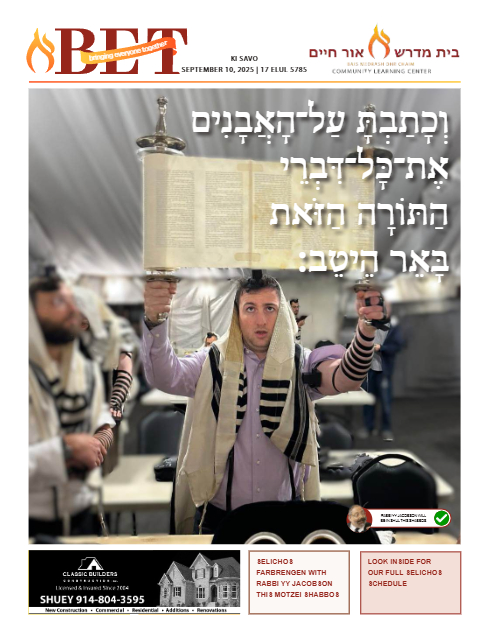
At the end of the parsha, Moshe summoned the Jewish people. He told them that they had witnessed all the miracles that Hashem had performed for them in Egypt and in the years since they left Egypt. Then, Moshe added the following, “Hashem did not give you a heart to know or eyes to see or ears to hear, until this day.” [Devorim 29:3]

There is a very unique Rashi on the expression “until this day”: “I have heard that the day on which Moshe gave the Torah scroll to the sons of Levi (as it is written, ‘Moshe wrote this Torah, and he gave it to the Kohanim, the sons of Levi’), all Israel came before Moshe and said to him, ‘Moshe, our master! We, too, stood at Sinai, and we accepted the Torah, and it was given to us. Why do you put the sons of your tribe in charge of it, so that one day, they may say to us, ‘It was not given to you. It was given to us.’? Moshe rejoiced over the matter. Regarding this, he said to them, ‘This day you have become a people to Hashem your G-d.’ That is, this day, I have understood that you cleave to and desire the Omnipresent.”

If we analyze this, it seems rather strange. The claim by the children of Israel that “It’s not fair!” seems kind of childish. Why would this incident, of all incidents, prove to Moshe Rabbeinu that they were, in fact, dedicated in their service and loyalty to the Almighty?

Rav Baruch Mordechai Ezrachi makes an interesting observation on this Rashi. Sometimes, you can see what a person is all about by their petty arguments, by what bothers them. Even though the argument may be unjustified or even ridiculous, it is still a barometer of what really agitates them. It is very revealing if what bothered the Jewish people was, “Why should the Tribe of Levi get the only copy of the Torah? They are no bigger owners of it than we are!” Granted, the argument may seem tainted with jealousy or somewhat beneath their dignity, but it clearly says, “We want the Torah, too!”

You can detect the truth in the small, candid moments of life. When G-d descended on Mt. Sinai, and the whole world stopped while Israel responded, “We will do and we will hear” (Na’aseh v’nishmah), those are the big moments of life. “This is my G-d, and I will glorify Him” is a big moment. It goes without saying that everyone will join in the chorus of such great moments of history. It is much more significant when people say, “We want the Torah, too!” in a candid and unrehearsed fashion, on a regular day, during the month of Adar. Then, Moshe Rabbeinu felt reassured that this was their true sentiment. Now, he was convinced that they truly wished to cling to the Ribbono Shel Olam. “This very day, you have become a people to Hashem your G-d.”

RABBI YISSACHAR FRAND

PDF Preview