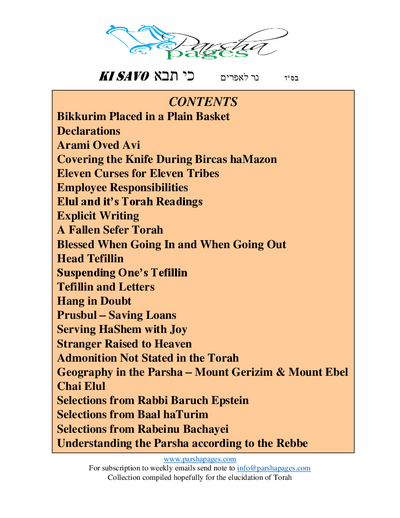
Declarations
Parsha Pages | August 27, 2023
Print This Article
View Original PDF

Declarations

Parsha Pages | December 31, 2025

SOTAH 32b: R. Shimon: One should mention his own praise in a low voice, is learnt from Viduy Ma'aser; One should mention his detriment in a loud voice is learnt from Mikra Bikurim.

Question: Here, R. Shimon says that detriment should be in a loud voice; Contradiction (R. Yochanan, citing R. Shimon): Prayer was instituted to be said quietly, to avoid embarrassing sinners, just like the Torah says to slaughter a Chatas (for a sin) in the same place (the north) as a (voluntary) Olah (so people will not know that he brings a Chatas).

Answer: Rather, one should discuss his affliction in a loud voice.
Beraisa): "He (a Metzora) will call out 'Tamei, Tamei'" - one should publicize his affliction, so others will ask HaShem to have mercy upon him. The same applies to one who lost a relative.

(R. Yochanan, citing R. Shimon): Prayer was instituted to be said quietly, to avoid embarrassing sinners, just like the Torah says to slaughter a Chatas in the same place as an Olah.

These two Mitzvos share many common features and are placed next in each other in the Torah. Yet they do have differences:

  • Mikra Bikurim – only said in Lashon haKodesh (Hebrew), is done in plural format and is said in a “loud” voice
  • Viduy Ma’aser – can be said in any language, is one in single format and is said in a “low” voice

Why the differences between Mikra Bikurim and Viduy Ma’aser?

The Torah Temimah explains that the purpose of the Bikurim declaration is to publicize and make know to the public the words that are proclaimed. This declaration is a testimony of thanksgiving and praise to HaShem. Thus, the declaration is for the sake of those hearing. The plural language includes the listener, Hebrew is a mutually-shared language, and is said loudly for all to hear.

Whereas, the declaration of Viduy Ma’aser is directed towards the confessor. Thus, the person needs to understand the language of the declaration, is only for that one person, and is said lowly in order to avoid self-aggrandizement.

VIDUY MA'ASER

(a) The Torah requires that at two times during the seven-year Shemitah cycle the owner of a field must recite Viduy Ma'aser (confession of leftover tithes), as is learned from Devarim 26:12-13.

(b) In the afternoon of Erev Pesach (Rambam states the afternoon of the last day of Pesach) in the fourth and seventh years, the owner first performs Bi'ur, giving all remaining Terumah and Terumas Ma'aser to Kohanim, Ma'aser Rishon to Leviyim, and Ma'aser Ani to the poor. All remaining Ma'aser Sheni, Pidyonos of Ma'aser Sheni (coins on which Ma'aser Sheni was redeemed), and Bikurim must be destroyed wherever they are.

(c) He then says Viduy Ma'aser, declaring that he has set aside all of the required tithes and gifts, and that he kept all the Mitzvos with regard to them. The declaration is found in Devarim 26:13-15, and may be recited in any language that the owner understands.

MIKRA BIKURIM

(a) The Mitzvah of Bikurim consists of bringing the first fruits to emerge in one's field every year to the Beis haMikdash. While the basket was on his shoulder, the owner recites the Mikra Bikurim, specific verses from Devarim (26:3, 5 - 10) thanking HaShem for taking us out of Egypt and giving us the land of Yisrael. He then places the basket of fruit at the base of the southwestern corner of the Mizbe'ach and bows down before HaShem. Afterwards, he gives the Bikurim to a Kohen.

(b) The Mitzvah of Bikurim applies only to the seven species with which the land of Eretz Yisrael was blessed (Devarim 8:8) -- wheat, barley, grapes, figs, pomegranates, olives and dates.

(c) In certain instances, the owner only brings the fruit, without reciting the declaration (Mevi v'Eino Korei). For example, if he brings them between Sukkos and Chanukah, he does not recite the verses.

(d) Kohanim eat the Bikurim within the walls of Yerushalayim. If a person eats them outside of Yerushalayim after the Bikurim have entered Yerushalayim (according to the Rambam, or after the Bikurim have entered the Azarah according to Rashi in Makkos 18b), he receives Malkos. They must be brought back into Yerushalayim and eaten there.

How does Rabi Shimon state that prayer was instituted to be said silently, when we evidently learn this concept from a verse in Tanach from Chanah?

Rabbi Shimon uses the work תקנו which implies that Chaza”l instituted this concept, where it is an apparent verse "וקולה לא ישמע".

Maharitz Chayos declares that matters from the Prophets are also called תקנות (decrees) as well as the from the Anshei Kenesses haGadolah, even though the concept is directly said in a verse in Tanach.

Yalkut haMeiri answers that without the decree of Chaza”l we might have concluded that this action was specifically for Chanah who was a prophetess and on a high spiritual level who hear the voice of HaShem and did not need to speak to HaShem with a “voice” to be heard. However, the common person would need to articulate the words of prayer with a “voice” until Chaza”l instituted that prayer should not be said loudly.

Sefer haPardes suggests that Chanah learnt the concept of silent prayer from the Torah that placed the slaughter of the Korban Chatos in the same place as the Korban Olah in order to avoid embarrassing the sinner. In that time period, Chanah and the Bais Din of that time instituted to say prayer silently.

What is the reason for the decree not to raise one’s voice in prayer? The Gemara in Berachos 24b states that one who raises his voice in prayer is called קטני אמונה (small in faith) since it appears that this person is suggesting that HaShem does not hear his prayer unless he says in loudly. This seems to contradict the concept that a decree was made not to raise one’s voice in prayer for the reason not to embarrass a sinner.

Maharsha responds that calling one a קטני אמונה for raising one’s voice in prayer only occurs after the decree was established for the initial reason of not embarrassing a sinner.

Iyun Yaacov answers that one is only called a קטני אמונה when one raises his voice louder than his normal voice for prayer. One is not called קטני אמונה if one uses one’s normal voice. The decree was to speak quietly (not one’s normal voice) so that another would not hear one’s words.

Do Not Raise Your Voice in Prayer to HaShem

(Shmoneh Esreh) אורח חיים ק"א סימן ג'

  • Prayer like speaking מבקש צרכיו רמב"ם
  • Speak quietly due to awe in the presence of the King
  • Proper intention עבודה שבלב בית יוסף
  • Requires quiet speech
  • Loud prayer disturbs oneself
  • In Atzilus, world of unity, to stand before G-d in complete bitul זוהר (פנימיות התורה)
  • Words not even heard by one’s own ears

What is learnt from the verse "He (a Metzora) will call out 'Tamei, Tamei'"?

Rashi implies that the Metzora calls out so others may keep their distance from contact with tumah. This seems to contradict our Gemara that one should publicize his affliction, so others will ask HaShem to have mercy upon him.

Ikvei Yaakov suggests that if one would say “tamei” only once another would not understand that the person is tameh and would also not request mercy. Therefore, the verse says the Metzora says “tamei, tamei” twice which makes clear that he is tameh and another person would now know to request mercy from HaShem.

Others explain that the main point of the declaration (as mentioned by Rashi) is to make known to others to distance themselves from the Metzora. The verse says a second time “tamei” in order that the other person will know request mercy from HaShem.
SOTAH 32b: R. Shimon: One should mention his own praise in a low voice, is learnt from Viduy Ma'aser; One should mention his detriment in a loud voice is learnt from Mikra Bikurim.

Question: Here, R. Shimon says that detriment should be in a loud voice; Contradiction (R. Yochanan, citing R. Shimon): Prayer was instituted to be said quietly, to avoid embarrassing sinners, just like the Torah says to slaughter a Chatas (for a sin) in the same place (the north) as a (voluntary) Olah (so people will not know that he brings a Chatas).

Answer: Rather, one should discuss his affliction in a loud voice.
Beraisa): "He (a Metzora) will call out 'Tamei, Tamei'" - one should publicize his affliction, so others will ask HaShem to have mercy upon him. The same applies to one who lost a relative.

(R. Yochanan, citing R. Shimon): Prayer was instituted to be said quietly, to avoid embarrassing sinners, just like the Torah says to slaughter a Chatas in the same place as an Olah.

These two Mitzvos share many common features and are placed next in each other in the Torah. Yet they do have differences:

  • Mikra Bikurim – only said in Lashon haKodesh (Hebrew), is done in plural format and is said in a “loud” voice
  • Viduy Ma’aser – can be said in any language, is one in single format and is said in a “low” voice

Why the differences between Mikra Bikurim and Viduy Ma’aser?

The Torah Temimah explains that the purpose of the Bikurim declaration is to publicize and make know to the public the words that are proclaimed. This declaration is a testimony of thanksgiving and praise to HaShem. Thus, the declaration is for the sake of those hearing. The plural language includes the listener, Hebrew is a mutually-shared language, and is said loudly for all to hear.

Whereas, the declaration of Viduy Ma’aser is directed towards the confessor. Thus, the person needs to understand the language of the declaration, is only for that one person, and is said lowly in order to avoid self-aggrandizement.

VIDUY MA'ASER

(a) The Torah requires that at two times during the seven-year Shemitah cycle the owner of a field must recite Viduy Ma'aser (confession of leftover tithes), as is learned from Devarim 26:12-13.

(b) In the afternoon of Erev Pesach (Rambam states the afternoon of the last day of Pesach) in the fourth and seventh years, the owner first performs Bi'ur, giving all remaining Terumah and Terumas Ma'aser to Kohanim, Ma'aser Rishon to Leviyim, and Ma'aser Ani to the poor. All remaining Ma'aser Sheni, Pidyonos of Ma'aser Sheni (coins on which Ma'aser Sheni was redeemed), and Bikurim must be destroyed wherever they are.

(c) He then says Viduy Ma'aser, declaring that he has set aside all of the required tithes and gifts, and that he kept all the Mitzvos with regard to them. The declaration is found in Devarim 26:13-15, and may be recited in any language that the owner understands.

MIKRA BIKURIM

(a) The Mitzvah of Bikurim consists of bringing the first fruits to emerge in one's field every year to the Beis haMikdash. While the basket was on his shoulder, the owner recites the Mikra Bikurim, specific verses from Devarim (26:3, 5 - 10) thanking HaShem for taking us out of Egypt and giving us the land of Yisrael. He then places the basket of fruit at the base of the southwestern corner of the Mizbe'ach and bows down before HaShem. Afterwards, he gives the Bikurim to a Kohen.

(b) The Mitzvah of Bikurim applies only to the seven species with which the land of Eretz Yisrael was blessed (Devarim 8:8) -- wheat, barley, grapes, figs, pomegranates, olives and dates.

(c) In certain instances, the owner only brings the fruit, without reciting the declaration (Mevi v'Eino Korei). For example, if he brings them between Sukkos and Chanukah, he does not recite the verses.

(d) Kohanim eat the Bikurim within the walls of Yerushalayim. If a person eats them outside of Yerushalayim after the Bikurim have entered Yerushalayim (according to the Rambam, or after the Bikurim have entered the Azarah according to Rashi in Makkos 18b), he receives Malkos. They must be brought back into Yerushalayim and eaten there.

How does Rabi Shimon state that prayer was instituted to be said silently, when we evidently learn this concept from a verse in Tanach from Chanah?

Rabbi Shimon uses the work תקנו which implies that Chaza”l instituted this concept, where it is an apparent verse "וקולה לא ישמע".

Maharitz Chayos declares that matters from the Prophets are also called תקנות (decrees) as well as the from the Anshei Kenesses haGadolah, even though the concept is directly said in a verse in Tanach.

Yalkut haMeiri answers that without the decree of Chaza”l we might have concluded that this action was specifically for Chanah who was a prophetess and on a high spiritual level who hear the voice of HaShem and did not need to speak to HaShem with a “voice” to be heard. However, the common person would need to articulate the words of prayer with a “voice” until Chaza”l instituted that prayer should not be said loudly.

Sefer haPardes suggests that Chanah learnt the concept of silent prayer from the Torah that placed the slaughter of the Korban Chatos in the same place as the Korban Olah in order to avoid embarrassing the sinner. In that time period, Chanah and the Bais Din of that time instituted to say prayer silently.

What is the reason for the decree not to raise one’s voice in prayer? The Gemara in Berachos 24b states that one who raises his voice in prayer is called קטני אמונה (small in faith) since it appears that this person is suggesting that HaShem does not hear his prayer unless he says in loudly. This seems to contradict the concept that a decree was made not to raise one’s voice in prayer for the reason not to embarrass a sinner.

Maharsha responds that calling one a קטני אמונה for raising one’s voice in prayer only occurs after the decree was established for the initial reason of not embarrassing a sinner.

Iyun Yaacov answers that one is only called a קטני אמונה when one raises his voice louder than his normal voice for prayer. One is not called קטני אמונה if one uses one’s normal voice. The decree was to speak quietly (not one’s normal voice) so that another would not hear one’s words.

Do Not Raise Your Voice in Prayer to HaShem

(Shmoneh Esreh) אורח חיים ק"א סימן ג'

  • Prayer like speaking מבקש צרכיו רמב"ם
  • Speak quietly due to awe in the presence of the King
  • Proper intention עבודה שבלב בית יוסף
  • Requires quiet speech
  • Loud prayer disturbs oneself
  • In Atzilus, world of unity, to stand before G-d in complete bitul זוהר (פנימיות התורה)
  • Words not even heard by one’s own ears

What is learnt from the verse "He (a Metzora) will call out 'Tamei, Tamei'"?

Rashi implies that the Metzora calls out so others may keep their distance from contact with tumah. This seems to contradict our Gemara that one should publicize his affliction, so others will ask HaShem to have mercy upon him.

Ikvei Yaakov suggests that if one would say “tamei” only once another would not understand that the person is tameh and would also not request mercy. Therefore, the verse says the Metzora says “tamei, tamei” twice which makes clear that he is tameh and another person would now know to request mercy from HaShem.

Others explain that the main point of the declaration (as mentioned by Rashi) is to make known to others to distance themselves from the Metzora. The verse says a second time “tamei” in order that the other person will know request mercy from HaShem.

PDF Preview