Mount Gerizim and Mount Ebal
Parsha Pages | August 27, 2023
Print This Article
View Original PDF

Mount Gerizim and Mount Ebal

Parsha Pages | December 31, 2025

The Importance of the Covenant at Mount Gerizim and Mount Ebal

The location that lies at the heart of Parashat Ki Tavo is undoubtedly Mount Gerizim and Mount Ebal. The covenant of Mount Gerizim and Mount Ebal seems to be quite an important mitzvain the context of Deuteronomy. It is mentioned twice in Deuteronomy, in extremely significant places. The book of Deuteronomy is divided into three parts, and since Parashat Ki Tavo is always read at the end of the month of Elul, it is only fitting to compare this three-part division to the three parts of each shofar blast on Rosh Ha-shana. It is well known that each blast (teru’a) is accompanied by a “plain blast” (teki’a) before it and after it, totaling three distinct sounds. The book of Deuteronomy is constructed using a similar format: In the beginning, Moses presents the basic tenets of faith (Parashiyot Devarim, Va’etchanan and Ekev); then comes the complex and diverse list of mitzvot (Re’eh, Shoftim, Ki Tetze, and the beginning of Ki Tavo); and finally the “plain blast” returns – the covenant is forged, accompanied by song and blessing.

It is interesting that it is precisely at the two points of transition between the three sections that the mitzva to bless and curse at Mount Gerizim and Mount Ebal occurs. The first time, this mitzva appears only briefly, at the end of the faith chapters of Deuteronomy and before the start of the list of mitzvot in the opening to Parashat Re’eh. The second time, it is described at length in Parashat Ki Tavo, after the mitzvotsection and before the covenant section. This demonstrates that the book of Deuteronomy assigns unique significance to the blessing and curse ritual that took place between Mount Gerizim and Mount Ebal. Its textual placement between the principles of faith and the mitzva details seemingly teaches us that within the essence of this transition lies the connection between lofty principles and practical actions.

The outsize importance of the mitzva to read the blessing and the curse between Mount Gerizim and Mount Ebal is especially striking in light of the fact that the mitzva is not applicable for future generations. It was a one-time event that captivated the hearts of the entire nation at the time of their entry into the land of Canaan. It may be that the final two commandments in the Torah – the mitzva of hak’hel, which renews the covenant every seven years, and the mitzva to write down the song of Ha’azinu for future generations, “in order that this poem may be My witness against the people of Israel” (Deuteronomy 31:19) – represent an intergenerational vehicle for the message of this one-time event. Be that as it may, this is an exceptionally unique mitzva, one that was intended from the start to be fulfilled one time only. In addition, the Torah dedicates considerable attention to the details of the mitzva and to the precise location where it was set to take place. In order for us to understand the essence of this event, we must first try to understand the details of this mitzva, as well as the framework for the time and place that the Torah designates for its fulfillment. It is easy to become lost in the sea of rabbinic commentary on this question, so we will not attempt to review all of the opinions and possibilities. Instead we will attempt to forge directly to the crux of the matter.

Why Specifically on Mount Gerizim and Mount Ebal?

What is the unique significance of this place? And why was the city of Shechem not mentioned explicitly in the Torah’s description of the location.

The first idea was proposed by Henry Baker Tristram (1822-1906), a Christian scholar who possessed great love and knowledge of the Tanakh. Tristram toured the land and studied its sites, focusing specifically on their flora and fauna, about 150 years ago. He scaled Mount Gerizim, reaching its peak on December 21, 1863. According to Tristram, Mount Gerizim was chosen for the blessing and curse ceremony, and later as the site where Jotham delivered his parable, because of the unique acoustic effect created by the two tall mountains that enclose the Shechem valley. Tristram writes:

A single voice might be heard by many thousands, shut in and conveyed up and down by the enclosing hills. In the early morning we could not only see from Gerizim a man driving his ass down a path on Mount Ebal, but could hear every word he uttered as he urged it on; and in order to test the matter more certainly, on a subsequent occasion two of our party stationed themselves on opposite sides of the valley, and with perfect ease recited the commandments antiphonally.

I do not know what inspired Tristram’s companions to recite the Ten Commandments specifically for this test, but the key point here is the technical appropriateness of the location for its purpose, as Tristram states: “It is impossible to conceive a spot more admirably adapted for the purpose than this one.” It is interesting to note that Eusebius, the Greek bishop of Caesarea around 320 CE, believed that Mount Gerizim and Mount Ebal near Shechem are not the actual mountains in question, since “they are not able to hear one another when calling out from one” (Onomasticon64:13-15). Tristram’s “test” and my own personal experience (as well as that of many others) seem to belie this statement.

While Tristram’s account is as charming as it is true, it is somewhat difficult to suffice with such a technical explanation for such a portentous choice.
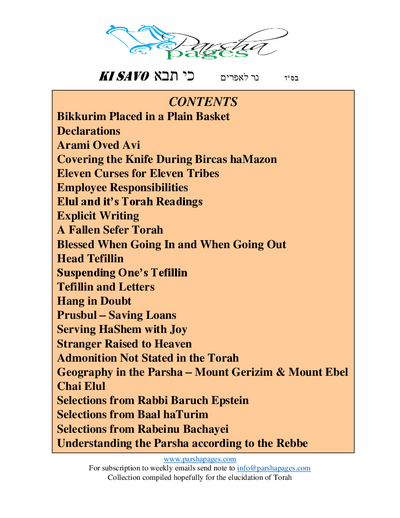
The Importance of the Covenant at Mount Gerizim and Mount Ebal

The location that lies at the heart of Parashat Ki Tavo is undoubtedly Mount Gerizim and Mount Ebal. The covenant of Mount Gerizim and Mount Ebal seems to be quite an important mitzvain the context of Deuteronomy. It is mentioned twice in Deuteronomy, in extremely significant places. The book of Deuteronomy is divided into three parts, and since Parashat Ki Tavo is always read at the end of the month of Elul, it is only fitting to compare this three-part division to the three parts of each shofar blast on Rosh Ha-shana. It is well known that each blast (teru’a) is accompanied by a “plain blast” (teki’a) before it and after it, totaling three distinct sounds. The book of Deuteronomy is constructed using a similar format: In the beginning, Moses presents the basic tenets of faith (Parashiyot Devarim, Va’etchanan and Ekev); then comes the complex and diverse list of mitzvot (Re’eh, Shoftim, Ki Tetze, and the beginning of Ki Tavo); and finally the “plain blast” returns – the covenant is forged, accompanied by song and blessing.

It is interesting that it is precisely at the two points of transition between the three sections that the mitzva to bless and curse at Mount Gerizim and Mount Ebal occurs. The first time, this mitzva appears only briefly, at the end of the faith chapters of Deuteronomy and before the start of the list of mitzvot in the opening to Parashat Re’eh. The second time, it is described at length in Parashat Ki Tavo, after the mitzvotsection and before the covenant section. This demonstrates that the book of Deuteronomy assigns unique significance to the blessing and curse ritual that took place between Mount Gerizim and Mount Ebal. Its textual placement between the principles of faith and the mitzva details seemingly teaches us that within the essence of this transition lies the connection between lofty principles and practical actions.

The outsize importance of the mitzva to read the blessing and the curse between Mount Gerizim and Mount Ebal is especially striking in light of the fact that the mitzva is not applicable for future generations. It was a one-time event that captivated the hearts of the entire nation at the time of their entry into the land of Canaan. It may be that the final two commandments in the Torah – the mitzva of hak’hel, which renews the covenant every seven years, and the mitzva to write down the song of Ha’azinu for future generations, “in order that this poem may be My witness against the people of Israel” (Deuteronomy 31:19) – represent an intergenerational vehicle for the message of this one-time event. Be that as it may, this is an exceptionally unique mitzva, one that was intended from the start to be fulfilled one time only. In addition, the Torah dedicates considerable attention to the details of the mitzva and to the precise location where it was set to take place. In order for us to understand the essence of this event, we must first try to understand the details of this mitzva, as well as the framework for the time and place that the Torah designates for its fulfillment. It is easy to become lost in the sea of rabbinic commentary on this question, so we will not attempt to review all of the opinions and possibilities. Instead we will attempt to forge directly to the crux of the matter.

Why Specifically on Mount Gerizim and Mount Ebal?

What is the unique significance of this place? And why was the city of Shechem not mentioned explicitly in the Torah’s description of the location.

The first idea was proposed by Henry Baker Tristram (1822-1906), a Christian scholar who possessed great love and knowledge of the Tanakh. Tristram toured the land and studied its sites, focusing specifically on their flora and fauna, about 150 years ago. He scaled Mount Gerizim, reaching its peak on December 21, 1863. According to Tristram, Mount Gerizim was chosen for the blessing and curse ceremony, and later as the site where Jotham delivered his parable, because of the unique acoustic effect created by the two tall mountains that enclose the Shechem valley. Tristram writes:

A single voice might be heard by many thousands, shut in and conveyed up and down by the enclosing hills. In the early morning we could not only see from Gerizim a man driving his ass down a path on Mount Ebal, but could hear every word he uttered as he urged it on; and in order to test the matter more certainly, on a subsequent occasion two of our party stationed themselves on opposite sides of the valley, and with perfect ease recited the commandments antiphonally.

I do not know what inspired Tristram’s companions to recite the Ten Commandments specifically for this test, but the key point here is the technical appropriateness of the location for its purpose, as Tristram states: “It is impossible to conceive a spot more admirably adapted for the purpose than this one.” It is interesting to note that Eusebius, the Greek bishop of Caesarea around 320 CE, believed that Mount Gerizim and Mount Ebal near Shechem are not the actual mountains in question, since “they are not able to hear one another when calling out from one” (Onomasticon64:13-15). Tristram’s “test” and my own personal experience (as well as that of many others) seem to belie this statement.

While Tristram’s account is as charming as it is true, it is somewhat difficult to suffice with such a technical explanation for such a portentous choice.

PDF Preview