Understanding the Parsha according to the Rebbe
Ben Chamesh L'Mikra | August 27, 2023
Print This Article
View Original PDF

Understanding the Parsha according to the Rebbe

Ben Chamesh L'Mikra | December 31, 2025

QUESTION: The command “to walk in His Paths” (ללכת בדרכיו) seems to be a general command. What is special about this mitzvah that confirms its listing as unique Mitzvah?

ANSWER: Angels are considered as if in a constant state of “standing” (thus, only one leg), they can not change or advance. People are considered “goers” (thus, people have two legs). We are mobile and can change and advance in spiritual levels. It is possible for us to perform a mitzvah and to remain stationary - finding oneself in the same state as before. However, this mitzvah of “walking in His path” is unique since it propels the individual into motion, to leave the previous station and go to a higher spiritual rank. Thus, this action is listed as a particular mitzvah.

QUESTION: Why does the Mitzvah of “First Fruits” only apply after 14 years of conquering and division of the land of Israel? (Thus, those that had First Fruits during those first 14 years were unable to make public declaration of their faith and thanksgiving to HaShem during that period.)

ANSWER: The bringing of the First Fruits began only after the complete good in inheriting the land (and not just entering the Land); complete good could only happen after everyone received their portion. This concept of total unity of Ahavas Yisrael is also reflected by both luminaries of Chai Elul, Baal Shem Tov and Alter Rebbe.

QUESTION: What is the purpose of the admonitions in this week’s Parsha?

ANSWER: Ultimate purpose of the admonitions is to lead the Jews to Teshuvah and a higher level than before, as reflected in the final verse (28, 68).

והתמכרתם שם לאיביך

There, you will offer yourselves for sale to your enemies

“There” in the realms of the forbidden, a Baal Teshuvah will “offer oneself for sale” spiritually elevate, “your enemies” the forbidden interactions from prior to Teshuvah

לעבדים ולשפחות

As slaves and handmaidens

Being a master of self control, the Baal Teshuvah is compared to a slave who does not find the tasks easy, but does them nonetheless with utmost dedication

ואין קונה

But there will be no buyer

“because they will decree death upon you” the Baal Teshuvah manages to “kill” the obsession with pleasures of the world, yearning to become one with G-d revealing אין which is higher than קונה

QUESTION: What does it mean that HaShem “regrets” Galus?

ANSWER: Galus only has a negative side without an intrinsic existence. Thus, HaShem “regrets” since in the final view, Galus has no value. In terms of our service, we should not let Galus cloud or disrupt us since it has no value (though we can not make peace with Galus or not stop our efforts for its end).
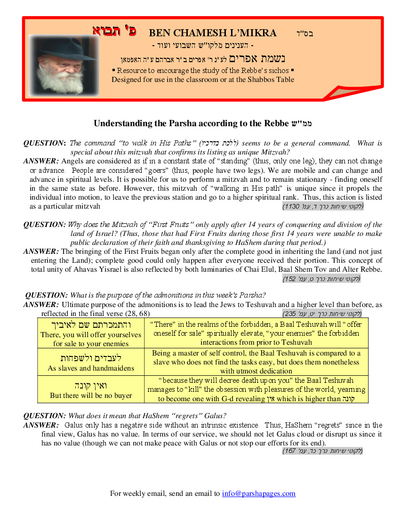
QUESTION: The command “to walk in His Paths” (ללכת בדרכיו) seems to be a general command. What is special about this mitzvah that confirms its listing as unique Mitzvah?

ANSWER: Angels are considered as if in a constant state of “standing” (thus, only one leg), they can not change or advance. People are considered “goers” (thus, people have two legs). We are mobile and can change and advance in spiritual levels. It is possible for us to perform a mitzvah and to remain stationary - finding oneself in the same state as before. However, this mitzvah of “walking in His path” is unique since it propels the individual into motion, to leave the previous station and go to a higher spiritual rank. Thus, this action is listed as a particular mitzvah.

QUESTION: Why does the Mitzvah of “First Fruits” only apply after 14 years of conquering and division of the land of Israel? (Thus, those that had First Fruits during those first 14 years were unable to make public declaration of their faith and thanksgiving to HaShem during that period.)

ANSWER: The bringing of the First Fruits began only after the complete good in inheriting the land (and not just entering the Land); complete good could only happen after everyone received their portion. This concept of total unity of Ahavas Yisrael is also reflected by both luminaries of Chai Elul, Baal Shem Tov and Alter Rebbe.

QUESTION: What is the purpose of the admonitions in this week’s Parsha?

ANSWER: Ultimate purpose of the admonitions is to lead the Jews to Teshuvah and a higher level than before, as reflected in the final verse (28, 68).

והתמכרתם שם לאיביך

There, you will offer yourselves for sale to your enemies

“There” in the realms of the forbidden, a Baal Teshuvah will “offer oneself for sale” spiritually elevate, “your enemies” the forbidden interactions from prior to Teshuvah

לעבדים ולשפחות

As slaves and handmaidens

Being a master of self control, the Baal Teshuvah is compared to a slave who does not find the tasks easy, but does them nonetheless with utmost dedication

ואין קונה

But there will be no buyer

“because they will decree death upon you” the Baal Teshuvah manages to “kill” the obsession with pleasures of the world, yearning to become one with G-d revealing אין which is higher than קונה

QUESTION: What does it mean that HaShem “regrets” Galus?

ANSWER: Galus only has a negative side without an intrinsic existence. Thus, HaShem “regrets” since in the final view, Galus has no value. In terms of our service, we should not let Galus cloud or disrupt us since it has no value (though we can not make peace with Galus or not stop our efforts for its end).

PDF Preview