ABSTRACT Likkutei Sichos Part 2
Ben Chamesh L'Mikra | September 12, 2024
Print This Article
View Original PDF

ABSTRACT Likkutei Sichos Part 2

Ben Chamesh L'Mikra | June 27, 2025

Before one can attain love of HaShem, one needs to separate from worldly desires. Two approaches: “kiddushin” separation from worldly desires, followed by “kesef” love of HaShem; or, love of HaShem “kesef” followed by separation from worldly desires “kiddushin”.

Even when in a high state of holiness (Shabbos) one must be careful of subtle rebellion to G-d (Amalek). “Remember the Shabbos” and “remember what Amalek did” share the concepts of remembrance in speech and of a state of constant remembrance. Amalek has its source in holiness.

The essence of everyone’s soul does not sin; learning the concealed Torah (Chassidus) reveals the concealed part of the soul. Ari z”l praised the Ramak from this verse that his passing was only due to the tree of knowledge which brought death into the world, as opposed to the “four Tzadikim” who passed away due to the snake.

TWO LEVELS OF TZADIKIM (and of Tzidkus by individuals)

THE FOUR TZADIKIMRAMAKDeath due to Zuhamah from the SnakeDeath due to Tree of KnowledgeExternal חיצוניות הנשמהInternal פנימיות הנשמהExternal connection to evil in the worldReveals G-d’s plan for death in the worldSense of Self גוףSense of G-d נשמהנגלה שבתורהתורת חסידות

A roof as the highest part of the structure refers to one’s ego, which needs a guardrail to prevent a spiritual falling. In the Bais HaMikdash one is obligated to make a guard-rail since it is a dwelling place (by eating). But one is not obligated to make a guard-rail in a synagogue or a Bais Medrash.

Concept of adding kedusha and light is by bringing together two opposing forces. Mitzvah of not plowing together an ox and a donkey (Torah refers to common in that time). Different understanding of this Mitzvah between the Rosh and the Rambam (see chart below).

Act of declaring the litigant “righteous” brings to a negation of one’s “wickedness”. Rashi sees from the unusual word “quarrel” that the judgment in court will not bring peace between the opposing parties; nevertheless, the court must issue their ruling.
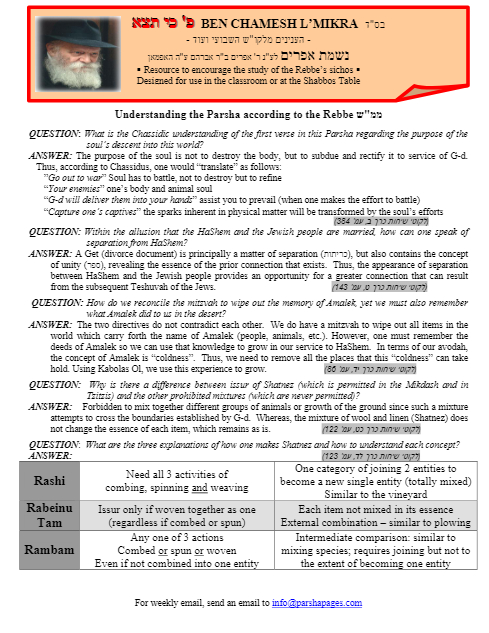
Before one can attain love of HaShem, one needs to separate from worldly desires. Two approaches: “kiddushin” separation from worldly desires, followed by “kesef” love of HaShem; or, love of HaShem “kesef” followed by separation from worldly desires “kiddushin”.

Even when in a high state of holiness (Shabbos) one must be careful of subtle rebellion to G-d (Amalek). “Remember the Shabbos” and “remember what Amalek did” share the concepts of remembrance in speech and of a state of constant remembrance. Amalek has its source in holiness.

The essence of everyone’s soul does not sin; learning the concealed Torah (Chassidus) reveals the concealed part of the soul. Ari z”l praised the Ramak from this verse that his passing was only due to the tree of knowledge which brought death into the world, as opposed to the “four Tzadikim” who passed away due to the snake.

TWO LEVELS OF TZADIKIM (and of Tzidkus by individuals)

THE FOUR TZADIKIMRAMAKDeath due to Zuhamah from the SnakeDeath due to Tree of KnowledgeExternal חיצוניות הנשמהInternal פנימיות הנשמהExternal connection to evil in the worldReveals G-d’s plan for death in the worldSense of Self גוףSense of G-d נשמהנגלה שבתורהתורת חסידות

A roof as the highest part of the structure refers to one’s ego, which needs a guardrail to prevent a spiritual falling. In the Bais HaMikdash one is obligated to make a guard-rail since it is a dwelling place (by eating). But one is not obligated to make a guard-rail in a synagogue or a Bais Medrash.

Concept of adding kedusha and light is by bringing together two opposing forces. Mitzvah of not plowing together an ox and a donkey (Torah refers to common in that time). Different understanding of this Mitzvah between the Rosh and the Rambam (see chart below).

Act of declaring the litigant “righteous” brings to a negation of one’s “wickedness”. Rashi sees from the unusual word “quarrel” that the judgment in court will not bring peace between the opposing parties; nevertheless, the court must issue their ruling.

PDF Preview