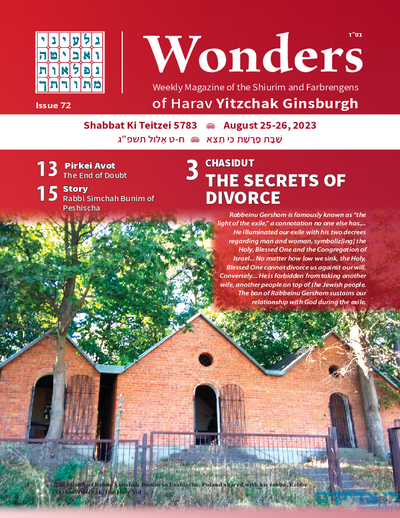
Divorce and Remarrying
The seeming physical lust and attraction that a warrior feels to the beautiful maiden taken prisoner in battle stems from a true soul connection between the two, and not just from physical desire. Similarly, regarding the laws of divorce, which also appear in parashat Ki Teitzei (which opens with the law of the beautiful maiden), there is the issue of the true soul connection between a man and a woman. Thus, when a divorce is a result of the husband feeling that he has found someone whom he is attracted to more than his wife—and we are of course speaking here of a true connection, when the husband is absolutely free from suspicion of catering to his evil inclination (a very rare event indeed)—such a divorce and a subsequent marriage to another woman also testifies to a true match between the two, unlike the connection between the man and his first wife.
However, even though the divorce that is permitted by Torah stems from a lack of true compatibility between the couple, the first marriage was also ordained from Heaven, and there is sorrow over the separation of the two through their divorce:
Therefore, the sages said that the altar sheds tears on it [the separation].
Divorce and Remarrying
And just as certainly as her match is from heaven, so is the divorce. Just as God matches couples in their first betrothals, so it is He who brings about divorce. Why did Divine Providence decree that a woman would marry someone who would eventually be revealed as the wrong match for her—not her true match? Apparently, the process causes some specific rectification in her life. Indeed, it is not only marriages that end in divorce that act towards this end. It is written that even a shidduch [matchmaking] proposal that never materialized, brings about some rectification. In a very colorful description, Rebbe Nachman tells us that every match is a proposal held by a particular angel, and a match that has reached the general marriage is entirely from God, therefore every proposal brings about a rectification, even though the proposed man is not her true match; that is the reason that Divine Providence so decreed.
Indeed, just as there was a certain rectification attained by means of the marriage, there is also a rectification that happens by means of the divorce, and in the end, it serves as a preparation for the true marriage that will come later:
Therefore, it indeed serves her lifelong rectification to connect her [with the divorce] to the Torah from which all details emerge. And therefore this is done specifically with a “book of cutting-off.”
Divorce provides a woman with her lifelong rectification by bonding her with the Torah—the “book” that is alluded to in the concept of “the book of cutting-off.” We see here that the bond with the Torah acts like an intermediate. Immediately upon receiving the divorce, without a moment's delay, the woman connects to the Torah, for the purpose marrying her true match. The woman's connection to the Torah, “the supernal wisdom,” serves as the intermediate state of nothingness (“wisdom emerges from nothingness”) that connects every two states of being. It is the connection with Torah that set the stage for the emergence of her true match like the emergence of creation ex nihilo—being out of nothing. The Torah is all-inclusive (“the all-inclusive intellect,” as noted earlier) out of which all the specific details emerge. Yet this all-inclusive state appears like a state of nothingness in relation to all the details that will emerge from it but which are not yet identified within it. In the end, from the general connection to the Torah in divorce, the woman will get the detail that suits her for her true marriage.
The tight transition between being divorced and being connected to the Torah that leads to a second marriage is further alluded to in the Torah’s wording, “She will exit [her first marriage]... then she will be [wed].” Even if it takes time until the woman finds her second, true match, the Torah’s wording implies that spiritually it happens immediately, because she immediately connects and bonds with the Torah:
Therefore, our sages said, “her divorce is juxtaposed with her marriage,” specifically at the moment of leaving her marriage, she acquires her future marriage, as long as she was included and connected to the Torah and the supernal wisdom.