Feeling Proud III
The Weekly Farbrengen | September 05, 2025
Print This Article
View Original PDF

Feeling Proud III

The Weekly Farbrengen | December 10, 2025

STRONG IDENTITY

The chossid Reb Michoel Teitelbaum once related:

My father, Reb Chaim Moshe, dealt in logs and would travel by train regularly. As a young boy, I accompanied him on one of these long trips. When the sun rose and it was time to daven Shacharis, my father took out his tallis and tefillin and began to prepare himself. The car was filled with noisy Russian peasants, but my father was completely oblivious to his surroundings. As he stood up to put on his tallis, the car suddenly fell silent. My father davened at his usual pace and during the entire time nobody spoke. As soon as he finished and sat down, the loud talking resumed. I of course shared my surprise with my father.

He later told me that when he first began travelling by train he consulted with the Rebbe Rashab. At that time it was dangerous for a Yid to travel by train since it was common for hooligans to throw Yidden out of the door as it was moving. My father asked the Rebbe if when he was davening on the train he should perhaps cover his tallis and tefillin with a coat and a hat. The Rebbe replied, “If you won’t stand proud in your Yiddishkeit, of whom can we expect it?”

From that day on, my father davened on the train without embarrassment, and the goyim accordingly respected him for it.

(מפי השמועה)

In a sicha addressed to women, the Rebbe spoke about the importance of keeping separate by wearing distinctive clothing:

The zechus which enabled the Yidden to leave Mitzrayim was that the men and women held onto the Yiddishe way of dress, and were not influenced by the garb, nor by the behavior of the mitzriyim around them. Knowing that they were an am echad, it was self-understood that as Yidden, they should not lower themselves. For, does it make sense that just because a mitzri has decided to wear certain clothing, a Yid should copy him?!

We can learn from this that we must not change our dress in order to imitate others. The nations amongst whom we live will then respect us, for they will see that we stand by our principles, and through this we will be lead out of golus.

(לקו"ש ח"ח ע' 223)

In a letter, the Rebbe stresses that since Yidden are a minority and are in danger of being influenced by their surroundings, effort must always be made to retain their Yiddishe identity. This is done by emphasizing positive Yiddishe traits and playing down the common ground with the goyim around them.

The Rebbe likewise bemoans the habit of those rabbis who use secular sources as proof of an idea, even when that idea is found in Torah sources. They imagine that this will impress the listeners, by demonstrating that they are well versed in secular literature and culture.

In a similar manner, at events in support of Yiddishe organizations, the Rebbe writes that emphasis should be placed on preserving Yiddishe values, instead of bringing a goyishe personality as a speaker or honored guest.

(היכל מנחם ח"ג ע' צד)

IGNORING SCOFFERS

Yehudah ben Teima said: “Be bold as a leopard, light as an eagle, swift as a deer, and strong as a lion, to carry out the will of your Father in heaven.” ‘Bold as a leopard’ means that one should not to be embarrassed by people who mock his service of HaShem. On the other hand, one should not respond with brazen words, so that he will acquire a brazen nature.

(אבות ה,כ, שוע”ר מהדו”ק ס”א ס”ג)

The Rebbe pointed out that the beginning of the entire Shulchan Aruch is, “Al yeivosh mipnei hamal’igim” – do not be embarrassed by scoffers, for that is the basis for observing the whole of the Shulchan Aruch. Since it is recorded in the Shulchan Aruch, it has the status of an obligatory halacha.

(אג”ק ח”ו ע’ שמ ועוד, לקו”ש חכ”א ע’ 287)

The Frierdiker Rebbe writes: At the end of galus, before Moshiach comes, there are many who disturb and ridicule those who fear HaShem. This is very challenging, particularly when the scoffers are people whose only interest is to indulge in worldly pleasures, and they mock great scholars. However, HaShem gives people the power to prevail over them, even more than during the times of the Beis HaMikdash.

(סה”מ תש”ט ע’ 118)

The Rebbe said: “Due to the weakness of the neshamos in our generation, HaShem has given us only one small test – to withstand ridicule. People today are afraid of being laughed at. Actually, what do you care if a fool will laugh at you? It should only confirm that whatever you’ve been doing is right, for they don’t laugh at fools...”

On the other hand, the Rebbe noted that since this can be quite a challenge, it is placed at the very beginning of the entire Shulchan Aruch.

(שיחו”ק תש”ל ח”א ע’ 295, תו”מ תשמ”ח ח”א ע’ 246)

The Rebbe once remarked: “Some people make every effort to hide their meticulous observance of mitzvos out of fear that they will be dubbed a farfrumter (someone who is overly frum). Instead, one should observe his mitzvos publicly and disregard any scoffers.”

(תו”מ ח”ח ע’ 231)

CONSIDER

Why is finding common ground with secular society, quoting secular proofs and inviting a goyishe speaker expressions of a weak identity?

Is withstanding ridicule an easy test or a difficult one?
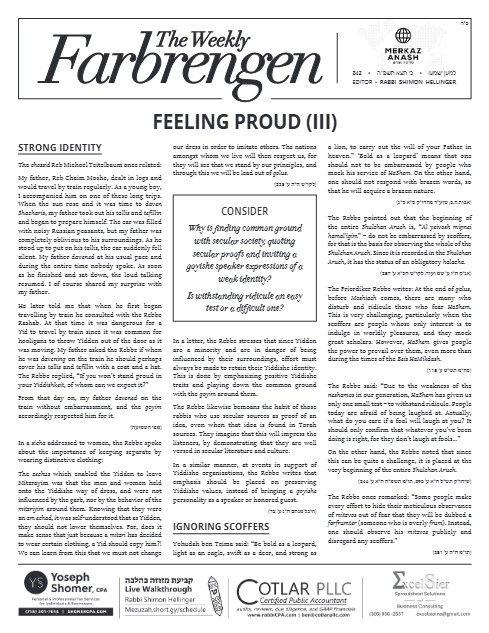
STRONG IDENTITY

The chossid Reb Michoel Teitelbaum once related:

My father, Reb Chaim Moshe, dealt in logs and would travel by train regularly. As a young boy, I accompanied him on one of these long trips. When the sun rose and it was time to daven Shacharis, my father took out his tallis and tefillin and began to prepare himself. The car was filled with noisy Russian peasants, but my father was completely oblivious to his surroundings. As he stood up to put on his tallis, the car suddenly fell silent. My father davened at his usual pace and during the entire time nobody spoke. As soon as he finished and sat down, the loud talking resumed. I of course shared my surprise with my father.

He later told me that when he first began travelling by train he consulted with the Rebbe Rashab. At that time it was dangerous for a Yid to travel by train since it was common for hooligans to throw Yidden out of the door as it was moving. My father asked the Rebbe if when he was davening on the train he should perhaps cover his tallis and tefillin with a coat and a hat. The Rebbe replied, “If you won’t stand proud in your Yiddishkeit, of whom can we expect it?”

From that day on, my father davened on the train without embarrassment, and the goyim accordingly respected him for it.

(מפי השמועה)

In a sicha addressed to women, the Rebbe spoke about the importance of keeping separate by wearing distinctive clothing:

The zechus which enabled the Yidden to leave Mitzrayim was that the men and women held onto the Yiddishe way of dress, and were not influenced by the garb, nor by the behavior of the mitzriyim around them. Knowing that they were an am echad, it was self-understood that as Yidden, they should not lower themselves. For, does it make sense that just because a mitzri has decided to wear certain clothing, a Yid should copy him?!

We can learn from this that we must not change our dress in order to imitate others. The nations amongst whom we live will then respect us, for they will see that we stand by our principles, and through this we will be lead out of golus.

(לקו"ש ח"ח ע' 223)

In a letter, the Rebbe stresses that since Yidden are a minority and are in danger of being influenced by their surroundings, effort must always be made to retain their Yiddishe identity. This is done by emphasizing positive Yiddishe traits and playing down the common ground with the goyim around them.

The Rebbe likewise bemoans the habit of those rabbis who use secular sources as proof of an idea, even when that idea is found in Torah sources. They imagine that this will impress the listeners, by demonstrating that they are well versed in secular literature and culture.

In a similar manner, at events in support of Yiddishe organizations, the Rebbe writes that emphasis should be placed on preserving Yiddishe values, instead of bringing a goyishe personality as a speaker or honored guest.

(היכל מנחם ח"ג ע' צד)

IGNORING SCOFFERS

Yehudah ben Teima said: “Be bold as a leopard, light as an eagle, swift as a deer, and strong as a lion, to carry out the will of your Father in heaven.” ‘Bold as a leopard’ means that one should not to be embarrassed by people who mock his service of HaShem. On the other hand, one should not respond with brazen words, so that he will acquire a brazen nature.

(אבות ה,כ, שוע”ר מהדו”ק ס”א ס”ג)

The Rebbe pointed out that the beginning of the entire Shulchan Aruch is, “Al yeivosh mipnei hamal’igim” – do not be embarrassed by scoffers, for that is the basis for observing the whole of the Shulchan Aruch. Since it is recorded in the Shulchan Aruch, it has the status of an obligatory halacha.

(אג”ק ח”ו ע’ שמ ועוד, לקו”ש חכ”א ע’ 287)

The Frierdiker Rebbe writes: At the end of galus, before Moshiach comes, there are many who disturb and ridicule those who fear HaShem. This is very challenging, particularly when the scoffers are people whose only interest is to indulge in worldly pleasures, and they mock great scholars. However, HaShem gives people the power to prevail over them, even more than during the times of the Beis HaMikdash.

(סה”מ תש”ט ע’ 118)

The Rebbe said: “Due to the weakness of the neshamos in our generation, HaShem has given us only one small test – to withstand ridicule. People today are afraid of being laughed at. Actually, what do you care if a fool will laugh at you? It should only confirm that whatever you’ve been doing is right, for they don’t laugh at fools...”

On the other hand, the Rebbe noted that since this can be quite a challenge, it is placed at the very beginning of the entire Shulchan Aruch.

(שיחו”ק תש”ל ח”א ע’ 295, תו”מ תשמ”ח ח”א ע’ 246)

The Rebbe once remarked: “Some people make every effort to hide their meticulous observance of mitzvos out of fear that they will be dubbed a farfrumter (someone who is overly frum). Instead, one should observe his mitzvos publicly and disregard any scoffers.”

(תו”מ ח”ח ע’ 231)

CONSIDER

Why is finding common ground with secular society, quoting secular proofs and inviting a goyishe speaker expressions of a weak identity?

Is withstanding ridicule an easy test or a difficult one?

PDF Preview