No Doubts and Confusion on Rosh Hashanah
The Rebbe's Pharmacy | August 25, 2023
Print This Article
View Original PDF

No Doubts and Confusion on Rosh Hashanah

The Rebbe's Pharmacy | December 31, 2025

This is the entire avodah of doing teshuvah and crowning Hashem. We should feel as if we don’t deserve anything, but at the same time, we acknowledge the true greatness of Hashem: the fact that He looks primarily at our good points and He forgives us for our sins. We have to do what we can according to our capabilities. We have to try our best. However, we shouldn’t get confused and have doubts about whether we’re good enough or not. We shouldn’t be afraid that we didn’t fulfill our obligations on Rosh Hashanah. Instead, we should be full of joy, knowing that Hashem loves us and He always judges us favorably. By ignoring our feelings of being distant from Hashem and doing whatever avodah that is at hand with simchah, we make Hashem our King.

And even if we get lost at times in confusion and sadness on Rosh Hashanah, we can easily redirect our thoughts to a positive place. Hashem is so good that He will certainly have compassion on us for this as well.

The Power of Our Tefillos

In other words, we should realize that it is necessary for us to daven. We shouldn’t think that Hashem will give us everything for free and we don’t have to do anything. Instead, We should recognize that without our prayers, we won’t have the vessels in which to receive Hashem’s abundant spiritual and material blessings.

On the other hand, however, we must avoid the pitfall of thinking that our tefillos don’t have the power to awaken Hashem’s compassion. We must push away the doubts about the tremendous effect that our prayers have in all the higher and lower worlds. Even if we see that we aren’t answered immediately, we should know that not a single tefillah is ever lost. Hashem cherishes our davening and He will grant us our wishes (see Likutei Halachos, Nachalos 4).

This is the avodah of coming close to Hashem through joy and positive thoughts on Rosh Hashanah, as Rebbe Nachman mentions in this sichah: “On Rosh Hashanah, a person has to be wise by thinking only good thoughts – that Hashem will do good for us, and so on. And a person should be happy on Rosh Hashanah.”

Tears of Yearning and Joy

In addition, this is why we cry on Rosh Hashanah, as Rebbe Nachman states: “Also, a person should cry on Rosh Hashanah.” We should recognize how small we are before the King of all kings and how much we need His assistance, and our hearts should be filled with embarrassment. We should humble ourselves in front of Hashem and beg Him to answer our requests. This embarrassment brings us to tears because it grabs our entire existence and awakens a powerful yearning for Hashem.

However, we also remember that Hashem is full of compassion, and He treasures our feelings of humiliation. He cherishes our tears of longing to come closer to Him. Through this, our embarrassment will bring us to simchah and our tears will become tears of joy. We will cry when we realize that, even though we have really messed up, Hashem is still with us and His right hand is outstretched to receive our teshuvah. This is what Rebbe Nachman reveals (Likutei Mohoran I, 175) on the verse that we say before blowing the shofar on Rosh Hashanah (Tehillim 89): Be’shimcha yagilun kol hayom – in Your Name we will rejoice the entire day,” whose first letters (Beis, Kaf, Yud, Heh) form the word “bechiyah”– crying.

Furthermore, the Arizal says that when we cry, this awakens Heaven’s judgement of us. The reason for this is that Hashem wants to judge us favorably. So, He waits until we’re trying to reach out to Him and we shed tears due to our yearning to be close to Him, and then He judges us with eyes of compassion.

In short, there is no reason to be worried or depressed on Rosh Hashanah (or any other time, for that matter). Right now, we’re occupied with crowning the King of all kings by doing whatever avodah is at hand – davening, listening to the shofar, eating a Yom Tov seudah, and so on – with the awareness of Hashem’s tremendous love for us. We’re busy fixing the whole world, so there’s no time for sadness! Simchah shows our true emunah in Hashem’s sovereignty and our recognition of His truest essence. We have a merciful King Who is close to us and we’re happy to be His precious children. Every mistake that we make is simply an opportunity for us to give Hashem incredible nachas by feeling embarrassed and strengthening our faith in His immense kindness. This is how we can do our part in revealing Hashem’s Kingship and completing the ultimate tikkun of our neshamos!
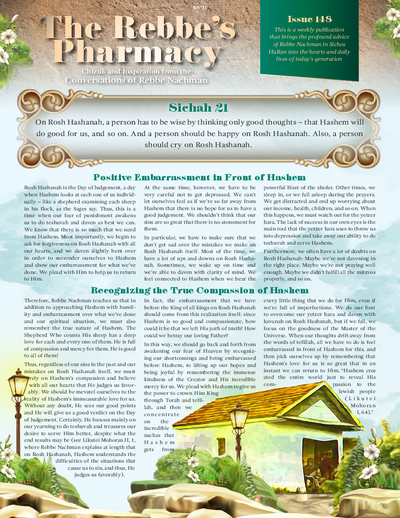
This is the entire avodah of doing teshuvah and crowning Hashem. We should feel as if we don’t deserve anything, but at the same time, we acknowledge the true greatness of Hashem: the fact that He looks primarily at our good points and He forgives us for our sins. We have to do what we can according to our capabilities. We have to try our best. However, we shouldn’t get confused and have doubts about whether we’re good enough or not. We shouldn’t be afraid that we didn’t fulfill our obligations on Rosh Hashanah. Instead, we should be full of joy, knowing that Hashem loves us and He always judges us favorably. By ignoring our feelings of being distant from Hashem and doing whatever avodah that is at hand with simchah, we make Hashem our King.

And even if we get lost at times in confusion and sadness on Rosh Hashanah, we can easily redirect our thoughts to a positive place. Hashem is so good that He will certainly have compassion on us for this as well.

The Power of Our Tefillos

In other words, we should realize that it is necessary for us to daven. We shouldn’t think that Hashem will give us everything for free and we don’t have to do anything. Instead, We should recognize that without our prayers, we won’t have the vessels in which to receive Hashem’s abundant spiritual and material blessings.

On the other hand, however, we must avoid the pitfall of thinking that our tefillos don’t have the power to awaken Hashem’s compassion. We must push away the doubts about the tremendous effect that our prayers have in all the higher and lower worlds. Even if we see that we aren’t answered immediately, we should know that not a single tefillah is ever lost. Hashem cherishes our davening and He will grant us our wishes (see Likutei Halachos, Nachalos 4).

This is the avodah of coming close to Hashem through joy and positive thoughts on Rosh Hashanah, as Rebbe Nachman mentions in this sichah: “On Rosh Hashanah, a person has to be wise by thinking only good thoughts – that Hashem will do good for us, and so on. And a person should be happy on Rosh Hashanah.”

Tears of Yearning and Joy

In addition, this is why we cry on Rosh Hashanah, as Rebbe Nachman states: “Also, a person should cry on Rosh Hashanah.” We should recognize how small we are before the King of all kings and how much we need His assistance, and our hearts should be filled with embarrassment. We should humble ourselves in front of Hashem and beg Him to answer our requests. This embarrassment brings us to tears because it grabs our entire existence and awakens a powerful yearning for Hashem.

However, we also remember that Hashem is full of compassion, and He treasures our feelings of humiliation. He cherishes our tears of longing to come closer to Him. Through this, our embarrassment will bring us to simchah and our tears will become tears of joy. We will cry when we realize that, even though we have really messed up, Hashem is still with us and His right hand is outstretched to receive our teshuvah. This is what Rebbe Nachman reveals (Likutei Mohoran I, 175) on the verse that we say before blowing the shofar on Rosh Hashanah (Tehillim 89): Be’shimcha yagilun kol hayom – in Your Name we will rejoice the entire day,” whose first letters (Beis, Kaf, Yud, Heh) form the word “bechiyah”– crying.

Furthermore, the Arizal says that when we cry, this awakens Heaven’s judgement of us. The reason for this is that Hashem wants to judge us favorably. So, He waits until we’re trying to reach out to Him and we shed tears due to our yearning to be close to Him, and then He judges us with eyes of compassion.

In short, there is no reason to be worried or depressed on Rosh Hashanah (or any other time, for that matter). Right now, we’re occupied with crowning the King of all kings by doing whatever avodah is at hand – davening, listening to the shofar, eating a Yom Tov seudah, and so on – with the awareness of Hashem’s tremendous love for us. We’re busy fixing the whole world, so there’s no time for sadness! Simchah shows our true emunah in Hashem’s sovereignty and our recognition of His truest essence. We have a merciful King Who is close to us and we’re happy to be His precious children. Every mistake that we make is simply an opportunity for us to give Hashem incredible nachas by feeling embarrassed and strengthening our faith in His immense kindness. This is how we can do our part in revealing Hashem’s Kingship and completing the ultimate tikkun of our neshamos!

PDF Preview