Optics
זכרון יעקב | September 12, 2024
Print This Article
View Original PDF

Optics

זכרון יעקב | June 27, 2025

“If a man commits a sin for which he is sentenced to death, and he is put to death, you shall [then] hang him on a pole. But you shall not leave his body on the pole overnight. Rather, you shall bury him on that [same] day, for a hanging [human corpse] is a blasphemy of G-d, and you shall not defile your land, which the L-rd, your G-d, is giving you as an inheritance.” (21:22-3)

Should a person commit a heinous crime that warrants stoning and being hung, what is the concern that the body should not remain overnight?

Rashi explains based on the Talmud (Sanhedrin 46b) that “... this is a degradation of the [Divine] King in Whose image Man is created, and the Israelites are G-d’s children. This is comparable to two identical twin brothers. One [of them] became king, while the other was arrested for robbery and hanged. Whoever saw him [the second brother, suspended on the gallows], would say, ‘The king is hanging!’ [Therefore, the king ordered, and they removed him.]” A similar interpretation is brought by the Chizkuni.

The obvious question is that surely people would know that this was not the King! Announcements were made when people were (infrequently) executed so why the concern about the King’s embarrassment?

Judaism has a raft of rules that relate to maaris ayin – behaviour that appears to be against halacha. For example, going into a non-kosher restaurant where the onlooker may conclude that this is for the purpose of purchasing non-kosher food even if that is not the case.

The contemporary term for this is ‘optics’. Nothing untoward takes place, but still, it just doesn’t look appropriate and, to the uninformed, may look bad.

Such behaviour is prohibited even if a person doesn’t care what anyone else may hypothesize.

This appears to be the takeaway from Rashi’s parable – even if you know that they know the reality that the body hanging is the king’s evil twin, you still need to account for the optics and take it down. Not only does the law need to be actioned correctly, but it needs to be seen to be actioned correctly.
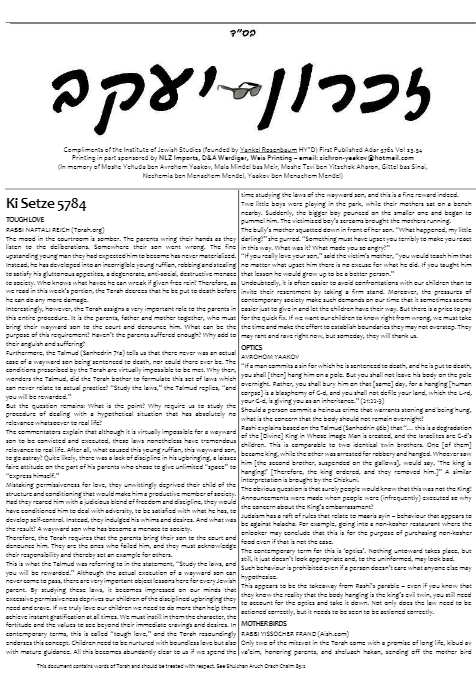

“If a man commits a sin for which he is sentenced to death, and he is put to death, you shall [then] hang him on a pole. But you shall not leave his body on the pole overnight. Rather, you shall bury him on that [same] day, for a hanging [human corpse] is a blasphemy of G-d, and you shall not defile your land, which the L-rd, your G-d, is giving you as an inheritance.” (21:22-3)

Should a person commit a heinous crime that warrants stoning and being hung, what is the concern that the body should not remain overnight?

Rashi explains based on the Talmud (Sanhedrin 46b) that “... this is a degradation of the [Divine] King in Whose image Man is created, and the Israelites are G-d’s children. This is comparable to two identical twin brothers. One [of them] became king, while the other was arrested for robbery and hanged. Whoever saw him [the second brother, suspended on the gallows], would say, ‘The king is hanging!’ [Therefore, the king ordered, and they removed him.]” A similar interpretation is brought by the Chizkuni.

The obvious question is that surely people would know that this was not the King! Announcements were made when people were (infrequently) executed so why the concern about the King’s embarrassment?

Judaism has a raft of rules that relate to maaris ayin – behaviour that appears to be against halacha. For example, going into a non-kosher restaurant where the onlooker may conclude that this is for the purpose of purchasing non-kosher food even if that is not the case.

The contemporary term for this is ‘optics’. Nothing untoward takes place, but still, it just doesn’t look appropriate and, to the uninformed, may look bad.

Such behaviour is prohibited even if a person doesn’t care what anyone else may hypothesize.

This appears to be the takeaway from Rashi’s parable – even if you know that they know the reality that the body hanging is the king’s evil twin, you still need to account for the optics and take it down. Not only does the law need to be actioned correctly, but it needs to be seen to be actioned correctly.

PDF Preview