The Announcement Of The Redemption Besuras Hageulo
Reflections of Redemption | September 05, 2025
Print This Article
View Original PDF

The Announcement Of The Redemption Besuras Hageulo

Reflections of Redemption | December 10, 2025

The Announcement Of The Redemption

All of the above receives particular emphasis in the month of Elul of the year Hey-Tuf-Nun-Sin-Aleph, the first letter of which also forms the word "Tinasay," which has the dual meaning of "you shall be exalted" and "you shall be married" in command form. This is relevant both to the revelation and coming of Moshiach, who "shall be exalted... very high" and to the marriage of the Jewish people and G-d that will take place in the days of Moshiach. In the language of the Yalkut Shimoni: "The year in which Melech HaMoshiach will be revealed... he will stand on the roof of the Temple and say, Humble ones, the time of your Redemption has arrived."

The students of the Yeshiva are called "Temimim" because they learn "the Torah of G-d, the revealed Torah and the Torah of Chassidus temimah."

The learning of the inner aspect of the Torah, with intellectual comprehension, moreover, resembles and is a preparation for the situation of the days of Moshiach, when "Israel will be extremely wise and know the hidden things and comprehend the knowledge of their creator, etc."

These students are therefore called "the soldiers of the house of David" who overcome the position of those who "revile the footsteps of your anointed." Their work reveals and brings Moshiach ben David in a way that "Blessed is G-d forever Amen and Amen."

This period (described at the conclusion of this Psalm) has already reached a conclusion after the accomplishments and work during the forty years since the histalkus of my sainted father-in-law, the Previous Rebbe, the leader of our generation. We have spread the wellsprings outward in such a way that "G-d gives to you a heart to understand and eyes to see and ears to hear," and we stand now in a period connected to Psalm 90, that concludes with the verse "May the pleasantness of the L-rd our G-d be upon us... and the work of our hands establish it." This means "the Divine Presence dwells in the work of their hands," which represents the

References

1. [This passage occurs in a discussion about the month of Elul as the last month of the year, and therefore the time for an honest accounting (soul-searching) and completion of the "marriage" between G-d and the Jewish people. The latter concept is raised because the name of the month - Elul - is a Hebrew acronym for "I am for my beloved and my beloved is mine." These two ideas are related to the times and the impossibility of a delay in the fulfillment of the promise that Moshiach's coming is imminent. Translator's note.]
2. [The letters used to designate the year in which this is said also form the word "Tinasay," which means to raise up or elevate. Translator's note.]
3. ["This" refers to the two concepts mentioned in note a. Translator's note.]
4. Yeshayahu (52:13).
5. [The word for marriage in Hebrew, "ni-su-in" is etymologically related to "tinasay," meaning to elevate. Translator's note.]
6. Yeshayahu, remez 499.
7. [The word "temimah" has the meanings of whole, perfect, innocent, upright, etc. By learning both the revealed aspects of Torah as well as its inner dimension, Torah study is itself whole, perfect, etc. Translator's note.]
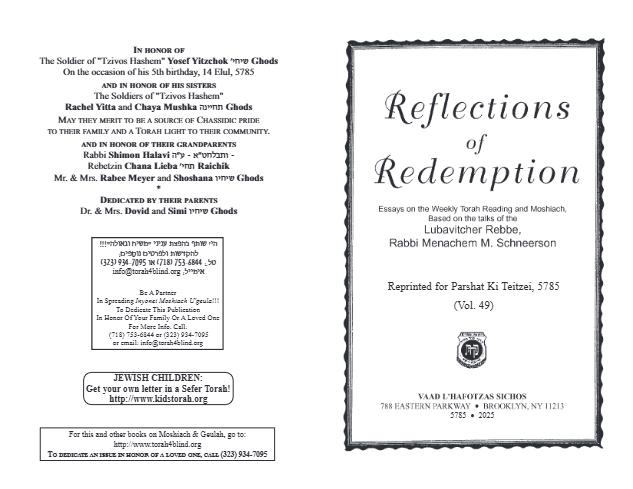
The Announcement Of The Redemption

All of the above receives particular emphasis in the month of Elul of the year Hey-Tuf-Nun-Sin-Aleph, the first letter of which also forms the word "Tinasay," which has the dual meaning of "you shall be exalted" and "you shall be married" in command form. This is relevant both to the revelation and coming of Moshiach, who "shall be exalted... very high" and to the marriage of the Jewish people and G-d that will take place in the days of Moshiach. In the language of the Yalkut Shimoni: "The year in which Melech HaMoshiach will be revealed... he will stand on the roof of the Temple and say, Humble ones, the time of your Redemption has arrived."

The students of the Yeshiva are called "Temimim" because they learn "the Torah of G-d, the revealed Torah and the Torah of Chassidus temimah."

The learning of the inner aspect of the Torah, with intellectual comprehension, moreover, resembles and is a preparation for the situation of the days of Moshiach, when "Israel will be extremely wise and know the hidden things and comprehend the knowledge of their creator, etc."

These students are therefore called "the soldiers of the house of David" who overcome the position of those who "revile the footsteps of your anointed." Their work reveals and brings Moshiach ben David in a way that "Blessed is G-d forever Amen and Amen."

This period (described at the conclusion of this Psalm) has already reached a conclusion after the accomplishments and work during the forty years since the histalkus of my sainted father-in-law, the Previous Rebbe, the leader of our generation. We have spread the wellsprings outward in such a way that "G-d gives to you a heart to understand and eyes to see and ears to hear," and we stand now in a period connected to Psalm 90, that concludes with the verse "May the pleasantness of the L-rd our G-d be upon us... and the work of our hands establish it." This means "the Divine Presence dwells in the work of their hands," which represents the

References

1. [This passage occurs in a discussion about the month of Elul as the last month of the year, and therefore the time for an honest accounting (soul-searching) and completion of the "marriage" between G-d and the Jewish people. The latter concept is raised because the name of the month - Elul - is a Hebrew acronym for "I am for my beloved and my beloved is mine." These two ideas are related to the times and the impossibility of a delay in the fulfillment of the promise that Moshiach's coming is imminent. Translator's note.]
2. [The letters used to designate the year in which this is said also form the word "Tinasay," which means to raise up or elevate. Translator's note.]
3. ["This" refers to the two concepts mentioned in note a. Translator's note.]
4. Yeshayahu (52:13).
5. [The word for marriage in Hebrew, "ni-su-in" is etymologically related to "tinasay," meaning to elevate. Translator's note.]
6. Yeshayahu, remez 499.
7. [The word "temimah" has the meanings of whole, perfect, innocent, upright, etc. By learning both the revealed aspects of Torah as well as its inner dimension, Torah study is itself whole, perfect, etc. Translator's note.]

PDF Preview