The Battle Against the Yetzer Hara and the Power of Torah
Torah Papers | August 25, 2023
Print This Article
View Original PDF

The Battle Against the Yetzer Hara and the Power of Torah

Torah Papers | December 31, 2025

Of course, the literal meaning of these words belong to the physical wars we fight. But those wars are never fought by an individual. They are fought by armies – groups of many people. Here, however, the Torah presents the instruction in the singular. The Ohr HaChaim, Kli Yakar, Alsheich HaKadosh, and others, all point to the individual battle we wage against our Yetzer Hara, and especially during the month of Elul. That Yetzer Hara is plural, as it has many names (Succah 52a) and disguises itself as our אוֹיֵב in many ways. We are being told that if we set out to battle our אוֹיֵב, we will not only win but also reclaim all our sins that previously served at the army that outnumbered us – עַ ם רַ ב מִ מְּ ך. Teshuva Mi’Ahava – repentance from love, results in our sins begin transformed into full-fledged merits.

I would like to ask you all – we’re instructed to go out and battle the Yetzer Hara. Wonderful. Tomorrow morning, the battle begins. But how do we fight? Are we to pick up a gun? Perhaps an old-fashioned slingshot? Who fires first? Do we need maps and a compass, or binoculars? What are the actual actions that comprise such a battle? It is not simple, as the Gemara doesn’t provide any of those answers or give us any precise instructions. Rashi says (Sanhedrin 111b), when approached by the Yetzer Hara to perform a sin, respond by first carrying out a mitzvah. מָ חָ ר ...צֵא הִ לָּחֵ ם בַּ עֲמָ לֵק – Tell the Yetzer Hara, “No problem. I’ll do as you’d like... tomorrow! What’s the rush? It shouldn’t make any difference if I defer a bit. I just have a couple of urgent mitzvot to take care of first!” Start by pushing off the aveira and focusing on a mitzvah in its place. The Yetzer Hara may eventually forget to follow-up with you, or you’ll gain enough power in the interim to fend it off even further.

The Ohr HaChaim says our starting point is different, and hinges on demonstrating self-restraint in our food consumption. Upon feeling the presence and influence of the Yetzer Hara, engage in fasting and crying, because the Yetzer Hara dresses itself up in food and an abundance of food is the source of harmful impulses and desires. There is a concept called Ta’anit haRa’avad – the Fast of the Ra’avad (Mishnah Berurah 571:2). In the middle of eating, simply stop and leave food on your plate. The leftovers don’t need to be thrown out – they can be put back in the fridge or freezer for a later date, or they can be given to someone else. Stopping in the middle ensures you receive the sustenance you need while avoiding all risks of over-indulgence and gluttony. I was once at a wedding and witnessed someone walk up to the buffet and load his plate with seven pieces of schnitzel – a Great Wall of chicken breast! I turned to him and quietly asked, “Are you bringing that for the entire table?” He replied, “No, no, no. This is my private plate!” I asked, “Are you going to eat that entire Eifel Tower of schnitzel?” He said, “Of course, not. I’m going to leave some of it for the Ra’avad!” Clearly, that isn’t the intended theory or execution, or what the Ohr HaChaim HaKadosh had in mind when suggesting the first act in our war be to show self-restraint in eating.

The Gemara teaches us with respect to our battle (Berachot 5a):

לְעוֹלָם יַרְגִּיז אָדָם יֵצֶר טוֹב עַל יֵצֶר הָרַע, שׁ ֶנֶּאֱמַר: ״רִגְזוּ וְאַל תֶּחֱטָאוּ״ אִם נִ ְ חו ֹּ צ— מוּטָב, וְאִם לָאו — יַעֲסוֹק בַּתּוֹרָה, שׁ ֶנֶּאֱמַר: ״אִמְרוּ בִלְבַבְכֶם״. אִם ְ חוֹּ נִצ— מוּטָב, וְאִם לָאו — יִקְרָא קְרִיאַת שְׁמַע, שׁ ֶנֶּאֱמַר: ״עַל מִשְׁכַּבְכֶם״. ְ חו ֹּ אִ ם נִ צ— מוּטָב, וְאִם לָאו — יִזְכּוֹר לוֹ יוֹם הַמִּיתָה, שׁ ֶנֶּאֱ מַר: ״וְדֹמּ וּ סֶלָה״.

One should always invoke his good inclination against his evil inclination, as it is stated: "Tremble, and do not sin." If one succeeds and subdues his evil inclination, excellent, but if not, study Torah, as the verse says: “Say to your heart.” If he subdues his evil inclination, excellent; if not, he should recite Shema, as it is stated: “Upon your bed,” which alludes to Shema, where it says: “When you lie down.” If he subdues his evil inclination, excellent; if not, he should remind himself of the day of death, whose silence is alluded to in the continuation of the verse: “And be still, Selah.”

Rabbotai, what in that sequence is the strongest weapon at our disposal? Torah! If so, why does it appear early on, and as a tactic that may not succeed? Why not list it as the final resort? We learn:

הוּא אָמַר לָהֶם לְיִשְׂרָאֵל: בָּנַי, בָּרָאתִי יֵצֶר הָרָע וּבָרָאתִי הַקָּדוֹשׁ בָּרוּך לוֹ תּוֹרָה תַּבְלִין. וְאִם אַתֶּם עוֹסְקִים בַּתּוֹרָה – אֵ ין אַ תֶּ ם נִמְ סָרִ ים בְּ יָדו.

Hakadosh Baruch Hu said to Israel: My children, I created an evil inclination, which is the wound, and I created Torah as its antidote. If you are engaged in Torah study, you will not be given over into the hand of the evil inclination.

Torah is targeted therapy, a precision medicine to counter the Yetzer Hara. Furthermore, the Gemara says, if the menuval (the Satan) attacks you, drag him by force to the Beit Midrash. The Ramchal in Mesilat Yesharim also says (Chapter 5):

וְהִנֵּה פָּשׁ וּט הוּא, שׁ ֶאִם הַבּוֹרֵא לֹא בְּרָא לְמַכָּה זוֹ אֶלָּא רְפוּאָה זוֹ, אִי אֶפְשׁ ָר בְּשׁ וּם פָּנִים שׁ ֶיַ חְ שׁ ֹ בְּרַפֵּא הָאָדָם מִזֹּאת הַמַּכָּה בִּלְתִּי זֹאת הָרְפוּאָה, וּמִי שׁ ֶ י לְהִנָּצֵל זוּלָתָהּ, אֵינוֹ אֶלָּא טוֹעֶה, וְיִרְאֶה טָעוּתוֹ לְבַסּוֹף כְּשׁ ֶי ָמוּת בְּחֶטְאוֹ. וְהוּא הִזְהִירָנוּ שׁ ֶהָרְפוּאָה לוֹ הִיא הַתּוֹרָה.

Behold, it is obvious that if the Creator created for this affliction only this remedy, then it is impossible under any circumstances for a man to heal himself from this affliction without employing this treatment. One who thinks to save himself without Torah study is only mistaken, and will see his error only in the end, when he dies in sin... and He Himself cautioned us that the only remedy for it is Torah.

Rabbotai, given all these statements – including from Hakadosh Baruch Hu Himself! – why is the solution of Torah buried in this battle plan? Why isn’t it first and last? Chazal answer, Torah certainly helps, but do Talmidei Chachamim not also have a Yetzer Hara? Of course, they do, and from this reality we can learn a tremendous yesod. Torah helps those who learn lishma – for its own sake, and to become closer to Hakadosh Baruch Hu through Torah influencing and correcting their ways. It serves as an antidote and negates the Yetzer Hara for these pure individuals. But for those who learn for the sake of honor or a myriad of other personal reasons – it will not complete the task. This is why reciting Shema comes after the failure of Torah to defeat the Yetzer Hara. The recitation of Shema will help one recalibrate and take upon themselves עֹל מַ לְ כוּת שׁ ָ מַ יִם – the yoke of Heaven along with the concept of reward and punishment – following which their learning will return to where it needs to be – lishma.

This is the reason for the Gemara (Berachot 10b) stating: Greater is one who recites Shema at its appropriate time than one who engages in Torah study. Sefer Likutei Batar Likutei (Vayigash), in the name of R’ David Moshe of Chortkov, says this idea found in the Gemara was already introduced by Yaakov Avinu, when he descended to Egypt, the most impure location on earth. How did he proceed? He first sent Yehuda to Goshen, to set up a Beit Midrash and a foundation of Torah. And upon his arrival, the first thing Yaakov Avinu did when meeting Yosef was to recite Kriyat Shema. Afterwards he said: אָמוּתָה הַפָּעַם. He followed the three-stage battle plan found in the Gemara: learning Torah, reciting Kriyat Shema, and reminding oneself of Yom HaMitah. The Ben Yehoyada adds (Berachot 5), David HaMelech eulogized Yonatan and Shaul with the following words (Shmuel II 1:18):

וַיֹאמֶר לְלַמֵּד בְּנֵי־יְהוּדָה קָשֶׁת הִנֵּה כְתוּבָה עַל־סֵפֶר הַיָשָׁר׃

And he said: To teach the children of Yehuda the use of the bow; behold, it is written in the book, Yashar.

After Shaul was killed in battle together with his son – David’s close friend – he said, “If these two gedolim died in war, there are enough reminders of death in front of us. What is needed to defeat the Yetzer Hara, is to teach the people קָשֶׁת – Kriyat Shema and Torah.”

I’d like to focus on one final question before we conclude with our main learning and yesod. The above formula suggests that reminding oneself of Yom HaMitah is the strongest weapon available. If it doesn’t work – that’s it, you’re toast. This is similar to someone who visits their doctor via Zoom, as that is the new way of the world these days, and the doctor requests, “Place the camera in front of you mouth, open wide and say ahhh.” Upon seeing white spots, the doctor says, “There’s no need to come in, I see your infection and have already sent over a prescription to the pharmacy. Start with Moxypen twice daily for a week; if that doesn’t work, we’ll switch to Zinnat for ten days; and if that doesn’t work, we’ll put you on Augmentin 850.” As a patient, I would respond, “Doctor, if you’re telling me Augmentin is the Tomahawk missile here, let’s cut to the chase and start with it!” And I’d surely receive a response of, “Sir, I do not prescribe Augmentin from the get-go. It leads to side-effects of dizziness, upset stomach, and hallucination. Do you really want to be hearing Beethoven all day long? Forget about it for now. We’ll use it at the end, but only if needed.”

The Chafetz Chaim says, we should utilize inspiration and reinvigoration ahead of fear of punishment. Torah and Kriyat Shema inspire one to improve and gives them energy to keep at their battle and make steady progress. Reminding someone of Yom HaMitah will scare them and drive them to depression, when their Avodah is meant to be with simcha. Use the Tomahawk only sporadically, when all else fails or the situation is extreme and requires extreme measures.

Another answer is provided by the Ktav Sofer. Akavya ben Mahalalel says in Pirkei Avot (3:1), “Look towards three things and you will not bring yourself to sin”: דַּע מֵאַיִן בָּאתָ, וּלְאָן אַתָּה הוֹלֵך, וְלִפְנֵי מִי אַתָּה עָתִיד לִתֵּן דִּין וְחֶשְׁבּוֹן. Know from where you come, where you are going, and before whom you are destined to give an account and reckoning.

The Ktav Sofer says there are two components in his directions – a section for the guf – the body, and a section for the neshama – the soul. לִמְ קוֹם עָפָר רִ מָּה וְתוֹלֵעָה is a message for the body who will go to a place of dust, worms and maggots. לִפְנֵי מֶלֶך הוּא מַלְכֵי הַמְּלָכִים הַקָּדוֹ שׁ בָּרוּך is a message for the neshama, who will be required to answer for itself in Din. Each message pertains to what concerns its recipient, and what will spur corrective action. Delivering an incompatible message won’t achieve the desired outcome.

I will add further, that continuously delivering a message of Yom HaMitah will often achieve the opposite effects, driving one to run even faster towards sin. Car manufacturers used to have place advertisements above their rear license plates, in the form of short, poetic, and often overly dramatic slogans hinting at the brand’s superpowers in adding meaning to life and delivering bliss. I recall slogans such as, “Honda ignites the imagination,” and “Peugeot, the lion of transportation.” I thought about it at length but could never figure out what was hiding behind these slogans. The best one was most definitely, “Audi, because you only live once.” I guarantee that one of the questions we will not be asked when arriving at the gates to Heaven is, “Did you drive an Audi in this life given to you? No? Go back!” But if asked, someone gave me a ride in an Audi last week, and I’m now fully prepared to answer in the affirmative. What are these slogans all about? If you give them any honest thought, you’ll realize how ludicrous and foreign they are, and they’ll end up pushing you even further away from their goal.

The same is true of messages aimed at driving us to Teshuva, and why there is a slow progression of such messaging. Yom HaMitah is the nuclear option, used only as a last resort in extreme cases. Torah is no-doubt the most powerful of all, but Kriyat Shema is the most central. Recitation of, and focusing on, the words of Kriyat Shema serves not only as an act of learning Torah in itself, but also leads one to Torah in the correct mindset – lishma.

There is one final point I’d like to focus on. The peak of our Rosh Hashana Avodah is with the sounding of the Shofar, yet we all know the Gemara detailing Hakadosh Baruch Hu’s instructions (Rosh Hashana 16a):

וְאִמְרוּ לְפָנַי בְּרֹאשׁ הַשָּׁנָה מַלְכִי— כְּ דֵ י שׁ ֶתַּמְ לִיכוּנִי עֲלֵיכֶם, זִכְרוֹנוֹת — ַעֲלֶה זִכְרוֹנְיכֶם לְפָנַי לְטוֹבוֹת זִכְרוֹנוֹת וְשׁ וֹפָרוֹת. וּבַמֶּה — ב ּ ְ שׁ ו ֹ פ ָ ר .

And recite before Me on Rosh Hashana verses that mention Kingships, Remembrances, and Shofarot: Kingships so that you will crown Me as King over you; Remembrances so that your remembrance will rise before Me for good; and with what will the remembrance rise? It will rise with the shofar.

What do we recite for Malchuyout? Chazal set a framework of three pesukim from the Torah, followed by three from Nevi’im, three from Ketuvim, and a concluding pasuk from Torah. How does this section declaring Hakadosh Baruch Hu as Melech begin and end? It starts with לֵֽינוּ לְשַׁבֵּֽחַ לַאֲדוֹן הַכֹּלעָ and ends דוְעַל הָאָֽרֶץ מִתָּֽחַת אֵין עוֹ. The section begins with the letter ayin and ends with the letter dalet. The same is true for the paragraph that follows, which begins with ל כֵּן נְקַוֶּה לְך עַ, and ends with ד לְעֹלָם וָעֶ ה’ יִמְלֹך.

עֵד – we testify as witnesses that Hakadosh Baruch Hu created all and is the Master of all. Our Parsha and its ע"ד Mitzvot serve as witness, and the eradication of Amalek removes all doubt from that testimony and restores the Throne of Hakadosh Baruch Hu. Twice each day we restore the ד and ד in Hakadosh Baruch Hu’s names, to strengthen our Emunah and reach the pinnacle of HaMelech. The section of Malchuyot contains verses reflecting the Oneness of Hakadosh Baruch Hu – ל ֹהִ ים-אֲנִי רִאשׁ וֹן וַאֲנִי אַחֲרוֹן וּמִבַּלְעָדַי אֵין אֱ.

There should be no doubt, despite the constant efforts of Eisav, Amalek, and the Yetzer Hara to corrupt our thoughts and actions. The question of הֲ יֵשׁ ה' בְּ קִ רְ בֵּ נוּ אִ ם־אָ יִ ן should never enter our minds. אֶ חָ ד וּשׁ ְ מוֹ אֶ חָ ד – our dalet can never become a reish, and our Echad can never become acher. The section of Malchuyot concludes:

וּבְתוֹרָתְך-לֹהֵֽינוּ ה’ אֶחָד: כָּתוּב לֵאמֹר: שְׁמַע יִשְׂרָאֵל ה’ אֱ

On Rosh Hashana we anoint Hakadosh Baruch Hu as Melech through our recitation of Shema Yisrael, a pasuk that brings us closer to Him and closer to Torah.

The final Selichot recited by Ashkenazim prior to Yom Kippur contains the verse:

בַּמֶּה אֲקַדֵּם וְאִכַּף פְּנֵי לֹא יִקַּח שׁ ֹחַד. וּבְיָדִי אֵין מַעַשֹ וְעַל־זֹאת לִבִּי יִפְחַד. אֲבָל עַתָּ ה בְּ זָכְרִי מַלְכוּת שׁ ֵם הַמְיֻחָד. וְעַל זֹאת אֲנִי בוֹטֵחַ בְּאוֹמְרִים ה’ אֶחָד. וּמוֹשְׁכִים כֻּלָּם יַחַד מִזֶּה אֶחָד וּמִזֶּה: מָחָר יִהְיֶה הָאוֹת הַזֶּה:

How shall I greet, approach, the One Who takes no bribe? I have no deed in hand, and my heart is therefore afraid. But now that I mention the kingship of Your unique Name, on this I rely, when we say “Hashem is One” in unison as one, one on that side and one on this. This sign will take place tomorrow.

We arrive at Yom Kippur empty-handed, with nothing significant and valuable enough to provide to Hakadosh Baruch Hu in exchange for forgiveness and a new lease on life. However, we go to Yom Kippur with Shema Yisrael in our hands. That is our strength and that is our answer! There are just a small number of days left and we can all do teshuva in one flash moment. Even Elisha ben Avuya could have returned. May Hakadosh Baruch Hu accept our teshuva and our tefillot, and may we merit seeing the arrival of Mashiach Tzidkeinu speedily in our day, to restore the name of Hashem and His Kiseh HaKavod for the entire world to see. ◊
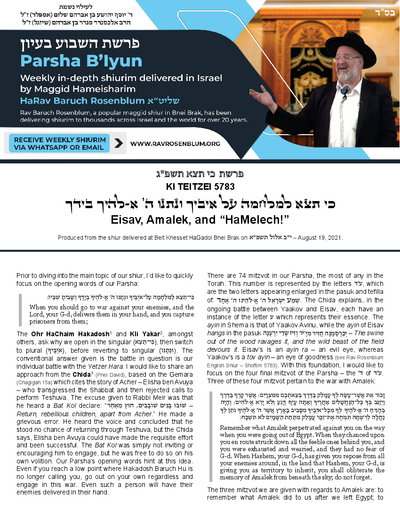
Of course, the literal meaning of these words belong to the physical wars we fight. But those wars are never fought by an individual. They are fought by armies – groups of many people. Here, however, the Torah presents the instruction in the singular. The Ohr HaChaim, Kli Yakar, Alsheich HaKadosh, and others, all point to the individual battle we wage against our Yetzer Hara, and especially during the month of Elul. That Yetzer Hara is plural, as it has many names (Succah 52a) and disguises itself as our אוֹיֵב in many ways. We are being told that if we set out to battle our אוֹיֵב, we will not only win but also reclaim all our sins that previously served at the army that outnumbered us – עַ ם רַ ב מִ מְּ ך. Teshuva Mi’Ahava – repentance from love, results in our sins begin transformed into full-fledged merits.

I would like to ask you all – we’re instructed to go out and battle the Yetzer Hara. Wonderful. Tomorrow morning, the battle begins. But how do we fight? Are we to pick up a gun? Perhaps an old-fashioned slingshot? Who fires first? Do we need maps and a compass, or binoculars? What are the actual actions that comprise such a battle? It is not simple, as the Gemara doesn’t provide any of those answers or give us any precise instructions. Rashi says (Sanhedrin 111b), when approached by the Yetzer Hara to perform a sin, respond by first carrying out a mitzvah. מָ חָ ר ...צֵא הִ לָּחֵ ם בַּ עֲמָ לֵק – Tell the Yetzer Hara, “No problem. I’ll do as you’d like... tomorrow! What’s the rush? It shouldn’t make any difference if I defer a bit. I just have a couple of urgent mitzvot to take care of first!” Start by pushing off the aveira and focusing on a mitzvah in its place. The Yetzer Hara may eventually forget to follow-up with you, or you’ll gain enough power in the interim to fend it off even further.

The Ohr HaChaim says our starting point is different, and hinges on demonstrating self-restraint in our food consumption. Upon feeling the presence and influence of the Yetzer Hara, engage in fasting and crying, because the Yetzer Hara dresses itself up in food and an abundance of food is the source of harmful impulses and desires. There is a concept called Ta’anit haRa’avad – the Fast of the Ra’avad (Mishnah Berurah 571:2). In the middle of eating, simply stop and leave food on your plate. The leftovers don’t need to be thrown out – they can be put back in the fridge or freezer for a later date, or they can be given to someone else. Stopping in the middle ensures you receive the sustenance you need while avoiding all risks of over-indulgence and gluttony. I was once at a wedding and witnessed someone walk up to the buffet and load his plate with seven pieces of schnitzel – a Great Wall of chicken breast! I turned to him and quietly asked, “Are you bringing that for the entire table?” He replied, “No, no, no. This is my private plate!” I asked, “Are you going to eat that entire Eifel Tower of schnitzel?” He said, “Of course, not. I’m going to leave some of it for the Ra’avad!” Clearly, that isn’t the intended theory or execution, or what the Ohr HaChaim HaKadosh had in mind when suggesting the first act in our war be to show self-restraint in eating.

The Gemara teaches us with respect to our battle (Berachot 5a):

לְעוֹלָם יַרְגִּיז אָדָם יֵצֶר טוֹב עַל יֵצֶר הָרַע, שׁ ֶנֶּאֱמַר: ״רִגְזוּ וְאַל תֶּחֱטָאוּ״ אִם נִ ְ חו ֹּ צ— מוּטָב, וְאִם לָאו — יַעֲסוֹק בַּתּוֹרָה, שׁ ֶנֶּאֱמַר: ״אִמְרוּ בִלְבַבְכֶם״. אִם ְ חוֹּ נִצ— מוּטָב, וְאִם לָאו — יִקְרָא קְרִיאַת שְׁמַע, שׁ ֶנֶּאֱמַר: ״עַל מִשְׁכַּבְכֶם״. ְ חו ֹּ אִ ם נִ צ— מוּטָב, וְאִם לָאו — יִזְכּוֹר לוֹ יוֹם הַמִּיתָה, שׁ ֶנֶּאֱ מַר: ״וְדֹמּ וּ סֶלָה״.

One should always invoke his good inclination against his evil inclination, as it is stated: "Tremble, and do not sin." If one succeeds and subdues his evil inclination, excellent, but if not, study Torah, as the verse says: “Say to your heart.” If he subdues his evil inclination, excellent; if not, he should recite Shema, as it is stated: “Upon your bed,” which alludes to Shema, where it says: “When you lie down.” If he subdues his evil inclination, excellent; if not, he should remind himself of the day of death, whose silence is alluded to in the continuation of the verse: “And be still, Selah.”

Rabbotai, what in that sequence is the strongest weapon at our disposal? Torah! If so, why does it appear early on, and as a tactic that may not succeed? Why not list it as the final resort? We learn:

הוּא אָמַר לָהֶם לְיִשְׂרָאֵל: בָּנַי, בָּרָאתִי יֵצֶר הָרָע וּבָרָאתִי הַקָּדוֹשׁ בָּרוּך לוֹ תּוֹרָה תַּבְלִין. וְאִם אַתֶּם עוֹסְקִים בַּתּוֹרָה – אֵ ין אַ תֶּ ם נִמְ סָרִ ים בְּ יָדו.

Hakadosh Baruch Hu said to Israel: My children, I created an evil inclination, which is the wound, and I created Torah as its antidote. If you are engaged in Torah study, you will not be given over into the hand of the evil inclination.

Torah is targeted therapy, a precision medicine to counter the Yetzer Hara. Furthermore, the Gemara says, if the menuval (the Satan) attacks you, drag him by force to the Beit Midrash. The Ramchal in Mesilat Yesharim also says (Chapter 5):

וְהִנֵּה פָּשׁ וּט הוּא, שׁ ֶאִם הַבּוֹרֵא לֹא בְּרָא לְמַכָּה זוֹ אֶלָּא רְפוּאָה זוֹ, אִי אֶפְשׁ ָר בְּשׁ וּם פָּנִים שׁ ֶיַ חְ שׁ ֹ בְּרַפֵּא הָאָדָם מִזֹּאת הַמַּכָּה בִּלְתִּי זֹאת הָרְפוּאָה, וּמִי שׁ ֶ י לְהִנָּצֵל זוּלָתָהּ, אֵינוֹ אֶלָּא טוֹעֶה, וְיִרְאֶה טָעוּתוֹ לְבַסּוֹף כְּשׁ ֶי ָמוּת בְּחֶטְאוֹ. וְהוּא הִזְהִירָנוּ שׁ ֶהָרְפוּאָה לוֹ הִיא הַתּוֹרָה.

Behold, it is obvious that if the Creator created for this affliction only this remedy, then it is impossible under any circumstances for a man to heal himself from this affliction without employing this treatment. One who thinks to save himself without Torah study is only mistaken, and will see his error only in the end, when he dies in sin... and He Himself cautioned us that the only remedy for it is Torah.

Rabbotai, given all these statements – including from Hakadosh Baruch Hu Himself! – why is the solution of Torah buried in this battle plan? Why isn’t it first and last? Chazal answer, Torah certainly helps, but do Talmidei Chachamim not also have a Yetzer Hara? Of course, they do, and from this reality we can learn a tremendous yesod. Torah helps those who learn lishma – for its own sake, and to become closer to Hakadosh Baruch Hu through Torah influencing and correcting their ways. It serves as an antidote and negates the Yetzer Hara for these pure individuals. But for those who learn for the sake of honor or a myriad of other personal reasons – it will not complete the task. This is why reciting Shema comes after the failure of Torah to defeat the Yetzer Hara. The recitation of Shema will help one recalibrate and take upon themselves עֹל מַ לְ כוּת שׁ ָ מַ יִם – the yoke of Heaven along with the concept of reward and punishment – following which their learning will return to where it needs to be – lishma.

This is the reason for the Gemara (Berachot 10b) stating: Greater is one who recites Shema at its appropriate time than one who engages in Torah study. Sefer Likutei Batar Likutei (Vayigash), in the name of R’ David Moshe of Chortkov, says this idea found in the Gemara was already introduced by Yaakov Avinu, when he descended to Egypt, the most impure location on earth. How did he proceed? He first sent Yehuda to Goshen, to set up a Beit Midrash and a foundation of Torah. And upon his arrival, the first thing Yaakov Avinu did when meeting Yosef was to recite Kriyat Shema. Afterwards he said: אָמוּתָה הַפָּעַם. He followed the three-stage battle plan found in the Gemara: learning Torah, reciting Kriyat Shema, and reminding oneself of Yom HaMitah. The Ben Yehoyada adds (Berachot 5), David HaMelech eulogized Yonatan and Shaul with the following words (Shmuel II 1:18):

וַיֹאמֶר לְלַמֵּד בְּנֵי־יְהוּדָה קָשֶׁת הִנֵּה כְתוּבָה עַל־סֵפֶר הַיָשָׁר׃

And he said: To teach the children of Yehuda the use of the bow; behold, it is written in the book, Yashar.

After Shaul was killed in battle together with his son – David’s close friend – he said, “If these two gedolim died in war, there are enough reminders of death in front of us. What is needed to defeat the Yetzer Hara, is to teach the people קָשֶׁת – Kriyat Shema and Torah.”

I’d like to focus on one final question before we conclude with our main learning and yesod. The above formula suggests that reminding oneself of Yom HaMitah is the strongest weapon available. If it doesn’t work – that’s it, you’re toast. This is similar to someone who visits their doctor via Zoom, as that is the new way of the world these days, and the doctor requests, “Place the camera in front of you mouth, open wide and say ahhh.” Upon seeing white spots, the doctor says, “There’s no need to come in, I see your infection and have already sent over a prescription to the pharmacy. Start with Moxypen twice daily for a week; if that doesn’t work, we’ll switch to Zinnat for ten days; and if that doesn’t work, we’ll put you on Augmentin 850.” As a patient, I would respond, “Doctor, if you’re telling me Augmentin is the Tomahawk missile here, let’s cut to the chase and start with it!” And I’d surely receive a response of, “Sir, I do not prescribe Augmentin from the get-go. It leads to side-effects of dizziness, upset stomach, and hallucination. Do you really want to be hearing Beethoven all day long? Forget about it for now. We’ll use it at the end, but only if needed.”

The Chafetz Chaim says, we should utilize inspiration and reinvigoration ahead of fear of punishment. Torah and Kriyat Shema inspire one to improve and gives them energy to keep at their battle and make steady progress. Reminding someone of Yom HaMitah will scare them and drive them to depression, when their Avodah is meant to be with simcha. Use the Tomahawk only sporadically, when all else fails or the situation is extreme and requires extreme measures.

Another answer is provided by the Ktav Sofer. Akavya ben Mahalalel says in Pirkei Avot (3:1), “Look towards three things and you will not bring yourself to sin”: דַּע מֵאַיִן בָּאתָ, וּלְאָן אַתָּה הוֹלֵך, וְלִפְנֵי מִי אַתָּה עָתִיד לִתֵּן דִּין וְחֶשְׁבּוֹן. Know from where you come, where you are going, and before whom you are destined to give an account and reckoning.

The Ktav Sofer says there are two components in his directions – a section for the guf – the body, and a section for the neshama – the soul. לִמְ קוֹם עָפָר רִ מָּה וְתוֹלֵעָה is a message for the body who will go to a place of dust, worms and maggots. לִפְנֵי מֶלֶך הוּא מַלְכֵי הַמְּלָכִים הַקָּדוֹ שׁ בָּרוּך is a message for the neshama, who will be required to answer for itself in Din. Each message pertains to what concerns its recipient, and what will spur corrective action. Delivering an incompatible message won’t achieve the desired outcome.

I will add further, that continuously delivering a message of Yom HaMitah will often achieve the opposite effects, driving one to run even faster towards sin. Car manufacturers used to have place advertisements above their rear license plates, in the form of short, poetic, and often overly dramatic slogans hinting at the brand’s superpowers in adding meaning to life and delivering bliss. I recall slogans such as, “Honda ignites the imagination,” and “Peugeot, the lion of transportation.” I thought about it at length but could never figure out what was hiding behind these slogans. The best one was most definitely, “Audi, because you only live once.” I guarantee that one of the questions we will not be asked when arriving at the gates to Heaven is, “Did you drive an Audi in this life given to you? No? Go back!” But if asked, someone gave me a ride in an Audi last week, and I’m now fully prepared to answer in the affirmative. What are these slogans all about? If you give them any honest thought, you’ll realize how ludicrous and foreign they are, and they’ll end up pushing you even further away from their goal.

The same is true of messages aimed at driving us to Teshuva, and why there is a slow progression of such messaging. Yom HaMitah is the nuclear option, used only as a last resort in extreme cases. Torah is no-doubt the most powerful of all, but Kriyat Shema is the most central. Recitation of, and focusing on, the words of Kriyat Shema serves not only as an act of learning Torah in itself, but also leads one to Torah in the correct mindset – lishma.

There is one final point I’d like to focus on. The peak of our Rosh Hashana Avodah is with the sounding of the Shofar, yet we all know the Gemara detailing Hakadosh Baruch Hu’s instructions (Rosh Hashana 16a):

וְאִמְרוּ לְפָנַי בְּרֹאשׁ הַשָּׁנָה מַלְכִי— כְּ דֵ י שׁ ֶתַּמְ לִיכוּנִי עֲלֵיכֶם, זִכְרוֹנוֹת — ַעֲלֶה זִכְרוֹנְיכֶם לְפָנַי לְטוֹבוֹת זִכְרוֹנוֹת וְשׁ וֹפָרוֹת. וּבַמֶּה — ב ּ ְ שׁ ו ֹ פ ָ ר .

And recite before Me on Rosh Hashana verses that mention Kingships, Remembrances, and Shofarot: Kingships so that you will crown Me as King over you; Remembrances so that your remembrance will rise before Me for good; and with what will the remembrance rise? It will rise with the shofar.

What do we recite for Malchuyout? Chazal set a framework of three pesukim from the Torah, followed by three from Nevi’im, three from Ketuvim, and a concluding pasuk from Torah. How does this section declaring Hakadosh Baruch Hu as Melech begin and end? It starts with לֵֽינוּ לְשַׁבֵּֽחַ לַאֲדוֹן הַכֹּלעָ and ends דוְעַל הָאָֽרֶץ מִתָּֽחַת אֵין עוֹ. The section begins with the letter ayin and ends with the letter dalet. The same is true for the paragraph that follows, which begins with ל כֵּן נְקַוֶּה לְך עַ, and ends with ד לְעֹלָם וָעֶ ה’ יִמְלֹך.

עֵד – we testify as witnesses that Hakadosh Baruch Hu created all and is the Master of all. Our Parsha and its ע"ד Mitzvot serve as witness, and the eradication of Amalek removes all doubt from that testimony and restores the Throne of Hakadosh Baruch Hu. Twice each day we restore the ד and ד in Hakadosh Baruch Hu’s names, to strengthen our Emunah and reach the pinnacle of HaMelech. The section of Malchuyot contains verses reflecting the Oneness of Hakadosh Baruch Hu – ל ֹהִ ים-אֲנִי רִאשׁ וֹן וַאֲנִי אַחֲרוֹן וּמִבַּלְעָדַי אֵין אֱ.

There should be no doubt, despite the constant efforts of Eisav, Amalek, and the Yetzer Hara to corrupt our thoughts and actions. The question of הֲ יֵשׁ ה' בְּ קִ רְ בֵּ נוּ אִ ם־אָ יִ ן should never enter our minds. אֶ חָ ד וּשׁ ְ מוֹ אֶ חָ ד – our dalet can never become a reish, and our Echad can never become acher. The section of Malchuyot concludes:

וּבְתוֹרָתְך-לֹהֵֽינוּ ה’ אֶחָד: כָּתוּב לֵאמֹר: שְׁמַע יִשְׂרָאֵל ה’ אֱ

On Rosh Hashana we anoint Hakadosh Baruch Hu as Melech through our recitation of Shema Yisrael, a pasuk that brings us closer to Him and closer to Torah.

The final Selichot recited by Ashkenazim prior to Yom Kippur contains the verse:

בַּמֶּה אֲקַדֵּם וְאִכַּף פְּנֵי לֹא יִקַּח שׁ ֹחַד. וּבְיָדִי אֵין מַעַשֹ וְעַל־זֹאת לִבִּי יִפְחַד. אֲבָל עַתָּ ה בְּ זָכְרִי מַלְכוּת שׁ ֵם הַמְיֻחָד. וְעַל זֹאת אֲנִי בוֹטֵחַ בְּאוֹמְרִים ה’ אֶחָד. וּמוֹשְׁכִים כֻּלָּם יַחַד מִזֶּה אֶחָד וּמִזֶּה: מָחָר יִהְיֶה הָאוֹת הַזֶּה:

How shall I greet, approach, the One Who takes no bribe? I have no deed in hand, and my heart is therefore afraid. But now that I mention the kingship of Your unique Name, on this I rely, when we say “Hashem is One” in unison as one, one on that side and one on this. This sign will take place tomorrow.

We arrive at Yom Kippur empty-handed, with nothing significant and valuable enough to provide to Hakadosh Baruch Hu in exchange for forgiveness and a new lease on life. However, we go to Yom Kippur with Shema Yisrael in our hands. That is our strength and that is our answer! There are just a small number of days left and we can all do teshuva in one flash moment. Even Elisha ben Avuya could have returned. May Hakadosh Baruch Hu accept our teshuva and our tefillot, and may we merit seeing the arrival of Mashiach Tzidkeinu speedily in our day, to restore the name of Hashem and His Kiseh HaKavod for the entire world to see. ◊

PDF Preview