The Battle of Prayer in Parshas Ki Seitzei
Print This Article
View Original PDF

The Battle of Prayer in Parshas Ki Seitzei

הפצת המיינות חוצה | December 31, 2025

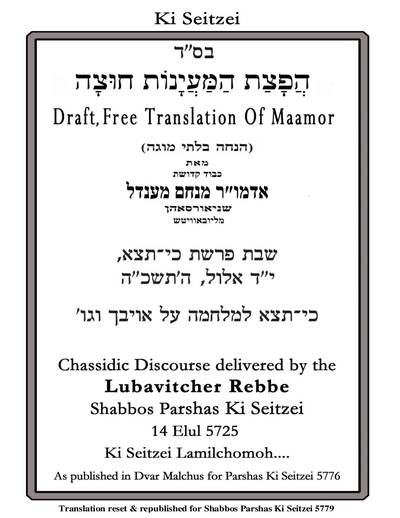
The Parsha begins with the Possuk א כִּי־תֵצֵא לַמִּלְחָמָה עַל־אֹיְבֶיך “If you go to war upon your enemies”. The Alter Rebbe explains in Likkutei Torah (this is further explained in the Maamorim of the Miteller Rebbe and of the Tzemach Tzedek and of the Rebbeim that succeeded) that it is brought down in the Zohar that the time of prayer is a time of battle.

The Alter Rebbe also brings the Targum translation on the words of the Possuk בְחַרְבִּי אֲשֶר לָקַחְתִּי מִּיַד הָאֱמֹרִּי וּבְקַשְתִּי “which I took from the hand of the Amorite with my sword and with my bow.”

The Targum substitutes the words my sword and my bow for: בִּצְלוֹתִּי וּבְבָעוּתִּי “my prayer and my supplications”. In other words, when our Possuk states כִּי־תֵצֵא לַמִּלְחָמָה it refers to the battle which is the ‘Avoda’ of prayer.

The Alter Rebbe goes on to explain the continuation of the Possuk that when the Possuk states (כִּי־תֵצֵא לַמִּלְחָמָה ) עַל־אֹיְבֶיך “(If you shall go to war) upon your enemies” it means when you will go out to battle, to win over and cool off one’s faculty of desire, from its focus on worldly material pleasures, to transform it as a love for HaShem. Then it shall be with the attitude that you are dealing עַל־אֹיְבֶיך “upon your enemies” from on top of your enemies i.e. at their root above because there is nothing negative that comes down from heaven, for their root is good, as it stems from HaShem’s supernal chariot of holiness.

The Alter Rebbe continues to explain that upon your enemy means above your enemy. Because in the realm above the enemy has no authority or hold whatsoever.

Reconciling Rashi and the Alter Rebbe

BEIS We need to understand how the Alter Rebbe’s explanation aligns with what Rashi says, that our Possuk לַמִּלְחָמָה כִּי־תֵצֵא “If you go out to war upon your enemies” refers to an optional battle (as opposed to an obligatory battle).

Rashi substantiates his interpretation that this Possuk is talking about a permitted battle from the words at the end of this Possuk וְשָבִּיתָ שִּבְיוֹ “You shall take captives”, since regarding the obligatory war to conquer the land of Eretz Yisroel, the Torah couldn’t possibly say וְשָבִּיתָ שִּבְיוֹ “You shall take captives” after instructing לֹא תְחַיֶה כָל־נְשָמָה “you shall not allow any soul to live”.

However, even in the literal translation of the Torah we can say that when the Torah says: “when you will go to battle (then it will be) upon your enemy” this can be understood not just to refer to an optional battle but also to refer to an obligatory battle.

In other words this Possuk is not only coming to instruct the law of וְשָבִּיתָ שִּבְיוֹ “You shall take captives” at the end of the Possuk, but also to teach you that when going out to any kind of war it must be with the triumphant attitude that one is above the enemy, and as a result of this you will be triumphant at battle.

This is akin to what the Torah writes in last week’s Parsha: כִּי־תֵצֵא לַמִּלְחָמָה עַל־אֹיְבֶך גוֹ׳ וְרָאִּיתָ סוּס וָרֶכֶב עַם רַב מִּמְך לֹא תִּירָא מֵהֶם גוֹ׳ “When you go out to war against your enemies, and you see horse and chariot, a people more numerous than you, you shall not be afraid of them”. The message of this Possuk is the instruction that you shall not fear them. Since in HaShem’s eyes they are all like one horse, which is consistent with what Rashi explains why the words horse and chariot are written in the singular form.

Similarly, we can explain our Possuk of כִּי־תֵצֵא לַמִּלְחָמָה “If you go out to war upon your enemies” that the instruction to go out to war ‘upon’ your enemy means to view the [essence of the] enemy as it is in its root and source. As a result of which the fear will dissipate, and it will become easier to be triumphant.

This principle is true with regards to an obligatory war as it is true with regards to an optional war and therefore it is also true with regards to the spiritual battle of the Avodah of prayer.

However, because the end of the Possuk states וְשָבִּיתָ שִּבְיוֹ “You shall take captives” it therefore also changes the basic translation of the words at the beginning of the Possuk of כִּי־תֵצֵא לַמִּלְחָמָה “If you go out to war upon your enemies” to only mean ‘If’ you will go to battle, and not ‘when’ you will go to battle, because by definition the word ‘if’ can only be talking about an optional battle.

So, our question returns: How is this consistent with the Alter Rebbe’s explanation, that this Possuk refers to the spiritual battle of the Avoda of prayer, considering that the battle of prayer is not an optional battle, but is an obligatory battle? And, even more so it is particularly an important obligation (even more of an obligation than the performance of Mitzvos)!

The Source and Descent of the Animal Soul

As is understood from the Alter Rebbe’s description of prayer: ‘That every person sacrifices his own animal soul to elevate it and to connect it back to its root’. The root of the animal soul also stems from the supernal element of fire, which is its source from where it was hewn and founded. This is in the holy spiritual mountains of the face of the lion and the face of the ox of HaShem’s supernal chariot.

It is only after the descent of the animal soul through the Seder Hishtalshelus and through the seventy spiritual princes and by pervading the waste product of the supernal Ofanim Angels, that the worldly pleasures and the faculty of desire stoop down below. The worldly pleasures and the faculty of desire remain however in the category of the heat of fire. As well as the Yetzer HoRa which is also a burning foreign fire. One’s objective therefore, is to elevate the animal soul back up to its source which is the state of fire above.

The Alter Rebbe continues to explain that every day a person’s inclination dominates him afresh and he has...
The Parsha begins with the Possuk א כִּי־תֵצֵא לַמִּלְחָמָה עַל־אֹיְבֶיך “If you go to war upon your enemies”. The Alter Rebbe explains in Likkutei Torah (this is further explained in the Maamorim of the Miteller Rebbe and of the Tzemach Tzedek and of the Rebbeim that succeeded) that it is brought down in the Zohar that the time of prayer is a time of battle.

The Alter Rebbe also brings the Targum translation on the words of the Possuk בְחַרְבִּי אֲשֶר לָקַחְתִּי מִּיַד הָאֱמֹרִּי וּבְקַשְתִּי “which I took from the hand of the Amorite with my sword and with my bow.”

The Targum substitutes the words my sword and my bow for: בִּצְלוֹתִּי וּבְבָעוּתִּי “my prayer and my supplications”. In other words, when our Possuk states כִּי־תֵצֵא לַמִּלְחָמָה it refers to the battle which is the ‘Avoda’ of prayer.

The Alter Rebbe goes on to explain the continuation of the Possuk that when the Possuk states (כִּי־תֵצֵא לַמִּלְחָמָה ) עַל־אֹיְבֶיך “(If you shall go to war) upon your enemies” it means when you will go out to battle, to win over and cool off one’s faculty of desire, from its focus on worldly material pleasures, to transform it as a love for HaShem. Then it shall be with the attitude that you are dealing עַל־אֹיְבֶיך “upon your enemies” from on top of your enemies i.e. at their root above because there is nothing negative that comes down from heaven, for their root is good, as it stems from HaShem’s supernal chariot of holiness.

The Alter Rebbe continues to explain that upon your enemy means above your enemy. Because in the realm above the enemy has no authority or hold whatsoever.

Reconciling Rashi and the Alter Rebbe

BEIS We need to understand how the Alter Rebbe’s explanation aligns with what Rashi says, that our Possuk לַמִּלְחָמָה כִּי־תֵצֵא “If you go out to war upon your enemies” refers to an optional battle (as opposed to an obligatory battle).

Rashi substantiates his interpretation that this Possuk is talking about a permitted battle from the words at the end of this Possuk וְשָבִּיתָ שִּבְיוֹ “You shall take captives”, since regarding the obligatory war to conquer the land of Eretz Yisroel, the Torah couldn’t possibly say וְשָבִּיתָ שִּבְיוֹ “You shall take captives” after instructing לֹא תְחַיֶה כָל־נְשָמָה “you shall not allow any soul to live”.

However, even in the literal translation of the Torah we can say that when the Torah says: “when you will go to battle (then it will be) upon your enemy” this can be understood not just to refer to an optional battle but also to refer to an obligatory battle.

In other words this Possuk is not only coming to instruct the law of וְשָבִּיתָ שִּבְיוֹ “You shall take captives” at the end of the Possuk, but also to teach you that when going out to any kind of war it must be with the triumphant attitude that one is above the enemy, and as a result of this you will be triumphant at battle.

This is akin to what the Torah writes in last week’s Parsha: כִּי־תֵצֵא לַמִּלְחָמָה עַל־אֹיְבֶך גוֹ׳ וְרָאִּיתָ סוּס וָרֶכֶב עַם רַב מִּמְך לֹא תִּירָא מֵהֶם גוֹ׳ “When you go out to war against your enemies, and you see horse and chariot, a people more numerous than you, you shall not be afraid of them”. The message of this Possuk is the instruction that you shall not fear them. Since in HaShem’s eyes they are all like one horse, which is consistent with what Rashi explains why the words horse and chariot are written in the singular form.

Similarly, we can explain our Possuk of כִּי־תֵצֵא לַמִּלְחָמָה “If you go out to war upon your enemies” that the instruction to go out to war ‘upon’ your enemy means to view the [essence of the] enemy as it is in its root and source. As a result of which the fear will dissipate, and it will become easier to be triumphant.

This principle is true with regards to an obligatory war as it is true with regards to an optional war and therefore it is also true with regards to the spiritual battle of the Avodah of prayer.

However, because the end of the Possuk states וְשָבִּיתָ שִּבְיוֹ “You shall take captives” it therefore also changes the basic translation of the words at the beginning of the Possuk of כִּי־תֵצֵא לַמִּלְחָמָה “If you go out to war upon your enemies” to only mean ‘If’ you will go to battle, and not ‘when’ you will go to battle, because by definition the word ‘if’ can only be talking about an optional battle.

So, our question returns: How is this consistent with the Alter Rebbe’s explanation, that this Possuk refers to the spiritual battle of the Avoda of prayer, considering that the battle of prayer is not an optional battle, but is an obligatory battle? And, even more so it is particularly an important obligation (even more of an obligation than the performance of Mitzvos)!

The Source and Descent of the Animal Soul

As is understood from the Alter Rebbe’s description of prayer: ‘That every person sacrifices his own animal soul to elevate it and to connect it back to its root’. The root of the animal soul also stems from the supernal element of fire, which is its source from where it was hewn and founded. This is in the holy spiritual mountains of the face of the lion and the face of the ox of HaShem’s supernal chariot.

It is only after the descent of the animal soul through the Seder Hishtalshelus and through the seventy spiritual princes and by pervading the waste product of the supernal Ofanim Angels, that the worldly pleasures and the faculty of desire stoop down below. The worldly pleasures and the faculty of desire remain however in the category of the heat of fire. As well as the Yetzer HoRa which is also a burning foreign fire. One’s objective therefore, is to elevate the animal soul back up to its source which is the state of fire above.

The Alter Rebbe continues to explain that every day a person’s inclination dominates him afresh and he has...

PDF Preview