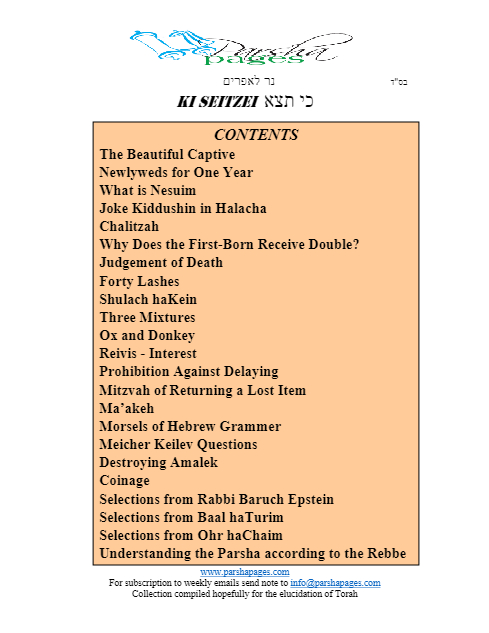
What is Nesuim
Parsha Pages | September 12, 2024
Print This Article
View Original PDF

What is Nesuim

Parsha Pages | June 27, 2025

What is Nessuin (a Marriage)?

The Rogatchover Gaon provided multiple sources that displayed two different approaches to the question of how a chasunah (a one-time event) has effect during the subsequent marriage life.

  1. Standard - A one-time action creating a binding contract that acquires and establishes an ongoing obligation (Raavad)
  2. Gaon’s innovation: A continuous action that is renewed each and every moment (Rambam)

(A story is told that Rabbi Chaim Brisker once gave mazel tov to the Gaon since each moment was like a new marriage. The Gaon provided a sharp retort that he did not need a new mazel tov since the one provided at the wedding also continued each moment to be new.)

Law: If a wife breaks dishes during the normal course of kitchen activities she is exempt from payment to her husband for the damages to his property.

Rambam: She is exempt due to a decree in order to promote Shalom Bayis. A constant new state of marriage exists each moment (able to divorce at any time and end the relationship). Thus, two different events (acquisition and the destruction) occur for which she is only exempt due to the decree.

Raavad: She is exempt by the law since the wife is constantly within the protection of the husband who is “rewarding” her all the time by letting her acquire the dish. Continuing state of obligation and reward exempts the wife from the damages.

Law: If the wife becomes “insane”, what is the status of the husband’s marital obligations?

Rambam: No obligation upon the husband to pay for medical expenses to heal the wife. Every moment is a new marital connection which results in marital obligations. However, when they can not live together, then no obligation occurs.

Raavad: Obligation to pay medical expenses remains from the initial marriage as long as they are not divorced.

Law: If the husband passes away then the estate is obligated to provide the physical needs (food, shelter, etc.) to the widow. What if more than one wife exists, is the apportionment of expenses adjusted according to the wife married first?

Rambam: The law does not recognize any historical priority; all wives are treated equally for this matter. Since each marriage is constantly new, all are on equal basis.

Raavad: All are treated equally but for a different reason. Since the obligation to support the wives occurs after death, they all acquire the obligation at the same time (but not due to the time of the marriage).

Law: In general, one makes a blessing immediately prior to an act, and not afterwards.

Rambam: If one fails to make the blessing on betrothal (ארוסין), then one can not say the blessing afterwards. However, the blessing on the marriage (נישואין) can be said even after many days. The Gaon understands this seemingly contradiction in terms that betrothal is a one-time event whereas marriage is constantly new.

Law: A nursing mother should not remarry within the first 24 months of the new baby’s life.

Mechaber (and Rambam): If one transgresses and becomes married, they must divorce even if he is a Cohen. However, if they only become betrothed, then they can wait till the end of the 24 months and then marry. Marriage is different since every moment is a new (and thus, a transgression).

Rema: No distinction exists whether marriage or betrothal; both are prohibited.
What is Nessuin (a Marriage)?

The Rogatchover Gaon provided multiple sources that displayed two different approaches to the question of how a chasunah (a one-time event) has effect during the subsequent marriage life.

  1. Standard - A one-time action creating a binding contract that acquires and establishes an ongoing obligation (Raavad)
  2. Gaon’s innovation: A continuous action that is renewed each and every moment (Rambam)

(A story is told that Rabbi Chaim Brisker once gave mazel tov to the Gaon since each moment was like a new marriage. The Gaon provided a sharp retort that he did not need a new mazel tov since the one provided at the wedding also continued each moment to be new.)

Law: If a wife breaks dishes during the normal course of kitchen activities she is exempt from payment to her husband for the damages to his property.

Rambam: She is exempt due to a decree in order to promote Shalom Bayis. A constant new state of marriage exists each moment (able to divorce at any time and end the relationship). Thus, two different events (acquisition and the destruction) occur for which she is only exempt due to the decree.

Raavad: She is exempt by the law since the wife is constantly within the protection of the husband who is “rewarding” her all the time by letting her acquire the dish. Continuing state of obligation and reward exempts the wife from the damages.

Law: If the wife becomes “insane”, what is the status of the husband’s marital obligations?

Rambam: No obligation upon the husband to pay for medical expenses to heal the wife. Every moment is a new marital connection which results in marital obligations. However, when they can not live together, then no obligation occurs.

Raavad: Obligation to pay medical expenses remains from the initial marriage as long as they are not divorced.

Law: If the husband passes away then the estate is obligated to provide the physical needs (food, shelter, etc.) to the widow. What if more than one wife exists, is the apportionment of expenses adjusted according to the wife married first?

Rambam: The law does not recognize any historical priority; all wives are treated equally for this matter. Since each marriage is constantly new, all are on equal basis.

Raavad: All are treated equally but for a different reason. Since the obligation to support the wives occurs after death, they all acquire the obligation at the same time (but not due to the time of the marriage).

Law: In general, one makes a blessing immediately prior to an act, and not afterwards.

Rambam: If one fails to make the blessing on betrothal (ארוסין), then one can not say the blessing afterwards. However, the blessing on the marriage (נישואין) can be said even after many days. The Gaon understands this seemingly contradiction in terms that betrothal is a one-time event whereas marriage is constantly new.

Law: A nursing mother should not remarry within the first 24 months of the new baby’s life.

Mechaber (and Rambam): If one transgresses and becomes married, they must divorce even if he is a Cohen. However, if they only become betrothed, then they can wait till the end of the 24 months and then marry. Marriage is different since every moment is a new (and thus, a transgression).

Rema: No distinction exists whether marriage or betrothal; both are prohibited.

PDF Preview