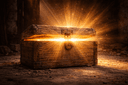
The Half Shekel of Redemption
Reflections of Redemption | February 28, 2024
Print This Article
View Original PDF

The Half Shekel of Redemption

Reflections of Redemption | December 10, 2025

The “coin of fire” atones for the sin of the Golden Calf. The two characteristics of the yearly half-shekel tithe are quality and enthusiasm. A coin has a fixed value of known quality. Fire is unlimited, transformative passion. Offering these two aspects of the soul atones for and burns away the sin that delayed Redemption.

The tragic incident of the Golden Calf occurs in this week’s Torah reading. However, the Torah reading does not begin with the story of the people’s transgression. Rather, it begins with the process of atonement. G-d instructs Moses to take a census of the Jewish people. Each male over twenty was to give a half-shekel; by counting the half-shekels, the number of able-bodied men can be determined. This half-shekel was to be a yearly tax; from the funds collected the communal offerings would be bought.

When Moses argues with G-d not to destroy the people, G-d relents, but declares that “in the day when I visit, I will visit their sin upon them.” This means that whenever the Jewish people are punished for a sin, included with it is a small measure of punishment for the transgression of the Golden Calf. By the same token, every sacrifice, every atonement, surely expiates a little of the sin. Thus, the yearly contribution of a half-shekel per male over twenty repaired, in part, the damage caused by the sin of the Golden Calf.

(As an aside, we may note this particular tithe – a yearly half-shekel per head – was limited to men over twenty because they alone, and not the women, participated in the transgression.)

There is an immediate and obvious connection between the required donation of a half-shekel and hastening the Redemption. We know that the revelation at Sinai elevated not just the Jewish people, but the whole world. The residue of the sin of the Tree of Knowledge was rinsed away. Once the Jewish people received the Torah, the world was ready for the final Redemption. Had the Jewish people remained steadfast and faithful, Moses would have been Moshiach; the age of Redemption would have begun with their entrance into Israel.

With the sin of the Golden Calf, however, Redemption was delayed. Before Moshiach can come, or at least, before there can be an open revelation of Moshiach, every trace of the transgression must be removed, consumed by fire, as it were. Thus, every act that transforms the calf back into a molten material brings us one step closer to Redemption.

This brings us to the Torah reading. G-d tells Moses, “When you take the sum of the children of Israel according to their number, then they shall give every man an atonement for his soul unto the L-rd... This they shall give... half a shekel of the shekel of the sanctuary... as an offering to the L-rd.”

So, given that the half-shekel is an “atonement for the soul,” a reparation of the sin, so to speak, it seems fair to ask why. What special features of the half-shekel make it an instrument of atonement, and therefore Redemption?

The uniqueness of the half-shekel confused even Moses. When G-d said, “This they shall give,” it wasn’t clear to Moses exactly what should be given. Moses did not understand how the people could atone for the sin of the Golden Calf. Therefore, as Rashi comments, G-d showed Moses a coin of fire which weighed half a shekel and explained, like this coin shall they give.

Giving the half-shekel atoned for the sin of the Golden Calf, and that sin delayed Redemption; when we give a half-shekel, in a spiritual sense, we hasten the Redemption. Accordingly, by understanding the two elements of G-d’s command, we can understand the form of atonement that brings Redemption.

The two elements we deduce from what G-d showed Moses: first, G-d showed Moses a coin; second, the coin itself was made of fire.

The half-shekel was given once a year because it functioned as a sacrifice: just as one could not give part of a sacrifice, so too the half-shekel could not be given piecemeal, at different times. For the same reason, the half-shekel had to be a coin. Since the shekel is a measurement, the command to give a half-shekel might mean a certain amount, not a fixed object. Maybe G-d wanted a half-shekel’s weight of silver, regardless of its form? No, G-d wanted specifically a coin.

The difference is that weights and measures are quantitative. A coin, on the other hand, is qualitative. It has a certain value independent of its size or mass or volume. Thus, G-d demands as an atonement for the sin of the Golden Calf a coin, not a measurement. The act that initiates Redemption must have a certain quality, not quantity.

For a similar reason, the coin G-d showed Moses was made of fire. The difference between fire and the other elements – earth, wind and water – is the difference between quality and quantity. Earth, wind and water have dimensions and mass and occupy space. They are limited to a location and cover a certain area. Fire, on the other hand, is unlimited. It has no particular form nor can it be contained within some vessel. Fire continually spreads; it naturally extends and increases itself.

Obviously, our yearly half-shekel tithe cannot be a coin of fire. But on an inner, spiritual level, the coin of silver we give reflects the Heavenly coin of fire. It is this which brings atonement and as a result, Redemption.

Let us remember that G-d said the half-shekel would serve as an atonement for the soul. It was more than a sacrifice. A sacrifice brings forgiveness, and therefore a removal of the impurity caused by the sin. But an atonement for the soul means a redemption, a replacement of the soul, as it were. The person becomes a new existence.

Purification takes place through immersion in water or immersion in fire. The first washes away the transgression, affecting only the external attributes and unintentional actions. Returning the soul to the furnace, so to speak, affects the essence of the person, transforming him.

The sin of the Golden Calf affected the essence of the Jewish people. By showing Moses a “coin of fire,” G-d indicated that atonement must come from the “fire of the soul.” The Jewish people must give their very essence to rectify the transgression and bring the Redemption. Further, this giving must be total and all at once. Like the half-shekel, the “coin” that is the “fire of the soul” – one’s very essence – cannot be given with reservations, conditions or in stages. To reach the level of Moshiach, there must be a transformation, one that reveals we have become a new existence.

But G-d revealed the coin of fire only after Moses admitted his confusion. Similarly, we must recognize our intellectual limitations before the essence of our soul can be revealed.

The practical lesson for us is obvious: we can sometimes lose enthusiasm for study of Torah, for performance of mitzvos, for acts of goodness and kindness, for preparing the world for Moshiach. At such a time, the Moses within us – the wisdom of our soul – becomes confused and disoriented. But when we realize that we have become desensitized, indifferent to G-d’s Will, that itself arouses G-d’s help and He shows us the coin of fire. The essence of the soul is transformed and revealed. Even a mundane act is atonement; the simple mitzvah rectifies the transgression and brings Moshiach. If this applies to our own actions, all the more so it applies when we help another Jew do a mitzvah.

Enthusiasm eventually brings comprehension. But even more, when we are “fired up,” so to speak, it hastens the fire, the Divine revelation, that will rebuild the Temple. By giving our half-shekel, by devoting our very essence to G-d’s Will, we hasten the coming of Moshiach.

(Based on Likkutei Sichos 16, pp. 381-393)

The “coin of fire” atones for the sin of the Golden Calf. The two characteristics of the yearly half-shekel tithe are quality and enthusiasm. A coin has a fixed value of known quality. Fire is unlimited, transformative passion. Offering these two aspects of the soul atones for and burns away the sin that delayed Redemption.

The tragic incident of the Golden Calf occurs in this week’s Torah reading. However, the Torah reading does not begin with the story of the people’s transgression. Rather, it begins with the process of atonement. G-d instructs Moses to take a census of the Jewish people. Each male over twenty was to give a half-shekel; by counting the half-shekels, the number of able-bodied men can be determined. This half-shekel was to be a yearly tax; from the funds collected the communal offerings would be bought.

When Moses argues with G-d not to destroy the people, G-d relents, but declares that “in the day when I visit, I will visit their sin upon them.” This means that whenever the Jewish people are punished for a sin, included with it is a small measure of punishment for the transgression of the Golden Calf. By the same token, every sacrifice, every atonement, surely expiates a little of the sin. Thus, the yearly contribution of a half-shekel per male over twenty repaired, in part, the damage caused by the sin of the Golden Calf.

(As an aside, we may note this particular tithe – a yearly half-shekel per head – was limited to men over twenty because they alone, and not the women, participated in the transgression.)

There is an immediate and obvious connection between the required donation of a half-shekel and hastening the Redemption. We know that the revelation at Sinai elevated not just the Jewish people, but the whole world. The residue of the sin of the Tree of Knowledge was rinsed away. Once the Jewish people received the Torah, the world was ready for the final Redemption. Had the Jewish people remained steadfast and faithful, Moses would have been Moshiach; the age of Redemption would have begun with their entrance into Israel.

With the sin of the Golden Calf, however, Redemption was delayed. Before Moshiach can come, or at least, before there can be an open revelation of Moshiach, every trace of the transgression must be removed, consumed by fire, as it were. Thus, every act that transforms the calf back into a molten material brings us one step closer to Redemption.

This brings us to the Torah reading. G-d tells Moses, “When you take the sum of the children of Israel according to their number, then they shall give every man an atonement for his soul unto the L-rd... This they shall give... half a shekel of the shekel of the sanctuary... as an offering to the L-rd.”

So, given that the half-shekel is an “atonement for the soul,” a reparation of the sin, so to speak, it seems fair to ask why. What special features of the half-shekel make it an instrument of atonement, and therefore Redemption?

The uniqueness of the half-shekel confused even Moses. When G-d said, “This they shall give,” it wasn’t clear to Moses exactly what should be given. Moses did not understand how the people could atone for the sin of the Golden Calf. Therefore, as Rashi comments, G-d showed Moses a coin of fire which weighed half a shekel and explained, like this coin shall they give.

Giving the half-shekel atoned for the sin of the Golden Calf, and that sin delayed Redemption; when we give a half-shekel, in a spiritual sense, we hasten the Redemption. Accordingly, by understanding the two elements of G-d’s command, we can understand the form of atonement that brings Redemption.

The two elements we deduce from what G-d showed Moses: first, G-d showed Moses a coin; second, the coin itself was made of fire.

The half-shekel was given once a year because it functioned as a sacrifice: just as one could not give part of a sacrifice, so too the half-shekel could not be given piecemeal, at different times. For the same reason, the half-shekel had to be a coin. Since the shekel is a measurement, the command to give a half-shekel might mean a certain amount, not a fixed object. Maybe G-d wanted a half-shekel’s weight of silver, regardless of its form? No, G-d wanted specifically a coin.

The difference is that weights and measures are quantitative. A coin, on the other hand, is qualitative. It has a certain value independent of its size or mass or volume. Thus, G-d demands as an atonement for the sin of the Golden Calf a coin, not a measurement. The act that initiates Redemption must have a certain quality, not quantity.

For a similar reason, the coin G-d showed Moses was made of fire. The difference between fire and the other elements – earth, wind and water – is the difference between quality and quantity. Earth, wind and water have dimensions and mass and occupy space. They are limited to a location and cover a certain area. Fire, on the other hand, is unlimited. It has no particular form nor can it be contained within some vessel. Fire continually spreads; it naturally extends and increases itself.

Obviously, our yearly half-shekel tithe cannot be a coin of fire. But on an inner, spiritual level, the coin of silver we give reflects the Heavenly coin of fire. It is this which brings atonement and as a result, Redemption.

Let us remember that G-d said the half-shekel would serve as an atonement for the soul. It was more than a sacrifice. A sacrifice brings forgiveness, and therefore a removal of the impurity caused by the sin. But an atonement for the soul means a redemption, a replacement of the soul, as it were. The person becomes a new existence.

Purification takes place through immersion in water or immersion in fire. The first washes away the transgression, affecting only the external attributes and unintentional actions. Returning the soul to the furnace, so to speak, affects the essence of the person, transforming him.

The sin of the Golden Calf affected the essence of the Jewish people. By showing Moses a “coin of fire,” G-d indicated that atonement must come from the “fire of the soul.” The Jewish people must give their very essence to rectify the transgression and bring the Redemption. Further, this giving must be total and all at once. Like the half-shekel, the “coin” that is the “fire of the soul” – one’s very essence – cannot be given with reservations, conditions or in stages. To reach the level of Moshiach, there must be a transformation, one that reveals we have become a new existence.

But G-d revealed the coin of fire only after Moses admitted his confusion. Similarly, we must recognize our intellectual limitations before the essence of our soul can be revealed.

The practical lesson for us is obvious: we can sometimes lose enthusiasm for study of Torah, for performance of mitzvos, for acts of goodness and kindness, for preparing the world for Moshiach. At such a time, the Moses within us – the wisdom of our soul – becomes confused and disoriented. But when we realize that we have become desensitized, indifferent to G-d’s Will, that itself arouses G-d’s help and He shows us the coin of fire. The essence of the soul is transformed and revealed. Even a mundane act is atonement; the simple mitzvah rectifies the transgression and brings Moshiach. If this applies to our own actions, all the more so it applies when we help another Jew do a mitzvah.

Enthusiasm eventually brings comprehension. But even more, when we are “fired up,” so to speak, it hastens the fire, the Divine revelation, that will rebuild the Temple. By giving our half-shekel, by devoting our very essence to G-d’s Will, we hasten the coming of Moshiach.

(Based on Likkutei Sichos 16, pp. 381-393)

PDF Preview