A Tale of Two Wives
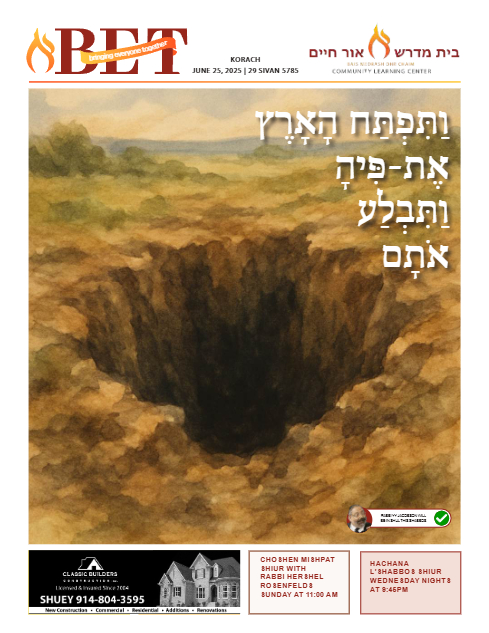
Korach (from the tribe of Levi), along with Dassan, Aviram, Ohn ben Peles (all from the tribe of Reuven), and 250 other men, rebelled against Moshe and Aharon’s leadership. G-d divinely confirmed Moshe and Aharon’s leadership when the earth swallowed up Korach, Dassan, Aviram, and their entire families, and a heavenly fire consumed the 250 men.
The obvious question is: What happened to Ohn ben Peles? While Ohn ben Peles and Korach started out in the same clique, they met very different ends. Korach suffered an ignominious death, while Ohn ben Peles escaped.
The Talmud [Sanhedrin 109b] explains how they wound up going their separate ways. The Gemara says that the wife of Ohn ben Peles saved him. She saw that he was getting all fired up about Korach’s rebellion. She told him, “What difference does it make to you? If Moshe is the leader, you will be his disciple, and if Korach is the leader, you will be his disciple. Either way, your station in life will not change. Why are you getting all excited?”
Ohn ben Peles told his wife that since he had already sworn allegiance to Korach, there was no way he could now remove himself from the group. His wife gave him alcoholic beverages to drink until he fell asleep. She then went outside the tent as the ‘mob’ passed by and did not allow them to come in and wake her husband. They ultimately left without him. Because of her, Ohn ben Peles was saved.
On the other hand, the Talmud tells us that Korach’s wife egged him on. It was her teasing that angered him against Moshe and fired him up to start his rebellion. We know the rest of the story.
The point of this Rabbinic teaching is to teach us what a difference a wife can make. Every once in a while, we need to hear words from our wives that set us straight and put us in our place. On the other hand, if a person does not merit a good wife, she and her urgings can be his undoing and the cause of his destruction.
This is the interpretation that Rav Naftali Tzvi Yehudah Berlin (the Netziv) gave to explain the expression “Ezer k’negdo” (a helpmate, opposite him) [Bereishis 2:18]. Sometimes, she can help by helping, and sometimes, she can help by opposing, standing up and protesting, putting the husband, respectfully, in his right place [Yevamos 63a].
The divergent fate of Korach on the one hand and that of Ohn ben Peles on the other was the tale of two men and, even more, the tale of two wives.
No Visitation Rights
“If these die like the death of all men, and the destiny of all men is visited upon them...” (16:29)
Moshe states that if Korach and his assembly die in a manner that requires that they be visited while on their sick beds, i.e., in a natural manner, Korach will be vindicated. The Talmud derives from Moshe’s statement the obligation of “bikur cholim,” visiting the sick. Why does the Talmud not rely on Hashem visiting Avraham after his circumcision, an earlier occurrence, as the source for the obligation of bikur cholim? Furthermore, the connection between visiting the sick and the story of Korach’s insurrection is unclear. The point that Moshe is making is that if Korach dies a natural death, this justifies his claim that Moshe had been abusing his position. However, there is no need to mention bikur cholim in describing a natural death. Why then does the Torah choose the story of Korach as the vehicle for relaying the requirement of visiting the sick?
There is a different passage in the Talmud that cites an alternative scriptural source for the mitzva of bikur cholim. Commenting upon the verse “vehodatah lahem es haderech asher yelchu vah” – “and you (Moshe) will make known the path they shall follow to them,” the Talmud states that this is the source for bikur cholim. Why is it necessary for the Talmud to cite two sources for the same obligation?
In yet another passage in the Talmud, we find the statement that since Hashem visits the sick, we are obliged to do the same, “vehalachta bidrachav” – “And you shall follow His path.” The Talmud is teaching us that one aspect of the bikur cholim obligation is derived from our obligation to emulate Hashem. It is this aspect that is portrayed in the story of Avraham, weak from having undergone circumcision, being visited by the Divine Presence. The verse cited by the Talmud , which contains the commandment to Moshe to instruct Bnei Yisroel as to the path which they should follow, is also accentuating this aspect of bikur cholim. The Maharsha explains that the path refers to the path of emulating Hashem.
In Parshas Korach, we are introduced to a new aspect of bikur cholim: the obligation to empathize with the pain of a fellow human being. A prerequisite to empathy is a person’s capacity to focus upon the kindred spirit that we as human beings share. By being able to identify with one another, we can share pain and bring each other comfort.
Korach is described by Chazal as a ba’al machlokes, a person who is divisive by nature. Such an individual thrives on focusing on those aspects within people that create conflict. This is the antithesis of empathy. A person who conducts himself in such a manner does not empathize with others, and as a result, does not receive their empathy, either. Korach claims that it is Moshe who is creating divisiveness within Klal Yisroel while Korach himself is the champion of equality and unity. Moshe challenges Korach’s assertions by stating that Korach cannot die in a natural manner, i.e., becoming bedridden and visited by others, since it is not possible for him to receive the empathy of others. A ba’al machlokes does not show empathy and, therefore, receives none in return.
It is now apparent why the Talmud cites this new source for bikur cholim. It focuses upon the second aspect of the mitzva, the obligation to empathize with one another. The story of Korach is the ideal setting in which to deliver this message, for Korach’s behavior showed a total lack of sensitivity.
RABBI YISSOCHOR FRAND
RABBI YOCHANAN ZWEIG