Korach's Mistake and the Symbolism of Oil and Wine
Parsha B'Iyun | June 27, 2025
Print This Article
View Original PDF

Korach's Mistake and the Symbolism of Oil and Wine

Parsha B'Iyun | December 10, 2025

The Kohen Gadol who has nothing of his own. The Rambam, in Hilchot Melachim, states that just as the Torah grants the king great honor and obligates all to respect him, so it commands him to have a humble and lowly heart, with compassion for small and great, tending to their needs and caring for the honor of the least of the least. He must always act with great humility. It follows that a person must feel humility, even in a lofty role. The Be’er Moshe says this was not the case with Korach, who thought he needed to rise above all, and that was his mistake. We use oil to anoint because of how it is made – olives are taken from high up in the tree, then crushed and pressed until they produce drops of oil. Who is appointed with oil? Someone who endured pressures and difficulties; not someone at the top.

The Mashiach is called משיח because he is anointed with oil, just as the Kohen Gadol is anointed. Why? Because Chazal say the oil is likened to Knesset Yisrael. Just as oil is crushed, so too Bnei Yisrael endure crushing until they grow; they grow through that crushing. The Be’er Moshe of Ozharov says this was Korach’s mistake. He thought, “I’m the son of oil, I rise above all.” But that is not how a person is appointed. They are anointed when they humble themselves.

With that, I want to bring one more point from the wonderful words of Rav David Tabil of Minsk, in his sefer Nachalat David. What is oil, and what is wine? Oil symbolizes the attribute of chesed (kindness), while wine symbolizes the attribute of din (judgment). The Zohar writes, the Kohanim’s attribute is chesed, while the attribute of the Levi’im is din. Since the tribe of Kohanim were of chesed, and the tribe of Levi’im were of din, one who is of din cannot transform to become chesed. Therefore, the Kohanim wear white garments in their Avodah, because white symbolizes Chesed.

B’ezrat Hashem, in less than one hundred days from now, we will be at Yom Kippur. What do we find on Yom Kippur? It says: אִ ם־יִהְ יוּ חֲטָאֵיכֶם כַּשָּׁנִים כַּשֶּׁלֶג יַלְבִּינוּ – Though your sins be as scarlet, they shall be as white as snow. They start off red and turn to the color of snow – white, a color that symbolizes the attribute of chesed. This is the tribe of Kohanim.

The Levi’im, on the other hand, serve in the attribute of din. Why? They are the singers and gatekeepers; responsible for the singing in the Beit Hamikdash and for the gates of the Beit Hamikdash. And when do they sing? Chazal say: There is no singing except over wine – יין אין שירה אלא על היין. Rabbotai, what does wine symbolize? Din. If wine symbolizes din, and there is no singing except over wine, it means the Levi’im serve in the attribute of din. We all remember the Gemara in Sukkot – and in just 115 days we will arrive at Sukkot, B’ezrat Hashem, I hope everyone is already preparing. What do we find with regards to one is in a Sukkah that is rained upon? It is likened to a servant who came to pour a cup for his master, and what did his master do? He poured a pitcher of water on him. The Vilna Gaon explains this parable: The cup is wine. How much is a כוס (cup) in gematria? 86, which is also the value of להים-א, representing מידת הדין – the attribute of din.

The master holds din in his hand, and he comes to dilute it with water. If we look, we’ll see that many people have a custom to add a few drops of water into their wine before making kiddush. Some put three drops, some four or five; and some don’t care how many, they pour water straight from the tap into the wine bottle without counting. Why? To dilute the wine, so it’s not only din; they put water in it to sweeten the din. Therefore, the Vilna Gaon says, if, heaven forbid, a decree of exile (galut) is issued upon us on Yom Kippur, what must we do? We must flee to the sukkah outside. We say so in the Yehi Ratzon of the sukkah: May it be Your will that the sukkah, in the merit of my leaving my house to the outside, if exile is decreed upon me, by sitting in the sukkah, I am saved.

But, Rabbotai, what happens if you come to dilute the din, in the sukkah and the Shade of Faith, but the King throws you out? If the King throws you out, then what? His master poured a pitcher on his face. He came to dilute, to put water in it – water is rachamim (mercy) – and his master poured a pitcher on his face, meaning the attribute of din is upon him. It follows that wine symbolizes din, and in contrast, oil symbolizes chesed. The Zohar says oil symbolizes chesed, and this belongs to the Kohanim. Therefore, a Kohen is anointed with the anointing oil.

If so, what did Korach want? Korach, the Levi, who is of the attribute of din, wanted to be the attribute of rachamim. He wanted to be chesed. But he was told he cannot be chesed. Why? Even though your father was called oil, what can you do – you were chosen to be a Levi! The Kohanim’s attribute is chesed, and you cannot turn the attribute of din into the attribute of chesed. It doesn’t work. Avraham was chesed and Yitzchak was din; each has their role and you cannot mix the two. True, Yaakov Avinu was the completion of both, but each has their role.

Sefer Nachalat David says, as a result of this, Moshe Rabbeinu says: אֶת־אֲשׁ ֶר־לוֹ 'בֹּקֶר וְיֹדַע ה – Morning, and Hashem will make known who is His. Morning represents chesed, just as it says: לְהַ גִּיד בַּבֹּקֶר חַסְדֶּךָ, and night is din: וֶאֱמוּנָתְךָ בַּלֵּילוֹת. Moshe Rabbeinu said to Korach, “Just as you cannot exchange morning for evening, so you cannot exchange Aharon the Kohen.” Just as day and night were separated by Hakadosh Baruch Hu – וַיַּבְדֵּל אֱלֹהִים בֵּין הָאוֹר וּבֵין הַחֹשֶךְ – so too Aharon was separated: וַיַּבְדֵּל אַהֲרֹן לְהַקְדִּישׁוֹ קֹדֶשׁ קָדָשִׁים. “Just as you cannot exchange the light and the darkness, so you cannot succeed in exchanging Aharon the Kohen’s role. Because Aharon’s attribute is chesed, and your attribute is din, and you cannot exchange one with the other.”

I’d like to share another beautiful idea I saw in the writings of the Shemen Rosh this week. Moshe Rabbeinu said: “Morning, and Hashem will make known who is His.” He says, there is a person whose life is in the aspect of morning – morning being a symbol of success. It shines; everything is illuminated and successful. Evening, on the other hand, is a time of lowliness, difficulties, and darkness. With regards to Avraham, it says: וְהִנֵּה אֵימָה חֲשֵׁכָה גְּדֹלָה נֹפֶלֶת עָלָיו. Troubles are called darkness, and dawn symbolizes the redemption when light finally breaks through.

Shemen Rosh says there is a person at the height of greatness, and he is in the aspect of oil. He floats above all; he is morning’s light and everything succeeds for him. And then suddenly, he falls to the depths of evening. They throw him out of his job, remove him from his role, and he is now living night’s darkness. One, who under these difficult circumstances, can nonetheless maintain the aspect of morning – such a person can be the Kohen Gadol. Morning, and Hashem will make known who is His. Only a person who knows they are being transferred from the role of morning to the role of evening, and remains the same, can be the Kohen Gadol.

Shemen Rosh then adds something very beautiful. Moshe Rabbeinu was in Egypt, and no one knew where he was. He was then in Midian, and no one knew where he was. Who was the leader in Egypt? Aharon HaKohen. It was Aharon who led Bnei Yisrael in Egypt. And then suddenly, Hakadosh Baruch Hu says to Moshe Rabbeinu at the burning bush, “Go, you will redeem Bnei Yisrael.” If Moshe was to lead these efforts, in effect, Aharon goes home. His role is no more. What should naturally happen next? Aharon should be upset and launch a protest. His younger brother comes out of nowhere to usurp him and throw him out?! But that is not what occurs. Hakadosh Baruch Hu says regarding Aharon: וְרָאֲךָ וְשָׂמַח בְּלִבּוֹ – And he will see you and rejoice in his heart. “Come, my brother. You can take whatever you want.” One who can rejoice when they lower him from morning to evening – he can be the Kohen Gadol. Korach cannot be the Kohen Gadol. Therefore, Moshe said to him, “Only one who was in the leadership role of morning and was then demoted to evening and an assistant role, and proceeded with joy – only he is suitable.”

Rabbotai, we have learned a wonderful yesod here. This concept of oil discussed here shows that Korach thought that because his father was called oil, he rose in stature. But this is not the case.
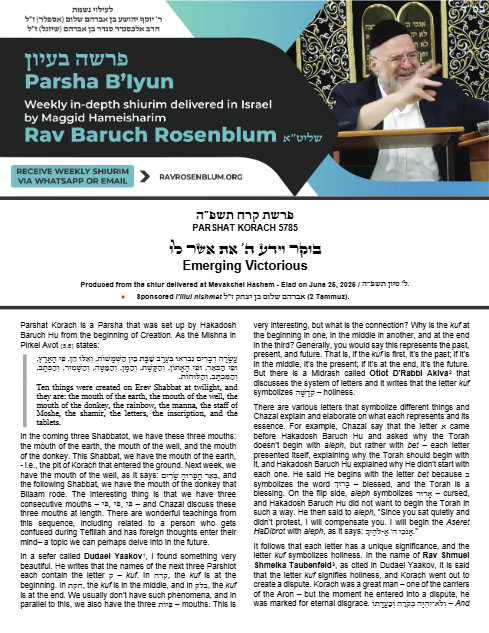
The Kohen Gadol who has nothing of his own. The Rambam, in Hilchot Melachim, states that just as the Torah grants the king great honor and obligates all to respect him, so it commands him to have a humble and lowly heart, with compassion for small and great, tending to their needs and caring for the honor of the least of the least. He must always act with great humility. It follows that a person must feel humility, even in a lofty role. The Be’er Moshe says this was not the case with Korach, who thought he needed to rise above all, and that was his mistake. We use oil to anoint because of how it is made – olives are taken from high up in the tree, then crushed and pressed until they produce drops of oil. Who is appointed with oil? Someone who endured pressures and difficulties; not someone at the top.

The Mashiach is called משיח because he is anointed with oil, just as the Kohen Gadol is anointed. Why? Because Chazal say the oil is likened to Knesset Yisrael. Just as oil is crushed, so too Bnei Yisrael endure crushing until they grow; they grow through that crushing. The Be’er Moshe of Ozharov says this was Korach’s mistake. He thought, “I’m the son of oil, I rise above all.” But that is not how a person is appointed. They are anointed when they humble themselves.

With that, I want to bring one more point from the wonderful words of Rav David Tabil of Minsk, in his sefer Nachalat David. What is oil, and what is wine? Oil symbolizes the attribute of chesed (kindness), while wine symbolizes the attribute of din (judgment). The Zohar writes, the Kohanim’s attribute is chesed, while the attribute of the Levi’im is din. Since the tribe of Kohanim were of chesed, and the tribe of Levi’im were of din, one who is of din cannot transform to become chesed. Therefore, the Kohanim wear white garments in their Avodah, because white symbolizes Chesed.

B’ezrat Hashem, in less than one hundred days from now, we will be at Yom Kippur. What do we find on Yom Kippur? It says: אִ ם־יִהְ יוּ חֲטָאֵיכֶם כַּשָּׁנִים כַּשֶּׁלֶג יַלְבִּינוּ – Though your sins be as scarlet, they shall be as white as snow. They start off red and turn to the color of snow – white, a color that symbolizes the attribute of chesed. This is the tribe of Kohanim.

The Levi’im, on the other hand, serve in the attribute of din. Why? They are the singers and gatekeepers; responsible for the singing in the Beit Hamikdash and for the gates of the Beit Hamikdash. And when do they sing? Chazal say: There is no singing except over wine – יין אין שירה אלא על היין. Rabbotai, what does wine symbolize? Din. If wine symbolizes din, and there is no singing except over wine, it means the Levi’im serve in the attribute of din. We all remember the Gemara in Sukkot – and in just 115 days we will arrive at Sukkot, B’ezrat Hashem, I hope everyone is already preparing. What do we find with regards to one is in a Sukkah that is rained upon? It is likened to a servant who came to pour a cup for his master, and what did his master do? He poured a pitcher of water on him. The Vilna Gaon explains this parable: The cup is wine. How much is a כוס (cup) in gematria? 86, which is also the value of להים-א, representing מידת הדין – the attribute of din.

The master holds din in his hand, and he comes to dilute it with water. If we look, we’ll see that many people have a custom to add a few drops of water into their wine before making kiddush. Some put three drops, some four or five; and some don’t care how many, they pour water straight from the tap into the wine bottle without counting. Why? To dilute the wine, so it’s not only din; they put water in it to sweeten the din. Therefore, the Vilna Gaon says, if, heaven forbid, a decree of exile (galut) is issued upon us on Yom Kippur, what must we do? We must flee to the sukkah outside. We say so in the Yehi Ratzon of the sukkah: May it be Your will that the sukkah, in the merit of my leaving my house to the outside, if exile is decreed upon me, by sitting in the sukkah, I am saved.

But, Rabbotai, what happens if you come to dilute the din, in the sukkah and the Shade of Faith, but the King throws you out? If the King throws you out, then what? His master poured a pitcher on his face. He came to dilute, to put water in it – water is rachamim (mercy) – and his master poured a pitcher on his face, meaning the attribute of din is upon him. It follows that wine symbolizes din, and in contrast, oil symbolizes chesed. The Zohar says oil symbolizes chesed, and this belongs to the Kohanim. Therefore, a Kohen is anointed with the anointing oil.

If so, what did Korach want? Korach, the Levi, who is of the attribute of din, wanted to be the attribute of rachamim. He wanted to be chesed. But he was told he cannot be chesed. Why? Even though your father was called oil, what can you do – you were chosen to be a Levi! The Kohanim’s attribute is chesed, and you cannot turn the attribute of din into the attribute of chesed. It doesn’t work. Avraham was chesed and Yitzchak was din; each has their role and you cannot mix the two. True, Yaakov Avinu was the completion of both, but each has their role.

Sefer Nachalat David says, as a result of this, Moshe Rabbeinu says: אֶת־אֲשׁ ֶר־לוֹ 'בֹּקֶר וְיֹדַע ה – Morning, and Hashem will make known who is His. Morning represents chesed, just as it says: לְהַ גִּיד בַּבֹּקֶר חַסְדֶּךָ, and night is din: וֶאֱמוּנָתְךָ בַּלֵּילוֹת. Moshe Rabbeinu said to Korach, “Just as you cannot exchange morning for evening, so you cannot exchange Aharon the Kohen.” Just as day and night were separated by Hakadosh Baruch Hu – וַיַּבְדֵּל אֱלֹהִים בֵּין הָאוֹר וּבֵין הַחֹשֶךְ – so too Aharon was separated: וַיַּבְדֵּל אַהֲרֹן לְהַקְדִּישׁוֹ קֹדֶשׁ קָדָשִׁים. “Just as you cannot exchange the light and the darkness, so you cannot succeed in exchanging Aharon the Kohen’s role. Because Aharon’s attribute is chesed, and your attribute is din, and you cannot exchange one with the other.”

I’d like to share another beautiful idea I saw in the writings of the Shemen Rosh this week. Moshe Rabbeinu said: “Morning, and Hashem will make known who is His.” He says, there is a person whose life is in the aspect of morning – morning being a symbol of success. It shines; everything is illuminated and successful. Evening, on the other hand, is a time of lowliness, difficulties, and darkness. With regards to Avraham, it says: וְהִנֵּה אֵימָה חֲשֵׁכָה גְּדֹלָה נֹפֶלֶת עָלָיו. Troubles are called darkness, and dawn symbolizes the redemption when light finally breaks through.

Shemen Rosh says there is a person at the height of greatness, and he is in the aspect of oil. He floats above all; he is morning’s light and everything succeeds for him. And then suddenly, he falls to the depths of evening. They throw him out of his job, remove him from his role, and he is now living night’s darkness. One, who under these difficult circumstances, can nonetheless maintain the aspect of morning – such a person can be the Kohen Gadol. Morning, and Hashem will make known who is His. Only a person who knows they are being transferred from the role of morning to the role of evening, and remains the same, can be the Kohen Gadol.

Shemen Rosh then adds something very beautiful. Moshe Rabbeinu was in Egypt, and no one knew where he was. He was then in Midian, and no one knew where he was. Who was the leader in Egypt? Aharon HaKohen. It was Aharon who led Bnei Yisrael in Egypt. And then suddenly, Hakadosh Baruch Hu says to Moshe Rabbeinu at the burning bush, “Go, you will redeem Bnei Yisrael.” If Moshe was to lead these efforts, in effect, Aharon goes home. His role is no more. What should naturally happen next? Aharon should be upset and launch a protest. His younger brother comes out of nowhere to usurp him and throw him out?! But that is not what occurs. Hakadosh Baruch Hu says regarding Aharon: וְרָאֲךָ וְשָׂמַח בְּלִבּוֹ – And he will see you and rejoice in his heart. “Come, my brother. You can take whatever you want.” One who can rejoice when they lower him from morning to evening – he can be the Kohen Gadol. Korach cannot be the Kohen Gadol. Therefore, Moshe said to him, “Only one who was in the leadership role of morning and was then demoted to evening and an assistant role, and proceeded with joy – only he is suitable.”

Rabbotai, we have learned a wonderful yesod here. This concept of oil discussed here shows that Korach thought that because his father was called oil, he rose in stature. But this is not the case.

PDF Preview