The Roots and Dangers of Envy
Peninim on the Torah | July 04, 2024
Print This Article
View Original PDF

The Roots and Dangers of Envy

Peninim on the Torah | June 27, 2025

Horav Yeruchem Levovitz, zl, teaches that studying the parsha superficially is a grave error, because one can lose sight of the real issues. Korach was no fool. He may have acted foolishly, but he was far from a fool. We must look at what provoked him to act inanely. Otherwise, we might think, “It could not happen to me. I am not a fool.” Indeed, Korach’s original desire to be Kohen Gadol or to be Nasi had its roots in a desire to elevate himself spiritually. This situation quickly soured when he saw that it was not happening. This, in and of itself, is an indication that the roots of his desire were murky.

Envy is an emotion characterized by a sense of discontent or resentment towards someone else’s possessions, qualities or achievements. A person compares himself to the subject of his envy and either sees no difference or thinks that he excels over him. Envy can serve as a motivator when channeled positively. It may inspire him to strive to achieve his goals by using another person’s success as a motivational tool. Korach did not. He allowed the envy to consume him.

The Mashgiach sums it up with the well-known Chazal (Yalkut Shimoni97b): Ein bein Gehinom l’Gan Eden ela k’chut ha’saarah; “The divide between purgatory and paradise is a hairsbreadth.” Ambition – regardless of its lofty goals -- requires purity. Korach’s ambition had that slight flaw which caused him to plummet to Gehinom. One drop of negius, self-centeredness, despite his desire to come closer to Hashem, can take a person down to the depths of infamy.

The statement that Korach was envious of Elitzaphan’s newly-appointed position as Prince begs elucidation. Is a person not permitted to look out for his own spiritual interests? Was not Aharon HaKohen envious of the contributions of the Nessiim to the Chanukas HaMishkan? It troubled him that neither he nor any member of Shevet Levi was involved in the inauguration. True, he felt that it was his fault for allowing the sin of the Golden Calf to materialize. Nonetheless, it troubled him. Korach also was troubled that he did not have greater spiritual representation in the hierarchy of Klal Yisrael. A great difference exists between Aharon’s envy and that of Korach. Aharon was concerned that neither he nor his shevet was involved. He would have been more than satisfied if his shevet had been included. It was not about him, but about his brothers whom he felt he might have let down. Korach, however, was a demagogue whose self-interest and narcissism pushed him over the brink. He could only talk about himself, including others only for the purpose of using them to promote his own self-centered agenda.
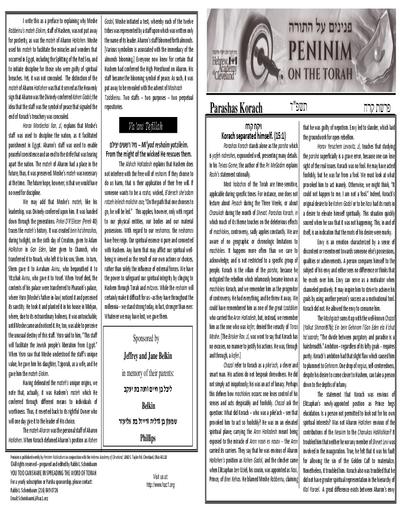

Horav Yeruchem Levovitz, zl, teaches that studying the parsha superficially is a grave error, because one can lose sight of the real issues. Korach was no fool. He may have acted foolishly, but he was far from a fool. We must look at what provoked him to act inanely. Otherwise, we might think, “It could not happen to me. I am not a fool.” Indeed, Korach’s original desire to be Kohen Gadol or to be Nasi had its roots in a desire to elevate himself spiritually. This situation quickly soured when he saw that it was not happening. This, in and of itself, is an indication that the roots of his desire were murky.

Envy is an emotion characterized by a sense of discontent or resentment towards someone else’s possessions, qualities or achievements. A person compares himself to the subject of his envy and either sees no difference or thinks that he excels over him. Envy can serve as a motivator when channeled positively. It may inspire him to strive to achieve his goals by using another person’s success as a motivational tool. Korach did not. He allowed the envy to consume him.

The Mashgiach sums it up with the well-known Chazal (Yalkut Shimoni97b): Ein bein Gehinom l’Gan Eden ela k’chut ha’saarah; “The divide between purgatory and paradise is a hairsbreadth.” Ambition – regardless of its lofty goals -- requires purity. Korach’s ambition had that slight flaw which caused him to plummet to Gehinom. One drop of negius, self-centeredness, despite his desire to come closer to Hashem, can take a person down to the depths of infamy.

The statement that Korach was envious of Elitzaphan’s newly-appointed position as Prince begs elucidation. Is a person not permitted to look out for his own spiritual interests? Was not Aharon HaKohen envious of the contributions of the Nessiim to the Chanukas HaMishkan? It troubled him that neither he nor any member of Shevet Levi was involved in the inauguration. True, he felt that it was his fault for allowing the sin of the Golden Calf to materialize. Nonetheless, it troubled him. Korach also was troubled that he did not have greater spiritual representation in the hierarchy of Klal Yisrael. A great difference exists between Aharon’s envy and that of Korach. Aharon was concerned that neither he nor his shevet was involved. He would have been more than satisfied if his shevet had been included. It was not about him, but about his brothers whom he felt he might have let down. Korach, however, was a demagogue whose self-interest and narcissism pushed him over the brink. He could only talk about himself, including others only for the purpose of using them to promote his own self-centered agenda.

PDF Preview