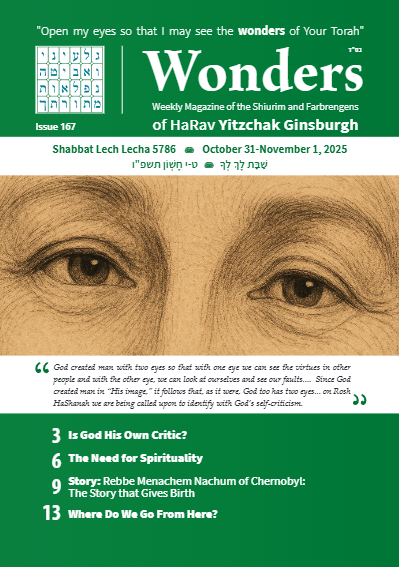
Is God His Own Critic
In a beautiful piece posted to his Twitter account just before Rosh HaShanah this year, HaRav Ginsburgh shed new light on the partnership between our own work of teshuvah and God’s teshuvah. As it turns out, the sages and Chasidic thought leave room for God criticizing Himself and asking us for forgiveness. Statements like this are very delicate and require an open mind and a discerning heart to properly understand. We hope we have presented these concepts in a manner that will serve to increase our connection with the Creator.
God created man with two eyes so that with one eye we can see the virtues in other people and with the other eye, we can look at ourselves and see our faults. The right eye is the eye that gazes outwards, to see the virtues in other people and is known to be the eye that has “light that illuminates others” (ֹתוָלּזוְיר לִאֵּמַר הֹאו), while the other eye is described as having “light that illuminates the self ” (ֹמוְצַעְיר לִאֵּמַר הֹאו), to shine a light on our own faults.
Now, since God created man in “His image,” it follows that, as it were, God too has two eyes, following the same principle: His right eye illuminates others with loving-kindness and love and his left eye illuminates Himself with judgment and might. As it were, God looks at Himself with a measure of self-criticism.
One allusion to this principle can be found in God’s words to Moses, “You shall see my backside, but my face will not be seen,” “for man will not see Me and live.” God’s backside, as it were, alludes to His personal Divine Providence over all creatures. This is His “light that illuminates others,” emanating from His right eye, as it were. God’s “face” refers to His inward gaze, as it were, His light that illuminates Himself, referring to the way in which God sees Himself, with His light, including His “faults,” so to speak!
In light of this interpretation, what God was telling Moses is that it is not proper for the servant to see how the master conducts the review of his own conduct and engages in self-criticism. Doing so might weaken, dampen, or chill the vivacity and enthusiasm of the servant/student for serving the master. More seriously, this might lead the servant/student to doubt the conduct of his master, a sure sign of the effect of Amalek (קֵלָמֲע), whose numerical value equals that of “doubt” (ּקֵפָס). It was Amalek who was the first to confront the Israelites and chill their vivacity and enthusiasm for God after they left Egypt. Indeed, it is a principle of Torah that an illustrious and esteemed individual must perform his self-reckoning in private.
Despite the Torah telling us that God’s face cannot be seen the Torah wants to reveal this secret—that God looks at Himself with self-criticism. What this means is that the origin of this secret is in a sense “higher” than the Torah. Though this idea may at first sound foreign to our ears, we find its explicit origin regarding the supplemental He-goat sacrifice brought on Rosh Chodesh, which the Torah states is “an atonement for Havayah.” The sages explain this enigmatic statement by saying that God is asking us to bring an atonement for His sake for having lessened the moon during Creation. This is also related to their description that God cries every day, as it were, for having created the evil inclination—the yetzer hara.
The occasion of bringing atonement for God, as it were, specifically on Rosh Chodesh, is a very powerful image. On the first of the month, the moon is completely hidden—it reaches its minutest state, where it cannot reflect any of the sun’s light. Like a person taking stock of their conduct, the moon is in a state of “self-reflection,” peering inward with its “left eye,” as it were, reviewing its conduct. This is why Moses had such a hard time fully understanding the commandment to sanctify the moon at the moment of its rebirth, when it is self-concealed in its self-reflection and hidden from our sight. Likewise, it is on Rosh HaShanah specifically that the Almighty engages in self-reflection and self-criticism, as it were, reviewing His own conduct. Indeed, Rosh HaShanah is described in the verse as “when concealed, leading to the day of our festival” (ּנוֵּגַם חֹיוְה לֶּסֵכַּב).
It follows then that on Rosh HaShanah we are being called upon to identify with God’s self-criticism. We call upon Him to reconstruct His sovereignty, referring to His light that illuminates others with compassion, as explained earlier. Not just with the light of yesteryear, but with a new light of compassion, a new revelation of love and mercy that has never before been revealed to others in the history of the world. This light/revelation that we beseech God to illuminate us with lies sequestered in His light that illuminates His self.
To prepare ourselves for calling upon God to reveal this new light, we improve our own conduct by doing teshuvah. By first acting to awaken our ourselves, we transform our understanding of God’s self-criticism from being some kind of “secret” that has been revealed to a joint effort that we perform with God. This is known as “an awakening below [in ourselves] that causes an awakening Above [in God].” By doing teshuvah below, we awaken God’s own teshuvah Above.
We call upon God, “forgive us for we have sinned,” and God answers us, with an unheard inner voice, “forgive Me for I have sinned.” This dynamic follows the path of Aharon the High Priest who would make peace between two individuals by slightly altering the truth, telling each that the other “regrets his behavior and seeks forgiveness.” When they eventually met, the two would embrace and kiss and put the past behind them. Slightly altering things in this way is considered the veritable truth.
Afterword
As strange as this entire discussion may sound to those uninitiated in the ways of Chasidic thought, after Rav Ginsburgh wrote this tweet, we found a very similar statement made by Rebbe Yisrael of Ruzhin, the grandson of the holy Maggid of Mezritch. He writes:
It is a veritable kindness from the Almighty that Rosh HaShanah is on a Rosh Chodesh. For if it were not so, we would be unable to come before Him and beseech Him to forgive our sins. That it is on Rosh Chodesh allows us to do so, for on Rosh Chodesh, the Almighty, as it were, asks us for forgiveness, as He requests, “bring for Me an atonement for having lessened the moon.” We then say, “Master of the Universe, we forgive You, but also request that You in Your infinite kindness, forgive us.” ... For You to be forgiven, it is only appropriate that You forgive us for all that we have sinned before You.