The Covenant of the Pieces and the Purpose of Exile
Lamplighter | October 25, 2023
Print This Article
View Original PDF

The Covenant of the Pieces and the Purpose of Exile

Lamplighter | December 31, 2025

In the Torah portion of Lech Lecha we read about the "The Covenant of the Pieces - Brit Bein Habetarim," that G-d made with our forefather Abraham. It was then that G-d promised to give Abraham the land of Israel as an inheritance for his descendants forever.

Among the many things G-d told Abraham was that his children would one day be exiled from their land. However, G-d promised that their exile would end and that they would return to their land which is the everlasting inheritance of every single Jew and not only for those who happen to reside there now. Every Jew own a piece of real estate in the Biblical land of Israel of no less than 4 amos (cubits) which no gov't or authority in the world has the right, power or jurisdiction to give away or relinquish as it is a biblically mandated inheritance.

G-d foreswore that not only would they return from their exile but they would also return from their exile with great wealth.

The intent of G-d's promise of "great wealth" was not simply as payment for their suffering. In truth, G-d's statement that "afterwards they will go out with great wealth" revealed the entire purpose behind their descent into Egypt.

At first glance this is difficult to understand. Had G-d asked the Jewish people to relinquish the "great wealth" they were promised in order to hasten the end of their suffering they would have surely agreed. Nonetheless, we find that G-d did not offer them this choice, as the "great wealth" they were to obtain in Egypt was of particular significance.

What was this "great wealth" that required the Jewish people to endure a bitter exile for hundreds of years, and why was it so important?

The inner purpose of the Jews' descent into Egypt was that through their service of G-d, the "sparks of holiness" that that country contained would be refined and elevated. Indeed, the Jews' Divine service was successful, as it states, "And a mixed multitude (erev rav) also went up with them," for the numerical equivalent of "rav" is 202 - i.e., all 202 sparks of holiness that Egypt possessed were successfully purified.

This, then, is the "great wealth" that the Jews brought out of Egypt with them. Indeed, it was for the Jewish people's own benefit; had it not occurred, Abraham would have had a valid complaint to level against G-d.

But what was the benefit that they derived?

Every soul has its own unique role in the mystical process of "elevating the sparks." By purifying the specific "sparks" he encounters throughout his life, the Jew brings redemption to his own soul, and to the world at large.

The lesson to be derived from all this is that the Jew's function is to involve himself in the material world for the express purpose of elevating these hidden sparks of holiness. For with these sparks we will merit to greet Moshiach imminently.
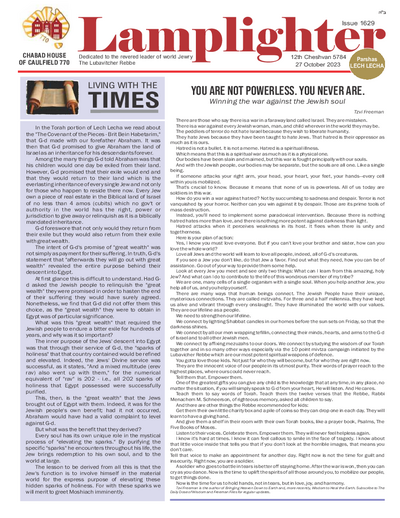

In the Torah portion of Lech Lecha we read about the "The Covenant of the Pieces - Brit Bein Habetarim," that G-d made with our forefather Abraham. It was then that G-d promised to give Abraham the land of Israel as an inheritance for his descendants forever.

Among the many things G-d told Abraham was that his children would one day be exiled from their land. However, G-d promised that their exile would end and that they would return to their land which is the everlasting inheritance of every single Jew and not only for those who happen to reside there now. Every Jew own a piece of real estate in the Biblical land of Israel of no less than 4 amos (cubits) which no gov't or authority in the world has the right, power or jurisdiction to give away or relinquish as it is a biblically mandated inheritance.

G-d foreswore that not only would they return from their exile but they would also return from their exile with great wealth.

The intent of G-d's promise of "great wealth" was not simply as payment for their suffering. In truth, G-d's statement that "afterwards they will go out with great wealth" revealed the entire purpose behind their descent into Egypt.

At first glance this is difficult to understand. Had G-d asked the Jewish people to relinquish the "great wealth" they were promised in order to hasten the end of their suffering they would have surely agreed. Nonetheless, we find that G-d did not offer them this choice, as the "great wealth" they were to obtain in Egypt was of particular significance.

What was this "great wealth" that required the Jewish people to endure a bitter exile for hundreds of years, and why was it so important?

The inner purpose of the Jews' descent into Egypt was that through their service of G-d, the "sparks of holiness" that that country contained would be refined and elevated. Indeed, the Jews' Divine service was successful, as it states, "And a mixed multitude (erev rav) also went up with them," for the numerical equivalent of "rav" is 202 - i.e., all 202 sparks of holiness that Egypt possessed were successfully purified.

This, then, is the "great wealth" that the Jews brought out of Egypt with them. Indeed, it was for the Jewish people's own benefit; had it not occurred, Abraham would have had a valid complaint to level against G-d.

But what was the benefit that they derived?

Every soul has its own unique role in the mystical process of "elevating the sparks." By purifying the specific "sparks" he encounters throughout his life, the Jew brings redemption to his own soul, and to the world at large.

The lesson to be derived from all this is that the Jew's function is to involve himself in the material world for the express purpose of elevating these hidden sparks of holiness. For with these sparks we will merit to greet Moshiach imminently.

PDF Preview

