Age or Stage
Project Likkutei Sichos | July 25, 2025
6. AGE OR STAGE?
The explanation:
The nature of vows uttered during “the twelfth year for a female minor and the thirteenth year for a male minor” — where “If they know for Whose sake they took the vow... their vows are binding” — can be understood in two ways:
- The novelty lies in their age: When it comes to vows, we don’t need to wait until the age of maturity (thirteen years and one day). Instead, even a minor who is twelve years and one day old can make a binding vow. The reason he must still be examined — “If they know for Whose sake they took the vow” — is simply to remove a possible impediment: Since the rule is that “If they do not know, their vows and their statements are of no consequence” — and he is still a minor — we must ensure that he is not lacking in knowledge.
- The novelty lies in their knowledge: When it comes to vows, a lesser level of knowledge is sufficient. The requirement that one must be at least twelve years and one day old is merely an indicator. This age serves as a sign that he has reached the age where it’s possible to have enough knowledge to utter a vow properly (as opposed to before this age, when even rudimentary knowledge is absent).
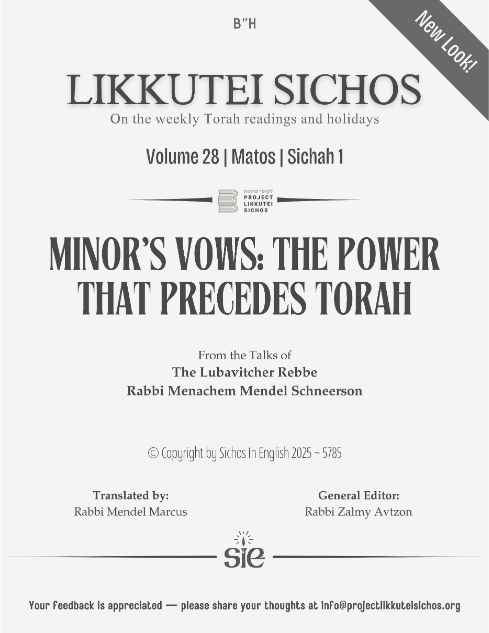
View The Full Article (PDF)
Related Articles

The Talmid Chochom Who Vowed Never to Leave the Bais Medrash
The Way of Emunah • Matos-Massei

Listen and Heed
Torah Papers • Matos-Massei

Trial Period
Project Likkutei Sichos • Matos-Massei

Minors Vows The Power That Precedes Torah
Project Likkutei Sichos • Matos-Massei

Answers to this Weeks Riddles
למודי משה • Matos-Massei