Awaiting His Coming I
The Weekly Farbrengen | July 23, 2025
Print This Article
View Original PDF

Awaiting His Coming I

The Weekly Farbrengen | December 10, 2025

The Value of Longing

The Rambam writes that it is not only obligatory to believe in the coming of Moshiach; one must also await his coming. Moreover, a person who does not do so is denying the Torah, Moshe Rabbeinu and all the other nevi'im.
(רמב"ם הל' מלכים פי"א ה"א)

The Midrash writes that at the time of the churban, Yitzchok Avinu asked Hashem, "Will the Yidden perhaps never merit to return?" Hashem answered: There will come a generation that will await the Geula, and they will immediately be redeemed. The Midrash adds that even if that is the only merit they have, for that alone they are worthy of being redeemed.

In this spirit, the Chida explains the meaning of our daily request, "את צמח דוד עבדך מהרה תצמיח... כי לישועתך קוינו כל היום". What kind of a reason is that? The Chida answers: We are asking Hashem to send us Moshiach immediately, and as to the possible argument that we are undeserving, we say, "...because we hope for your salvation all day" – as a reward for actively awaiting Moshiach, we deserve to be redeemed.
(ילקוט שמעוני איכה תתקצז, תהלים תשלו, מדבר קדמות ערך קיווי)

Chazal teach us that when a person is brought for judgment to the Beis Din shel Maalah, one of the questions he is asked is, Tzipisa liyeshua? – "Did you hope and look forward to the salvation promised by the nevi'im?"
(מסכת שבת דף ל"א ע"א)

Yearning for Moshiach

Reb Yitzchok of Radvil heard so much of the greatness of Reb Avrohom HaMalach, son of the Maggid, that he traveled to see him. He arrived in town on erev Tisha BeAv. That night, as everyone in shul sat on the floor, reading Eicha and mourning the churban, a bitter cry broke out. Turning around, Reb Yitzchok turned around and saw Reb Avrohom HaMalach sitting with his head between his knees, weeping bitterly. Long after everyone had left, he continued watching Reb Avrohom, who sat in the same position without moving. When the clock struck midnight, Reb Yitzchok retired for the night.

The following morning, when he arrived early to shul, he found the Malach still mourning, in the midst of a puddle of tears. From time to time, he would lift his head and ask in pain: "He's still not here...?!"
(יחס טשרנוביל)

Tzaddikim living in the time of the Yismach Moshe, Reb Moshe Teitelbaum, used to say that he was a gilgul of Yirmiyahu HaNovi, who prophesied the churban of the First Beis HaMikdosh. He would constantly cry about this lengthy golus, especially during the Three Weeks, and he longed for Moshiach intensely. Whenever he heard some hustle in the street, he would run to the window: Had Moshiach arrived? Next to his bed, his best Shabbos clothing always lay prepared. And every night, before going to sleep, he would warn his shammes to wake him the moment the shofar of Moshiach was heard.

He once received a letter informing him that on a certain date his beloved son-in-law would be arriving for a visit. The whole household prepared excitedly for his arrival. The great day came, but the visitor was nowhere to be seen. The family became restless. What could possibly have delayed him? The Yismach Moshe sat in his room engrossed in his seforim while some family members waited outside impatiently, when a carriage suddenly appeared on the horizon. The Rebbe's shammes excitedly ran inside to bring him the good news: "Rebbe, he has arrived!"

The Rebbe jumped up from his chair, put on his fine Shabbosdiker kapota and shtreimel and ran outside towards the approaching carriage. Seeing none other than his son-in-law stepping down from the carriage, he was unable to bear the pain and fell to the ground in a faint. When he came to, his family heard him moaning to himself, "Oy! It's not him... He hasn't yet arrived..."
(ומביא גואל ע' 127 ואילך)

The Rambam writes that the chachomim looked forward to the days of Moshiach because at that time Yidden will be able to learn Torah and keep mitzvos undisturbed, not because of the pleasures that will then be freely available.

The Rebbe adds that although the perfection of the world is part of the belief in Moshiach, it is not part of the mitzva of waiting for him.
(רמב"ם הל' מלכים ספי"ב, שערי גאולה ע' מד הע' 13)

The famed chossid Reb Hillel Paritcher transmitted to us this teaching by Reb Levi Yitzchok of Berditchev:
On Shabbos Chazon every Yid is shown a vision of the Third Beis HaMikdosh. This sight inspires us to yearn for it, and to follow a path that will enable us to be zocheh to behold its actual rebuilding, with the ultimate Geula.
(אוה״ת נ״ך (ח״ב) ע׳ א׳צז בשוה"ג)

Consider

Why is longing for the Geulah so significant, that it merits us its arrival?
How do we come to yearn for the spiritual side of the Geulah?
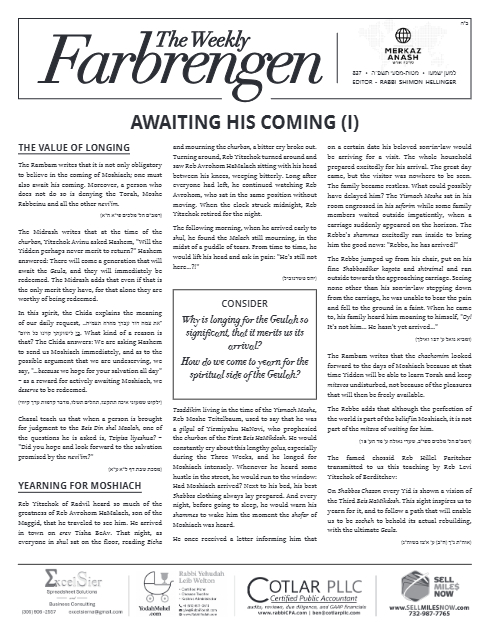

The Value of Longing

The Rambam writes that it is not only obligatory to believe in the coming of Moshiach; one must also await his coming. Moreover, a person who does not do so is denying the Torah, Moshe Rabbeinu and all the other nevi'im.
(רמב"ם הל' מלכים פי"א ה"א)

The Midrash writes that at the time of the churban, Yitzchok Avinu asked Hashem, "Will the Yidden perhaps never merit to return?" Hashem answered: There will come a generation that will await the Geula, and they will immediately be redeemed. The Midrash adds that even if that is the only merit they have, for that alone they are worthy of being redeemed.

In this spirit, the Chida explains the meaning of our daily request, "את צמח דוד עבדך מהרה תצמיח... כי לישועתך קוינו כל היום". What kind of a reason is that? The Chida answers: We are asking Hashem to send us Moshiach immediately, and as to the possible argument that we are undeserving, we say, "...because we hope for your salvation all day" – as a reward for actively awaiting Moshiach, we deserve to be redeemed.
(ילקוט שמעוני איכה תתקצז, תהלים תשלו, מדבר קדמות ערך קיווי)

Chazal teach us that when a person is brought for judgment to the Beis Din shel Maalah, one of the questions he is asked is, Tzipisa liyeshua? – "Did you hope and look forward to the salvation promised by the nevi'im?"
(מסכת שבת דף ל"א ע"א)

Yearning for Moshiach

Reb Yitzchok of Radvil heard so much of the greatness of Reb Avrohom HaMalach, son of the Maggid, that he traveled to see him. He arrived in town on erev Tisha BeAv. That night, as everyone in shul sat on the floor, reading Eicha and mourning the churban, a bitter cry broke out. Turning around, Reb Yitzchok turned around and saw Reb Avrohom HaMalach sitting with his head between his knees, weeping bitterly. Long after everyone had left, he continued watching Reb Avrohom, who sat in the same position without moving. When the clock struck midnight, Reb Yitzchok retired for the night.

The following morning, when he arrived early to shul, he found the Malach still mourning, in the midst of a puddle of tears. From time to time, he would lift his head and ask in pain: "He's still not here...?!"
(יחס טשרנוביל)

Tzaddikim living in the time of the Yismach Moshe, Reb Moshe Teitelbaum, used to say that he was a gilgul of Yirmiyahu HaNovi, who prophesied the churban of the First Beis HaMikdosh. He would constantly cry about this lengthy golus, especially during the Three Weeks, and he longed for Moshiach intensely. Whenever he heard some hustle in the street, he would run to the window: Had Moshiach arrived? Next to his bed, his best Shabbos clothing always lay prepared. And every night, before going to sleep, he would warn his shammes to wake him the moment the shofar of Moshiach was heard.

He once received a letter informing him that on a certain date his beloved son-in-law would be arriving for a visit. The whole household prepared excitedly for his arrival. The great day came, but the visitor was nowhere to be seen. The family became restless. What could possibly have delayed him? The Yismach Moshe sat in his room engrossed in his seforim while some family members waited outside impatiently, when a carriage suddenly appeared on the horizon. The Rebbe's shammes excitedly ran inside to bring him the good news: "Rebbe, he has arrived!"

The Rebbe jumped up from his chair, put on his fine Shabbosdiker kapota and shtreimel and ran outside towards the approaching carriage. Seeing none other than his son-in-law stepping down from the carriage, he was unable to bear the pain and fell to the ground in a faint. When he came to, his family heard him moaning to himself, "Oy! It's not him... He hasn't yet arrived..."
(ומביא גואל ע' 127 ואילך)

The Rambam writes that the chachomim looked forward to the days of Moshiach because at that time Yidden will be able to learn Torah and keep mitzvos undisturbed, not because of the pleasures that will then be freely available.

The Rebbe adds that although the perfection of the world is part of the belief in Moshiach, it is not part of the mitzva of waiting for him.
(רמב"ם הל' מלכים ספי"ב, שערי גאולה ע' מד הע' 13)

The famed chossid Reb Hillel Paritcher transmitted to us this teaching by Reb Levi Yitzchok of Berditchev:
On Shabbos Chazon every Yid is shown a vision of the Third Beis HaMikdosh. This sight inspires us to yearn for it, and to follow a path that will enable us to be zocheh to behold its actual rebuilding, with the ultimate Geula.
(אוה״ת נ״ך (ח״ב) ע׳ א׳צז בשוה"ג)

Consider

Why is longing for the Geulah so significant, that it merits us its arrival?
How do we come to yearn for the spiritual side of the Geulah?

PDF Preview