Is There Anything Behind the Minhag of Pregnant Women Not Entering a Cemetery
למודי משה | July 30, 2025
Print This Article
View Original PDF

Is There Anything Behind the Minhag of Pregnant Women Not Entering a Cemetery

למודי משה | December 10, 2025

The Shu”t Minchas Yitzchok (10:42) was asked if there is any source for the minhag of pregnant women being careful not to enter a beis hakevorois [cemetery]?

The Magen Avraham (343:1) quotes the Roke’ach who says that if the wife of a Kohen is pregnant, she is allowed to enter an ohel hames [tent where a dead body is] and we are not worried about the foetus becoming tomei. The Roke’ach says: The reason we are lenient is because there is a sfek sfeikah, a double doubt. Perhaps the child isn’t a male, and even if it is, it may be a miscarriage r”l. The Magen Avraham asks: Surely the foetus is taharah bluah (absorbed inside the mother, and isn’t able to become tomei)?

The Birkay Yosef (s.k. 4) answers: עובר ירך אמו – “a foetus is considered a limb of the mother”, and if the mother becomes tomei, the child does as well, therefore, the Roke’ach needed to come onto a sfek sfeikah.

The Minchas Chinuch (Mitzvah 263 end of s.k. 3) asks: If we say, עובר ירך אמו, then the whole discussion of tumah doesn’t start, as even if the foetus becomes tomei, it should be considered part of the mother, and not a Kohen, and there is nothing wrong with the mother becoming tomei? (the Minchas Chinuch cites proof from the Gemara in Yevamos 67a, see also Shu”t Chasam Sofer, Yoreh Deah 354, who already says such a logic).

At the end of the Teshuvah, the Minchas Yitzchok quotes the Mishnah in Porah (3:2). The Mishnah says: “There were courtyards in Yerusholayim which were built on top of rocks, and they were hollowed out underneath because of kever hatahom [tumah of the depths]. Pregnant women were brought there, and they would give birth and bring up their sons there, in order that they could be used to fill up water from the shiluach [stream] which would be used in the porah adumah process.” We see, that in order to merit taking part in a great mitzvah, women would be careful to avoid becoming tomei. Certainly, most Bnos Yisroel want their children to be able to take part in this great mitzvah, therefore, during the times of the Beis HaMikdosh they would be careful to avoid being tomei. Nowadays, as well, even though we don’t have the Beis HaMikdosh, מהרה יבנה בהמ״ ק – “we hope that the Beis HaMikdosh will be speedily rebuilt”, and pregnant women eagerly await that their children will merit to partake in this special mitzvah, therefore, they guard themselves as much as possible against becoming tomei.
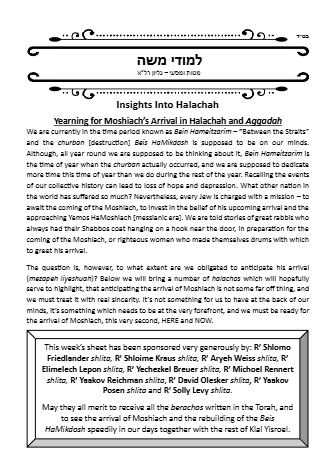
The Shu”t Minchas Yitzchok (10:42) was asked if there is any source for the minhag of pregnant women being careful not to enter a beis hakevorois [cemetery]?

The Magen Avraham (343:1) quotes the Roke’ach who says that if the wife of a Kohen is pregnant, she is allowed to enter an ohel hames [tent where a dead body is] and we are not worried about the foetus becoming tomei. The Roke’ach says: The reason we are lenient is because there is a sfek sfeikah, a double doubt. Perhaps the child isn’t a male, and even if it is, it may be a miscarriage r”l. The Magen Avraham asks: Surely the foetus is taharah bluah (absorbed inside the mother, and isn’t able to become tomei)?

The Birkay Yosef (s.k. 4) answers: עובר ירך אמו – “a foetus is considered a limb of the mother”, and if the mother becomes tomei, the child does as well, therefore, the Roke’ach needed to come onto a sfek sfeikah.

The Minchas Chinuch (Mitzvah 263 end of s.k. 3) asks: If we say, עובר ירך אמו, then the whole discussion of tumah doesn’t start, as even if the foetus becomes tomei, it should be considered part of the mother, and not a Kohen, and there is nothing wrong with the mother becoming tomei? (the Minchas Chinuch cites proof from the Gemara in Yevamos 67a, see also Shu”t Chasam Sofer, Yoreh Deah 354, who already says such a logic).

At the end of the Teshuvah, the Minchas Yitzchok quotes the Mishnah in Porah (3:2). The Mishnah says: “There were courtyards in Yerusholayim which were built on top of rocks, and they were hollowed out underneath because of kever hatahom [tumah of the depths]. Pregnant women were brought there, and they would give birth and bring up their sons there, in order that they could be used to fill up water from the shiluach [stream] which would be used in the porah adumah process.” We see, that in order to merit taking part in a great mitzvah, women would be careful to avoid becoming tomei. Certainly, most Bnos Yisroel want their children to be able to take part in this great mitzvah, therefore, during the times of the Beis HaMikdosh they would be careful to avoid being tomei. Nowadays, as well, even though we don’t have the Beis HaMikdosh, מהרה יבנה בהמ״ ק – “we hope that the Beis HaMikdosh will be speedily rebuilt”, and pregnant women eagerly await that their children will merit to partake in this special mitzvah, therefore, they guard themselves as much as possible against becoming tomei.

PDF Preview