It Is Our Victories That Make Us Who We Are
This week’s parsha, Maasei, lists the travels of the Jewish people, from when they left Egypt until they entered Israel, there were forty two places where they camped.
The Baal Shem Tov tells us that the forty two travels parallels the life of a Jewish person, every one of the travels represents a period in one’s life, with different happenings and different challenges. Birth, being the Exodus from Egypt, and the entry into Israel, being the end of life, the entry into the world of truth.
This is difficult to understand, because some of the places where they traveled, are known for the terrible episodes that happened there, where the Jewish people went against Hashem. Does it mean that we are condemned to an episode in our lives of sinfulness?
For example, one of the places where they camped was Kivros Hatava, where the Jewish people complained about the fact that Hashem took them out of Egypt and that they missed the food they had there. They even cried about it. They weren’t happy with the manna, the “bread from heaven,” they craved meat. Hashem gave them a lot of meat, but many of the complainers died, and they were buried there. That is why it is called Kivros Hatava, which means, “the graves of those who craved.”
Why would we want to go through that?
The Baal Shem Tov explains that every one of the places could have had two outcomes, positive or negative. And it was up to the Jewish people to choose between a positive or a negative outcome. It could have been “the graves of those who craved,” or Kivros Hatava could have been taken literally, to mean “The graves of the craving.” They could have buried their desire, done what is good in the eyes of Hashem, been grateful for being taken out of Egypt and for the holy manna that fell from heaven. And that was probably the true intended purpose of traveling there, but we failed.
The same is true for every one of us, we will have every one of these “travels,” and it is our choice to make it what it ultimately will be, a positive or negative episode in our life.
I know how hard life can be, the challenges Hashem throws our way are so great, they can be paralyzing and debilitating, we could feel that they are too much to handle and maybe they are. It can be a desire that you feel you can’t overcome. Right now, before the coming of Moshiach, it is especially difficult, it is the darkest time. It is so difficult to stay positive through our challenges, especially if they are prolonged.
In this situation, sometimes you will overcome and sometimes you may fail, but you should know that every time you overcome, Hashem revels in your victory, it deals a great blow to the forces of evil and it brings Moshiach ever closer. And the greater the challenges you overcome, the more powerful is the effect.
Don’t let your failures get you down, instead count your victories, be proud of your victories, and know how much your victories accomplish.
In my home, we suffer from a prolonged devastating challenge, on top of the regular challenges that my children, my wife and I have to deal with. Every day, every hour and every minute, is a challenge, and the suffering and anguish are sometimes unbearable. Sometimes we are victorious and sometimes it is just too much. Yes, we are just like everybody else, I too have my moments. But it is our victories that matter, that’s why I am so proud of my wife and my children, because with all we are going through, they are amazing and have good hearts.
You are also amazing, revel in your victories they will strengthen you and empower you. Hashem is proud of you.
It is enough of the suffering, may Hashem send Moshiach, when “Hashem will erase the tears from upon every face.” May it happen soon.
EVERY TIME YOU OVERCOME, G-D REVELS IN YOUR VICTORY.
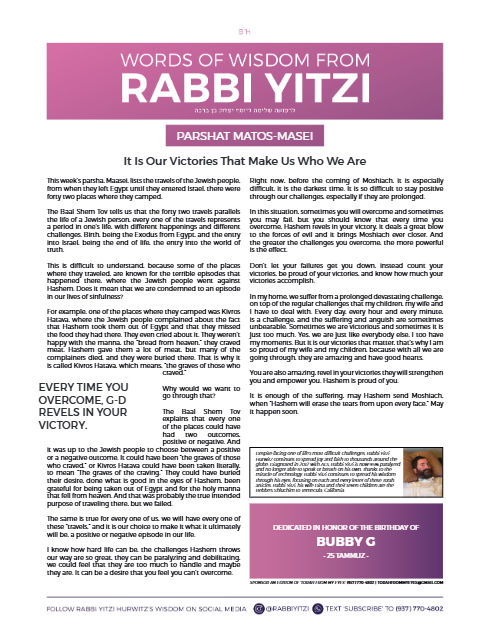
Despite facing one of life’s most difficult challenges, Rabbi Yitzi Hurwitz continues to spread joy and faith to thousands around the globe. Diagnosed in 2012 with ALS, Rabbi Yitzi is now 95% paralyzed and no longer able to speak or breath on his own. Thanks to the miracle of technology, Rabbi Yitzi continues to spread his wisdom through his eyes, focusing on each and every letter of these Torah articles. Rabbi Yitzi, his wife Dina and their seven children are the Rebbe’s Shluchim to Temecula, California.