Rav Wolbe On Chumash
Limuday Moshe | July 12, 2026
Print This Article
View Original PDF

Rav Wolbe On Chumash

Limuday Moshe | July 24, 2022

Nefesh HaChaim (Shaar Aleph, Chapter 4) offers a novel approach to understanding the Beis HaMikdash and its destruction. He writes that Hashem commanded, "Make for a Me a Mikdash so I can dwell within them" (Shemos 25:8). Hashem did not say, "So that I can dwell within it," but rather "within them," because He desires to dwell within each and every Jew. Every person can become a veritable Beis HaMikdash.

The navi (Yirmiyah 7:4) refers to the righteous as "the sanctuary of Hashem." The commandment to build an actual Beis HaMikdash was to facilitate an understanding of how our personal Beis HaMikdash should look. Actions carried out with pure and holy intentions and with the goal of creating an abode for Hashem in this physical world mirror the holy vessels of the Beis HaMikdash, which were prepared with the objective of creating a place in which the Shechinah would reside on Earth. When Bnei Yisrael's behavior deteriorated to the point that they defiled their internal Beis HaMikdash, the external Beis HaMikdash automatically lost its viability and was destroyed.

When we mourn on Tishah B'Av and the days leading up to it, we are not merely mourning for the Beis HaMikdash that once stood in Yerushalayim. We are mourning the destruction of our internal greatness. Is there anyone who truly believes that he has the ability to turn himself into an abode for the Shechinah?

Bnei Yisrael have always produced great leaders who provide us with glimpses of true greatness. One such example is the Chofetz Chaim. His every action was measured and every word was weighed. He was a Torah giant, a paradigm of kindness and humility, and a paragon of tefillah.

Every Jew has the ability to reach a similar level, but one of the obstacles we face is the mindset that people are small and will always remain small. We must rid ourselves of this mindset, because it destroys our personal Beis HaMikdash.

We do not recite Tachanun on Tishah B'Av because the passuk refers to it as a mo'ed. We can understand why Succos is a mo'ed, but why is Tishah B'Av a mo'ed? Rav Yerucham Levovitz explains that there are mo'adim of kiruv (closeness) and mo'adim of richuk (distance). Tishah B'Av is a time for a person to contemplate just how far he is from Hashem. His every action has the ability to create an atmosphere suitable to house the Shechinah, but he does not believe for a second that he can achieve this goal.

Recognizing and acknowledging one's distance from Hashem is the first step in rebuilding our internal Beis HaMikdash. Once this is accomplished, the Beis HaMikdash in Yerushalayim will follow immediately. This is why Chazal say (Taanis 30b), "Whoever mourns Yerushalayim will merit seeing its joy."

(See also Alei Shur, Vol. II, pp. 411, 412)
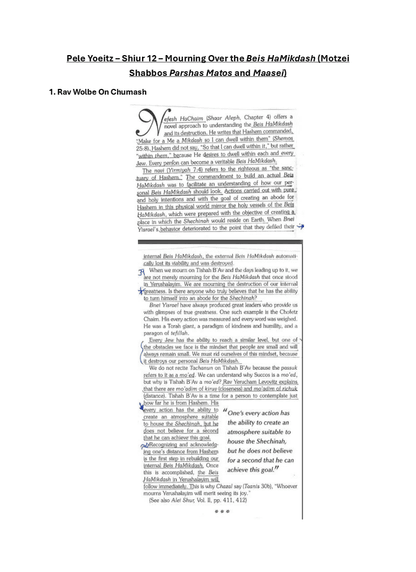
Nefesh HaChaim (Shaar Aleph, Chapter 4) offers a novel approach to understanding the Beis HaMikdash and its destruction. He writes that Hashem commanded, "Make for a Me a Mikdash so I can dwell within them" (Shemos 25:8). Hashem did not say, "So that I can dwell within it," but rather "within them," because He desires to dwell within each and every Jew. Every person can become a veritable Beis HaMikdash.

The navi (Yirmiyah 7:4) refers to the righteous as "the sanctuary of Hashem." The commandment to build an actual Beis HaMikdash was to facilitate an understanding of how our personal Beis HaMikdash should look. Actions carried out with pure and holy intentions and with the goal of creating an abode for Hashem in this physical world mirror the holy vessels of the Beis HaMikdash, which were prepared with the objective of creating a place in which the Shechinah would reside on Earth. When Bnei Yisrael's behavior deteriorated to the point that they defiled their internal Beis HaMikdash, the external Beis HaMikdash automatically lost its viability and was destroyed.

When we mourn on Tishah B'Av and the days leading up to it, we are not merely mourning for the Beis HaMikdash that once stood in Yerushalayim. We are mourning the destruction of our internal greatness. Is there anyone who truly believes that he has the ability to turn himself into an abode for the Shechinah?

Bnei Yisrael have always produced great leaders who provide us with glimpses of true greatness. One such example is the Chofetz Chaim. His every action was measured and every word was weighed. He was a Torah giant, a paradigm of kindness and humility, and a paragon of tefillah.

Every Jew has the ability to reach a similar level, but one of the obstacles we face is the mindset that people are small and will always remain small. We must rid ourselves of this mindset, because it destroys our personal Beis HaMikdash.

We do not recite Tachanun on Tishah B'Av because the passuk refers to it as a mo'ed. We can understand why Succos is a mo'ed, but why is Tishah B'Av a mo'ed? Rav Yerucham Levovitz explains that there are mo'adim of kiruv (closeness) and mo'adim of richuk (distance). Tishah B'Av is a time for a person to contemplate just how far he is from Hashem. His every action has the ability to create an atmosphere suitable to house the Shechinah, but he does not believe for a second that he can achieve this goal.

Recognizing and acknowledging one's distance from Hashem is the first step in rebuilding our internal Beis HaMikdash. Once this is accomplished, the Beis HaMikdash in Yerushalayim will follow immediately. This is why Chazal say (Taanis 30b), "Whoever mourns Yerushalayim will merit seeing its joy."

(See also Alei Shur, Vol. II, pp. 411, 412)

PDF Preview