Spiritual Warfare
Pulse of Emunah | July 25, 2025
Print This Article
View Original PDF

Spiritual Warfare

Pulse of Emunah | December 10, 2025

By Rabbi Moshe Pogrow

To ensure the moral and spiritual integrity of the Jewish people, it was necessary for them to conquer Midyan, because the Midyanim had attempted to seduce the Jews both physically and spiritually. In this parsha, the order was given to go to war against them.

Moshe had given the Jews the Torah, which is based on purity and loyalty to Hashem. Now, before his death, he was told to strike a blow against Midyan in order to safeguard these two pillars of his mission, to protect the people against gilui arayos and avodah zarah.

The war was waged against Midyan, not Moav, because Moav only sought to weaken the Jews physically, not to cause their destruction. Hence, it was necessary to make the people aware of the reason for the campaign. The true enemy of the Jewish people is not the one who seeks their physical destruction, but the one who plots their moral and spiritual demise.

Any defect in the Jews’ integrity severs the connection between them and Hashem. Therefore, Hashem sent them to bring His retribution upon Midyan.

With its policy of corrupting other nations, Midyan was guilty of the gravest international crime. It had lost its right to exist as a nation before G-d.

In the Torah’s accounts of earlier military campaigns—the wars against Sichon, Og, and the Emorim—it does not explicitly mention the presence of a kohen, nor that of the aron or chatzotzros. Those wars were wars of self-defense or conquest, fought for material reasons.

This war, however, was waged for the most exalted purposes. For such a war, it was especially fitting that a kohen should be there, along with the luchos haeidus and the trumpets that call for Hashem’s help.

The Jews went out to fight for the sake of the luchos and the aron, for the sake of the Torah and its bearers. They fought this war to ensure that the Torah and its bearers could dwell securely in the midst of the nations.

Based on the commentary of Rav Shamshon Raphael Hirsch zt”l on Chumash, with permission from the publisher.
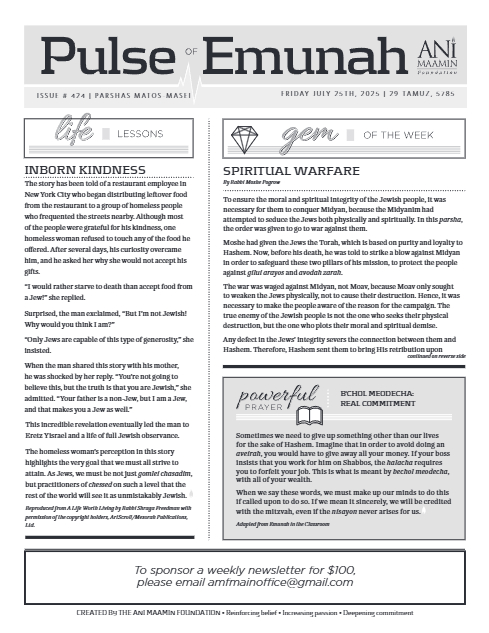

By Rabbi Moshe Pogrow

To ensure the moral and spiritual integrity of the Jewish people, it was necessary for them to conquer Midyan, because the Midyanim had attempted to seduce the Jews both physically and spiritually. In this parsha, the order was given to go to war against them.

Moshe had given the Jews the Torah, which is based on purity and loyalty to Hashem. Now, before his death, he was told to strike a blow against Midyan in order to safeguard these two pillars of his mission, to protect the people against gilui arayos and avodah zarah.

The war was waged against Midyan, not Moav, because Moav only sought to weaken the Jews physically, not to cause their destruction. Hence, it was necessary to make the people aware of the reason for the campaign. The true enemy of the Jewish people is not the one who seeks their physical destruction, but the one who plots their moral and spiritual demise.

Any defect in the Jews’ integrity severs the connection between them and Hashem. Therefore, Hashem sent them to bring His retribution upon Midyan.

With its policy of corrupting other nations, Midyan was guilty of the gravest international crime. It had lost its right to exist as a nation before G-d.

In the Torah’s accounts of earlier military campaigns—the wars against Sichon, Og, and the Emorim—it does not explicitly mention the presence of a kohen, nor that of the aron or chatzotzros. Those wars were wars of self-defense or conquest, fought for material reasons.

This war, however, was waged for the most exalted purposes. For such a war, it was especially fitting that a kohen should be there, along with the luchos haeidus and the trumpets that call for Hashem’s help.

The Jews went out to fight for the sake of the luchos and the aron, for the sake of the Torah and its bearers. They fought this war to ensure that the Torah and its bearers could dwell securely in the midst of the nations.

Based on the commentary of Rav Shamshon Raphael Hirsch zt”l on Chumash, with permission from the publisher.

PDF Preview
